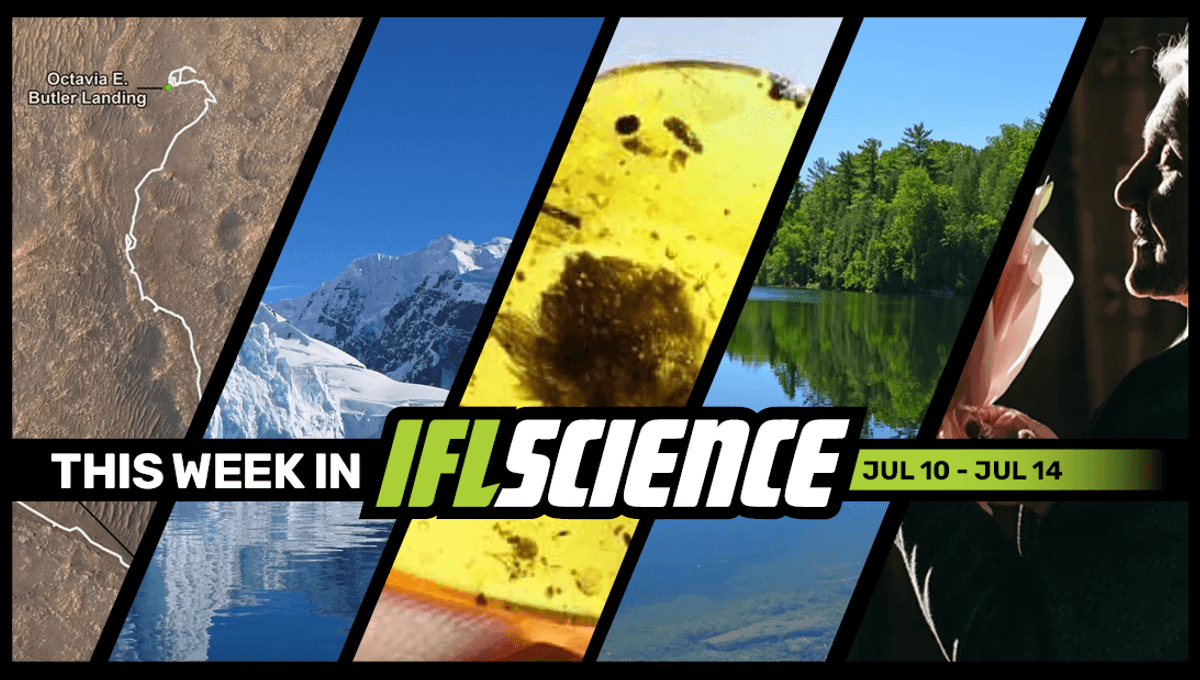
This week an extinct baby bird’s feathers have been found locked in 99-million-year-old amber, scientists have a new proposal for where and when the Anthropocene started, science proves that old people really do smell, and we get a sneak peek into what’s in store for the next few months of JWST discoveries.
Subscribe to the IFLScience newsletter for all the biggest science news delivered straight to your inbox every Wednesday and Saturday.
Perseverance Discovers More Evidence Of Building Blocks Of Life On Mars
Organic molecules found by the Perseverance rover in Jezero Crater on Mars are more varied than those previously found in Gale Crater by Curiosity and in meteorites knocked off Mars. The molecules detected could have formed without the presence of life, but they do show the planet once had more complex chemistry than previously recognized, reducing the steps required for life to occur. Read the full story here
World’s Oldest Glaciers Discovered Sitting Under South Africa’s Gold Fields
The first evidence of the world’s oldest discovered glaciers has been found in the gold fields of South Africa. Extremely well-preserved glacial deposits lay beneath the world’s largest gold deposits, providing convincing evidence of the environmental conditions of the early Earth. Read the full story here
Extinct Bird’s Baby Feathers Found Locked In 99-Million-Year-Old Amber
They say dinosaurs live on in the form of modern birds, but why was it that some of their relatives survived while this mighty animal group perished? Scientists believe a rare discovery may hold clues, as they describe a pinch of juvenile feathers that belonged to a baby bird of an extinct species. Read the full story here
Welcome To The Anthropocene? Scientists Propose Where And When It Started
In recent years a growing movement has arisen to argue that humans have changed the Earth so much we should consider ourselves in a geological timescale known as the Anthropocene. Geologists use markers in rocks at specific sites to define when these epochs begin, so if the Anthropocene is to get general recognition it needs one too. Now a committee established to recommend one has released its report of where and when it began but it’s already proving controversial. Read the full story here
Old Person Smell Is A Real Thing, And This Is Why It Happens
Here’s a weird thing: a study in 2012 found that humans are able to tell whether someone is young or old based on smell alone. In the study, researchers collected the body odors of different age groups, which were then sniffed by lucky volunteers aged between 20 and 30 years old. They were then asked to rate the pleasantness of the smell and estimate the donor’s age. Read the full story here
Feature of the week:
Spoiler Alert – This Is What’s Coming From JWST In The Coming Months
This week, JWST marked one year of official science missions. We sat down with some of the astronomers working on JWST to ask: what’s next for the biggest and most powerful space telescope? Read the full story here

Source Link: TWIS: Further Evidence Of Building Blocks Of Life Found On Mars, World’s Oldest Discovered Glaciers Are 2.9 Billion Years Old, And Much More This Week
