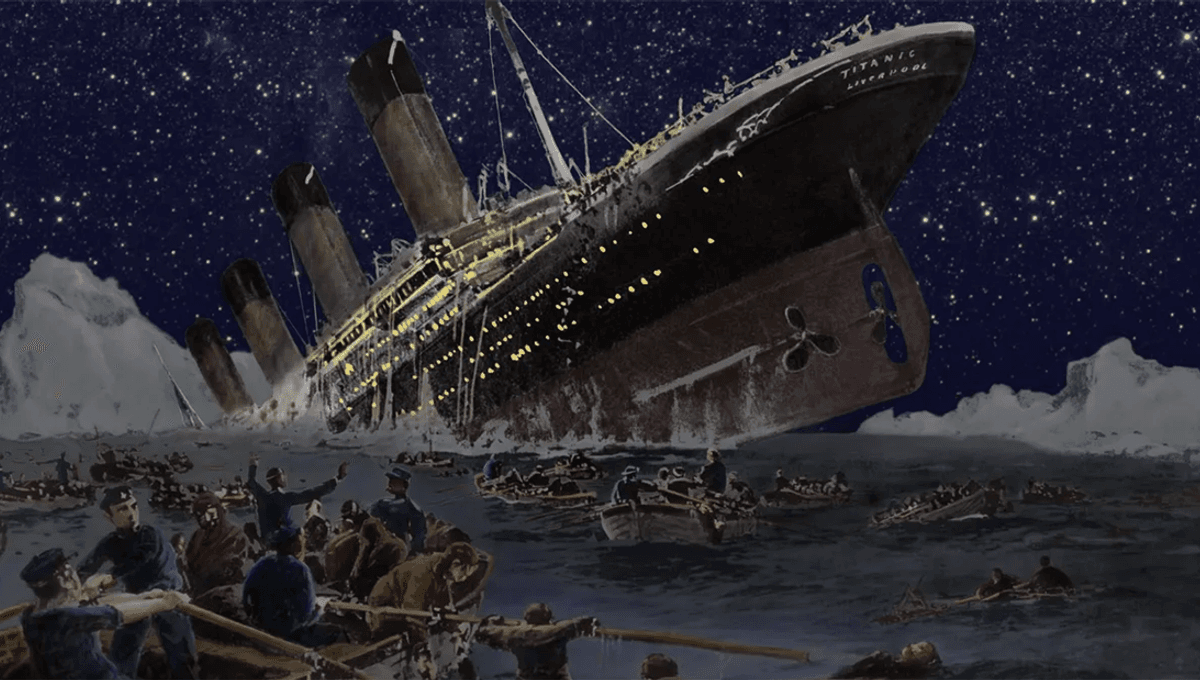
Scans of the wreck of the Titanic appear to show evidence for heartbreaking reports from the ship’s final few hours.
The wreck of the Titanic, which sank in April 1912, is slowly disintegrating and may soon disappear, the inevitable result of rust, sea salt, bacteria, and a plethora of deep-sea creatures.
“The future of the wreck is going to continue to deteriorate over time, it’s a natural process,” Lori Johnson, a scientist who was part of a team that photographed the wreck, explained in 2019. “These are natural types of bacteria, so the reason that the deterioration process ends up being quite a bit faster, is a group of bacteria, a community working symbiotically to eat, if you will, the iron and the sulfur.”
Before that happens, teams have been working hard to image the wreck, to learn what we can about the disaster before it is too late. One team has been attempting to create a 3D “digital twin” of the wreck, using Light Detection and Ranging (lidar) and photogrammetry.
As noted by National Geographic, photogrammetry was figured out by German engineer Albrecht Meydenbauer after a nearly fatal incident in 1858. Meydenbauer, then 24, was surveying an 11th-century church in Wetzlar, Germany, and in an attempt to forgo expensive scaffolding, he pulled himself up in a wooden box using ropes. While trying to step off the contraption onto a windowsill, he slipped and nearly fell off the building, barely managing to propel himself forward and through the window. After the incident, he set about trying to figure out a way of mathematically measuring buildings from photographs of it, getting 3D measurements from 2D images.
Using lidar – sending lasers at a target and then measuring how long they take to return – 700,000 images of the wreck, and photogrammetry, a team has recreated a full view of the Titanic for a documentary by National Geographic and Atlantic Productions.
“It’s like a crime scene: you need to see what the evidence is, in the context of where it is,” Titanic analyst Parks Stephenson told the BBC. “And having a comprehensive view of the entirety of the wreck site is key to understanding what happened here.”
A previous iteration of the scans, released in 2023.
According to the team, the models produced have provided further evidence to eyewitness accounts of the ship’s sinking. For one, the scan shows a porthole that was likely smashed by the iceberg itself, corroborating survivor reports that ice came into people’s cabins during the collision itself.
One intriguing detail found in the scans was that some of the ship’s boilers were concave, and a valve lay in the open position on the deck of the stern. This suggested that the boiler was still running as the ship sank into the water, supporting reports that a team of engineers led by 51-year-old Joseph Bell stayed behind in order to keep the furnace burning and the lights on the ship on, to guide passengers and crew attempting to flee.
“They kept the lights and the power working to the end, to give the crew time to launch the lifeboats safely with some light instead of in absolute darkness,” Stephenson told the BBC.
“They held the chaos at bay as long as possible, and all of that was kind of symbolised by this open steam valve just sitting there on the stern.”
The team may have uncovered more clues to exactly how the ship sank. While it was designed to stay afloat even if four compartments flooded, simulations suggest that the iceberg spread its damage across six compartments, creating small holes in all of them. However, this is the result of simulations conducted by the team rather than photographic evidence, as the damaged section of the lower bow is hidden in the ocean bed.
While the ship slowly disintegrates, the hope is that the scans will continue to provide insight into the wreckage for years to come, as researchers pore over the details.
“We’ve got actual data that engineers can take to examine the true mechanics behind the breakup and the sinking and thereby get even closer to the true story of the Titanic disaster,” Stephenson said when previous versions of the scans were released in 2023. “For the next generation of Titanic exploration, research, and analysis, this is the beginning of a new chapter.”

Source Link: Updated Scans Of The Titanic Confirm Heartbreaking Story Of Doomed Ship's Final Hours
