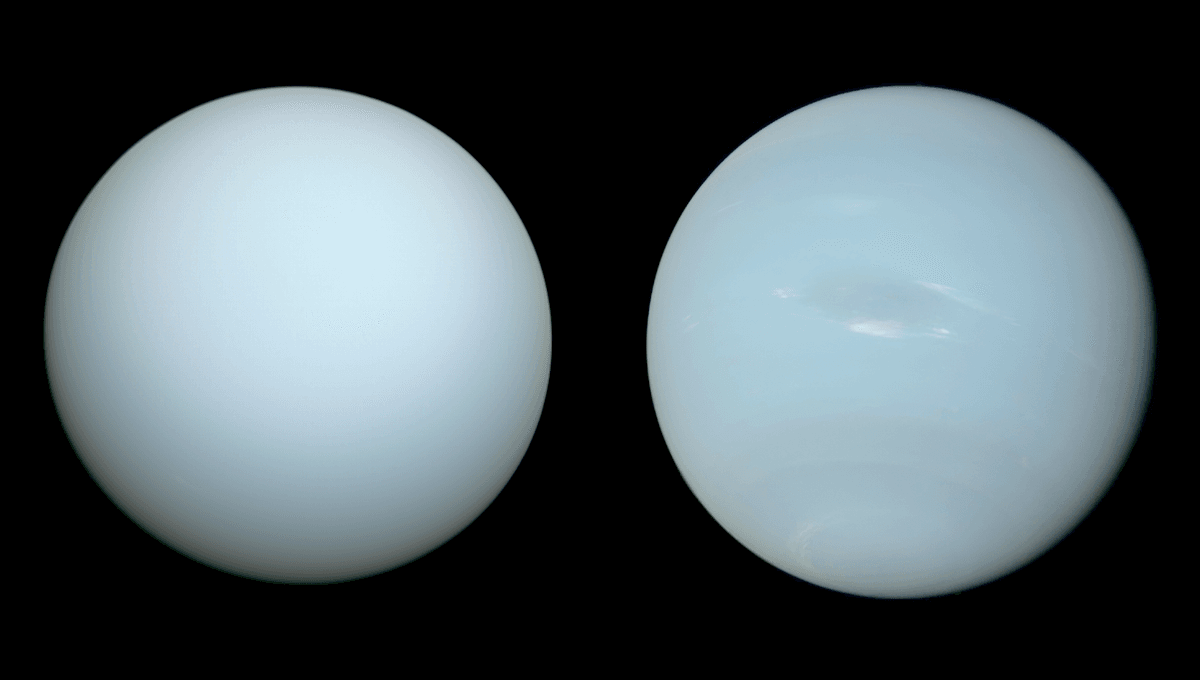
Uranus and Neptune are the two furthest planets in the Solar System and have been visited only once by human spacecraft – by Voyager 2 over 30 years ago – so there is a lot about them that we do not know. One thing we thought we knew, however, was what type of planet they are. Now, a new study wants to challenge something quite crucial about how we classify them: these worlds, it argues, are not ice giants.
The rest of this article is behind a paywall. Please sign in or subscribe to access the full content.
The four “rocky” planets of the Solar System – Earth, Mars, Venus, and Mercury – are small terrestrial planets made of solid rock and metal. The four giant planets – Jupiter, Saturn, Uranus, and Neptune – are divided into two categories because, though large, they are not the same. The first two are “gas giants” because they are overwhelmingly composed of hydrogen and helium, over 90 percent by mass. The latter two are known as “ice giants“. Hydrogen and helium comprise less than 20 percent of the planets’ masses. Uranus and Neptune, instead, are rich in numerous molecules like water and ammonia that were present in solid ice when the planets formed billions of years ago, as models tell us.
For decades, our understanding of Uranus and Neptune’s interiors has been based on what we can glean from their surface features, the behaviors of their moons, their magnetic fields, and other indirect means. Which has occasionally led us astray.
If I was one of these billionaires… just floating around with all my money, I would fund two missions: I’d fund an orbiter to Uranus and an orbiter to Neptune.
Prof Brian Cox
This new work suggests a different way of looking at these outer planets. Instead of modeling the interior of these two worlds based on the potentially flawed information we have, they created random models and then compared those to observational data, building a catalog of models that fit. They looked at both water-dominated and rock-dominated scenarios and concluded that while the planets have this mixture of molecules, a rockier internal structure makes more sense with the current observations.
“Overall, our findings challenge the conventional classification of Uranus and Neptune as ’ice giants’ and underscore the need for improved observational data or formation constraints to break compositional degeneracy,” the authors write in their paper.
So maybe Uranus and Neptune are not ice giants; perhaps we have the Solar System’s first “rocky giants”. Or another suitable name that doesn’t get them confused with the rocky planets of the Solar System. With a better understanding of what goes on inside these planets, we can explain their peculiarities, such as their magnetic fields, which in the case of Uranus is truly bizarre.
While the new paper is intriguing, the authors stress the need for dedicated missions to Uranus and Neptune to constrain their properties better and even get more accurate color pictures.
They’re not the only ones who want to revisit these outer worlds. “Really, the case for a big mission, an orbiter to both Uranus and Neptune, I think, is so overwhelming! If I was one of these billionaires… just floating around with all my money, I would fund two missions: I’d fund an orbiter to Uranus and an orbiter to Neptune,” Professor Brian Cox told IFLScience last year.
“With the potential for future dedicated missions to Uranus and Neptune, our method also provides a flexible and unbiased tool for interpreting forthcoming data,” the authors write. “Ultimately, the interiors of Uranus and Neptune remain enigmatic, not because they are beyond reach, but because the data required to resolve their secrets are still out of grasp. Until then, only a plurality of models, not a singular one, can capture the full extent of possibilities for their hidden depths.”
The study is accepted for publication in Astronomy & Astrophysics and is available on the ArXiv.

Source Link: Uranus And Neptune May Not Be "Ice Giants" But The Solar System's First "Rocky Giants"
