• Email Us: [email protected]
  • Contact Us: +1 718 874 1545
  • Skip to main content
  • Skip to primary sidebar

Medical Market Report

  • Home
  • All Reports
  • About Us
  • Contact Us

Watch 25 Years Of A Supernova Expanding Into Space Squeezed Into This 40-Second NASA Video

January 7, 2026 by Deborah Bloomfield

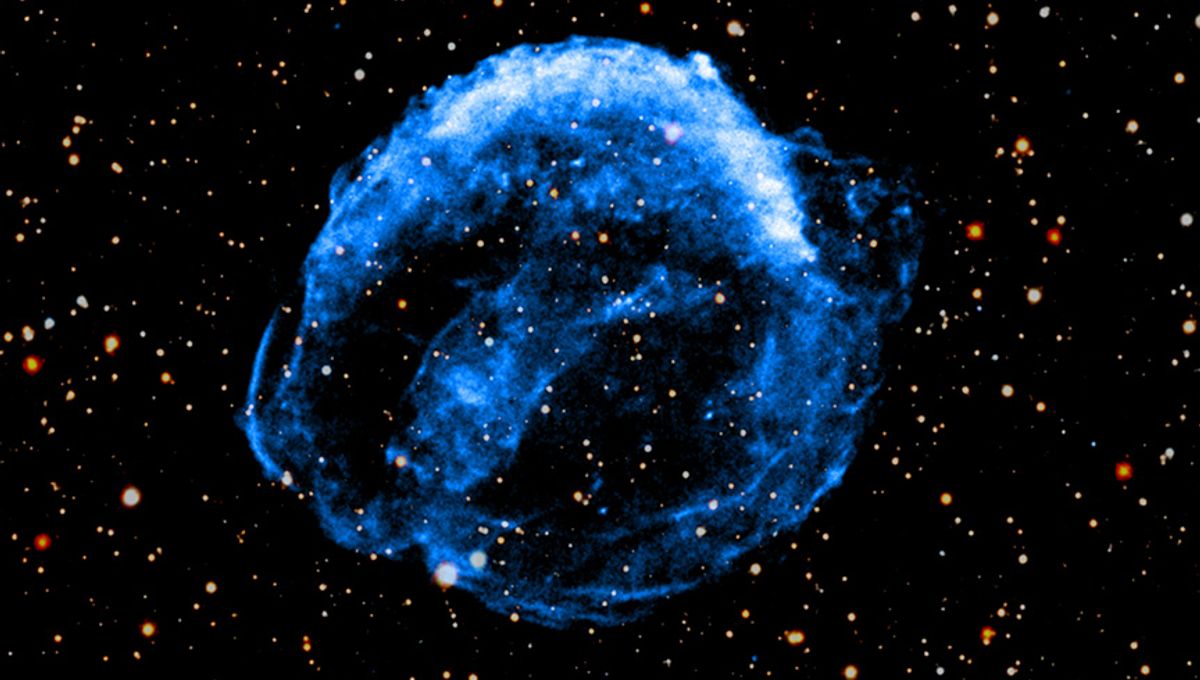
Picture this: Prague, October 1604. The then 34-year-old astronomer Johannes Kepler was looking at the constellation of Ophiuchus, and he spotted something that he had not seen before: a new star. It became the brightest star in the night sky, so bright that it was visible during the day for over three weeks. It was a supernova!

The rest of this article is behind a paywall. Please sign in or subscribe to access the full content.

It was not even the first supernova in a generation, with SN 1572 being witnessed a few decades earlier, but the appearance of SN 1604 – also known as Kepler’s supernova – appeared at a pivotal moment for Western science, adding to the evidence that the Aristotelian view of the universe was not right.

Over time, the supernova vanished from view, and it was only in 1941 that the remnant was rediscovered. Many observatories have looked at it since, and NASA’s X-ray space telescope Chandra has been keeping an eye on it for a quarter of a century. Those observations have now been turned into a beautiful video showing the remnant expanding.


“The plot of Kepler’s story is just now beginning to unfold,” Jessye Gassel, a graduate student at George Mason University in Virginia who led the work, said in a statement. “It’s remarkable that we can watch as these remains from this shattered star crash into material already thrown out into space.”

The supernova that created SN 1604 is believed to be a type Ia. This refers to the case of a white dwarf, the exposed remnant core of a star like the Sun having run out of fuel, stealing material from a companion star. Historical records from European, Chinese, Korean, and Arabic sources, are consistent with the brightness of a type Ia supernova, but it has been suggested that it might have been an anomalous one.

There is a lot that we do not know about supernovas and their remnants. These explosions produce a lot of the elements that are necessary for planets and life, so knowing more about them lets us gain insight into a plethora of celestial phenomena that end up being necessary for us to be here.

“Supernova explosions and the elements they hurl into space are the lifeblood of new stars and planets,” said Brian Williams of NASA’s Goddard Space Flight Center in Greenbelt, Maryland, and principal investigator of the new Chandra observations of Kepler. “Understanding exactly how they behave is crucial to knowing our cosmic history.”

Gassel presented the new Chandra video and the associated research at the 247th meeting of the American Astronomical Society in Phoenix, Arizona.

Deborah Bloomfield
Deborah Bloomfield

Related posts:

  1. Skype alumni head to court in a battle over Starship Technologies and Wire
  2. 4,000-Year-Old Tablet Shows Teachers Have Reached For The Red Pen For Centuries
  3. New Google Game Is A Fun Way To Learn About The Lunar Cycle
  4. When You Hack A Shark, You’re Exploiting A Glitch Billions Of Years In The Making

Source Link: Watch 25 Years Of A Supernova Expanding Into Space Squeezed Into This 40-Second NASA Video

Filed Under: News

Primary Sidebar

  • US Just Killed NASA’s Mars Sample Return Mission – So What Happens Now?
  • Art Sleuths May Have Recovered Traces Of Da Vinci’s DNA From One Of His Drawings
  • Countries With The Most Narcissists Identified By 45,000-Person Study, And The Results Might Surprise You
  • World’s Oldest Poison Arrows Were Used By Hunters 60,000 Years Ago
  • The Real Reason You Shouldn’t Eat (Most) Raw Cookie Dough
  • Antarctic Scientists Have Just Moved The South Pole – Literally
  • “What We Have Is A Very Good Candidate”: Has The Ancestor Of Homo Sapiens Finally Been Found In Africa?
  • Europe’s Missing Ceratopsian Dinosaurs Have Been Found And They’re Quite Diverse
  • Why Don’t Snorers Wake Themselves Up?
  • Endangered “Northern Native Cat” Captured On Camera For The First Time In 80 Years At Australian Sanctuary
  • Watch 25 Years Of A Supernova Expanding Into Space Squeezed Into This 40-Second NASA Video
  • “Diet Stacking” Trend Could Be Seriously Bad For Your Health
  • Meet The Psychedelic Earth Tiger, A Funky Addition To “10 Species To Watch” In 2026
  • The Weird Mystery Of The “Einstein Desert” In The Hunt For Rogue Planets
  • NASA Astronaut Charles Duke Left A Touching Photograph And Message On The Moon In 1972
  • How Multilingual Are You? This New Language Calculator Lets You Find Out In A Minute
  • Europa’s Seabed Might Be Too Quiet For Life: “The Energy Just Doesn’t Seem To Be There”
  • Amoebae: The Microscopic Health Threat Lurking In Our Water Supplies. Are We Taking Them Seriously?
  • The Last Dogs In Antarctica Were Kicked Out In April 1994 By An International Treaty
  • Interstellar Comet 3I/ATLAS Snapped By NASA’s Europa Mission: “We’re Still Scratching Our Heads About Some Of The Things We’re Seeing”
  • Business
  • Health
  • News
  • Science
  • Technology
  • +1 718 874 1545
  • +91 78878 22626
  • [email protected]
Office Address
Prudour Pvt. Ltd. 420 Lexington Avenue Suite 300 New York City, NY 10170.

Powered by Prudour Network

Copyrights © 2026 · Medical Market Report. All Rights Reserved.

Go to mobile version