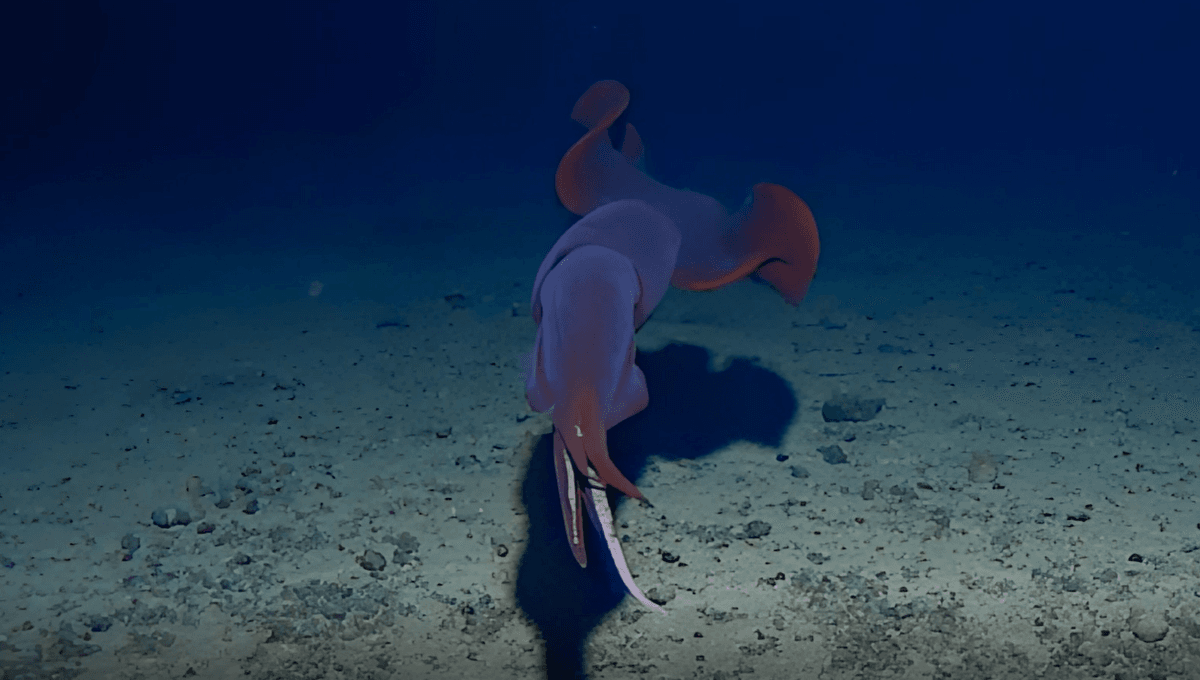
A chance encounter with a deeply mysterious cephalopod known as the whip-lash squid has been captured on camera some 1,000 meters (3,281 feet) below the sea’s surface in the Tonga Trench.
The video was shot last month by researchers from Minderoo-UWA Deep-Sea Research Centre and Inkfish as part of the Tonga Trench Expedition 2024. Between July until October 2024, the voyage used submersibles and deep-sea landers to survey the biodiversity and geodiversity of the Tonga Trench, the second-deepest oceanic trench in the world after the Mariana Trench.
Whip-lash squids (Mastigoteuthidae) are a family of deep-sea squids known for their two long, slender tentacles that resemble a whip.
Relatively little is known about this elusive family, although the individual in the new footage appears to belong to a genus known as Idioteuthis. They are also known as “love-heart squid” because of their heart-shaped fin, which waves in a gentle and hypnotic motion.
In 2010, a study investigated the diet of whip-lash squids by analyzing the stomach contents of some individuals caught off the coast of New Zealand – and it wasn’t exactly what they were expecting.
Deep-sea creatures are often opportunistic, passive predators (rather than active hunters) due to the unique challenges of their extreme environment, such as complete darkness, high pressure, and scarce food resources. However, DNA analysis of their gut contents revealed they consumed a type of deep-sea shark called dogfish. Although it’s possible the meat was scavenged, the paper concluded that “this squid may prey actively upon relatively large pelagic species.”
Like many other deep-sea cephalopods, some species of whip-lash squid can produce bioluminescence using photophores. It’s not clear why they have evolved light-producing organs, but they might play a role in courtship behavior or be used to dazzle their prey. Alternatively, they might simply be used to illuminate their pitch-black environment.
Females are significantly larger than the males. A 2021 paper looked at nearly 150 Idioteuthis specimens and found that mantle length ranged from 20 to 50 centimeters (8 to 20 inches) for males and 27 to 70.2 centimeters (11 to 28 inches) for females.
This instance of sexual dimorphism is, once again, a consequence of their extreme habitat and the low chances of encountering a mate. The large females can carry more eggs and increase their reproductive output, while the smaller males are more mobile, allowing them to cover greater distances in search of a mate.
The recent Tonga Trench Expedition 2024 came across a wealth of wildlife in the depths of the Pacific. At a depth of 3,300 meters (10,827 feet), the team even managed to capture footage of a bigfin squid, known for its alien-like appearance and unbelievably long tentacles. Fewer than 20 recorded sightings of the elusive creature have ever been confirmed and this is the first time it’s been seen in this part of the ocean.

Source Link: Watch A Mysterious Whip-Lash Squid Emerge 1,000 Meters Deep In The Tonga Trench
