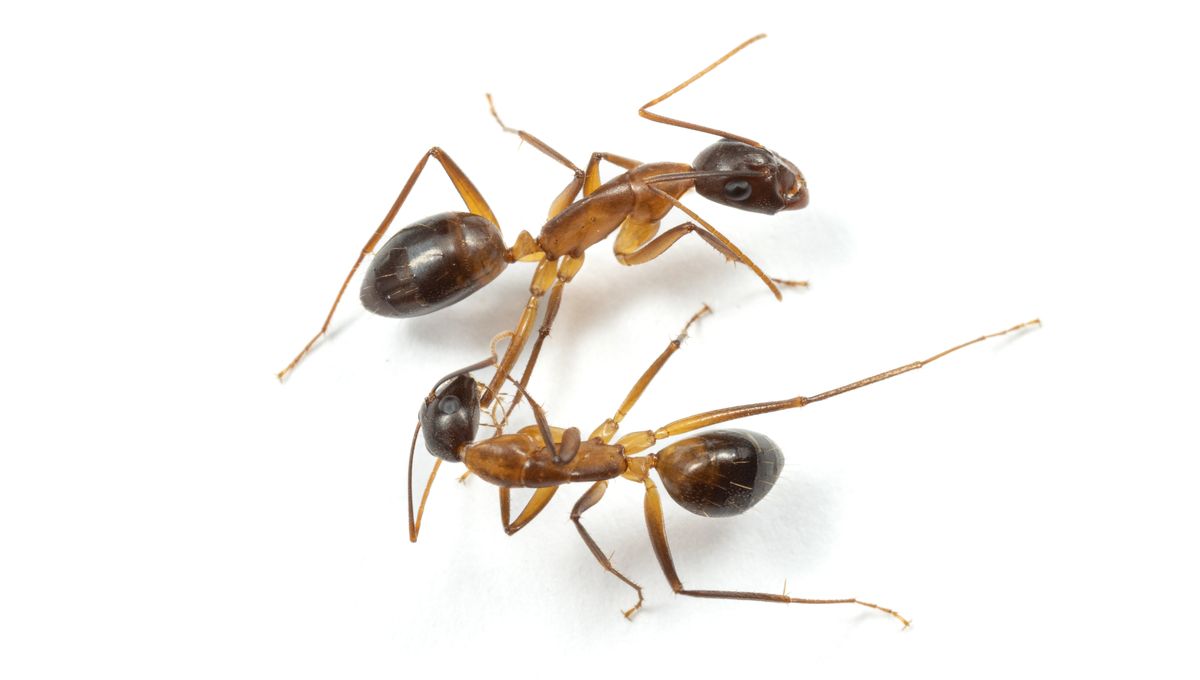
Ants are pretty remarkable creatures. From navigating via Earth’s magnetic field to spraying acid at their enemies, these tiny colonies are capable of big things, both as a unit and on an individual level. Now, new research has found that ants can even perform surgery, amputating the limbs of their friends and saving their lives in the process.
Florida carpenter ants (Camponotus floridanus) treat other ants with leg injuries by first assessing the wound, cleaning it, and then deciding whether to perform an amputation. The same researchers that made this discovery had previously found that another ant species can treat wounds with antibiotics in their saliva; however, Florida carpenter ants do not possess the same gland as the other species, and so their treatment is entirely mechanical.
“When we’re talking about amputation behavior, this is literally the only case in which a sophisticated and systematic amputation of an individual by another member of its species occurs in the animal Kingdom,” said first author Erik Frank, a behavioral ecologist from the University of Würzburg, in a statement.
The team found that the ants would assess the injury and either simply clean the wound, or clean the wound followed by a full amputation, which could take as long as 40 minutes. In the study, injuries to the femur (upper leg) were always cleaned and then amputated, while injuries to the tibia (lower leg) only received cleaning and were never amputated. Moreover, the survival rate for ants with either injury was remarkably high.
“Femur injuries, where they always amputate the leg, had a success rate around 90% or 95%. And for the tibia, where they did not amputate, it still achieved about the survival rate of 75%,” said Frank.
It was suspected that the decision whether to clean or amputate the leg could be based on the risk of infection. By using a micro-CT scanner, the team discovered that the femur is made up of lots of muscle tissue and can pump blood or hemolymph around to the rest of the body. The tibia, by contrast, contains very little muscle tissue, and much less involvement in the blood movement.
“In tibia injuries, the flow of the hemolymph was less impeded, meaning bacteria could enter the body faster. While in femur injuries the speed of the blood circulation in the leg was slowed down,” Frank explained.
Because the blood flow in the femur was slowed down via the injury, the ants could spend the extra time it takes to remove the limb, and not risk the infection spreading. But in tibia injuries, the faster blood flow means there’s not enough time for amputation without the infection spreading, so they clean more instead.
“Thus, because they are unable to cut the leg sufficiently quickly to prevent the spread of harmful bacteria, ants try to limit the probability of lethal infection by spending more time cleaning the tibia wound,” remarked senior author and evolutionary biologist Laurent Keller of the University of Lausanne.
This remarkable behavior shows that these Florida carpenter ants can find the location of the wounds of their nestmates and alter their treatment based on the location, thereby increasing the likelihood of survival for the injured ant. The team believes this is the first case of a non-human animal performing amputations in this way.
“The fact that the ants are able to diagnose a wound, see if it’s infected or sterile, and treat it accordingly over long periods of time by other individuals—the only medical system that can rival that would be the human one,” said Frank.
The study is published in Current Biology.

Source Link: Watch An Ant Amputate A Leg From A Fellow Nestmate To Save Its Life
