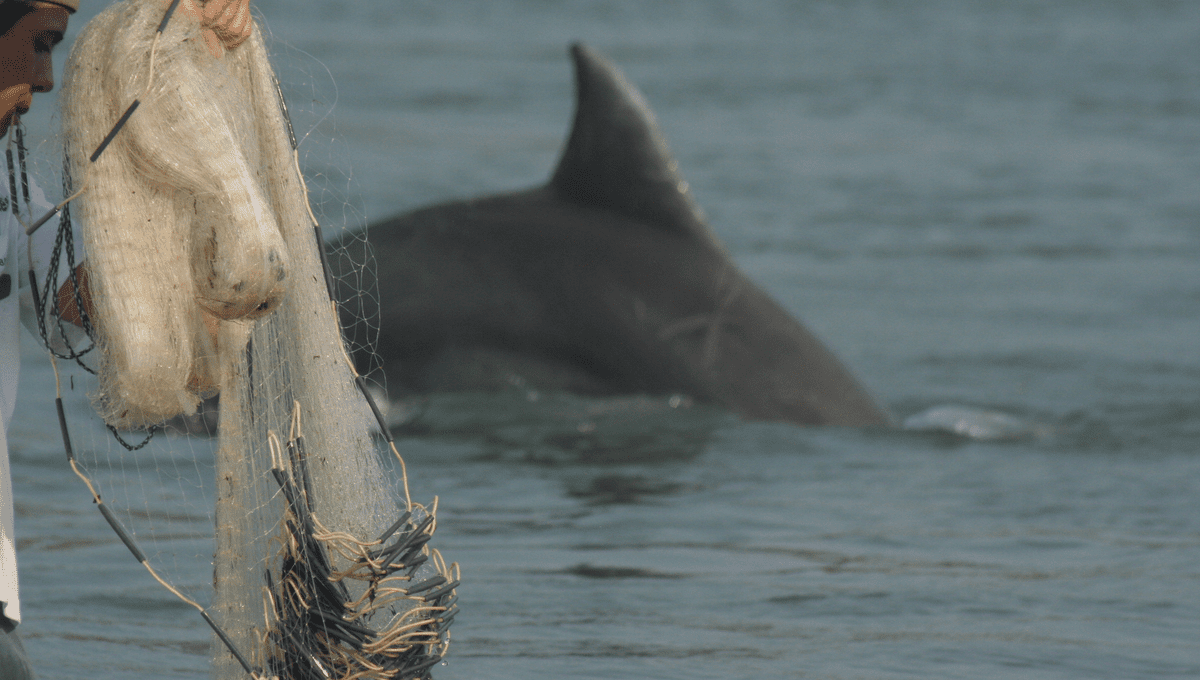
Near Laguna, Brazil, bottlenose dolphins have formed a rare alliance thought to have lasted 140 years with humans using hand-thrown fishnets. A study confirms that the collaboration benefits both mammal partners, but outside forces are destroying the conditions that make it possible.
Large schools of mullet (Mugil liza) migrate along the east coast of South America, providing an important food source for humans and dolphins alike. At Laguna, dolphins drive the fish close to shore, allowing them to be caught in nets thrown by fishers standing in the estuary. To know the best time for mullet catching, local residents watch out for dolphins, casting their nets in time with the dolphins’ dives.
The benefit to the fishers is obvious, but Dr Damien Farine of the Australian National University wanted to know what, if anything, the dolphins get from the arrangement. In a new paper, Farine and co-authors answered that question and quantified the benefits to humans. Knowing mullet numbers are declining, the authors also explored how best to keep the unusual collaboration alive.
Through a combination of drones and underwater imaging, the team confirmed the dolphins make longer dives to get under the nets, capturing fish that might escape them in open water. Farine told IFLScience that adult dolphins are generally too big, and perhaps too experienced, to be caught in the nets, but younger ones sometimes are. However, the fishers, who treasure their relationships with the dolphins, free any pups caught in this way. In contrast, dolphins can become bycatch of industrial fishers further offshore.
Three-fifths of the fishers the authors interviewed reported being able to feel when dolphins “pull one or two mullets” from the nets. However, this is a price they are happy to pay for the greater chance of catching a school when coordinating their casting with the dolphins.
Not all the local dolphins cooperate with humans; the authors found dolphins that frequently or occasionally cooperate with humans had 13 percent better survival rates during the study period compared to those that did not.
Farine admitted to IFLScience that the authors don’t know why some of the regions’ dolphins don’t cooperate with humans, given the demonstrable benefits. “One hypothesis is that dolphins compete for access to these sites,” Farine said. If so, those that lose out may be forced to hunt on their own. “Alternatively,” Farine added, “it may be not all of them known how.” The knowledge of how to catch fish from the nets may be passed down from mother to child, like some of the unique hunting strategies of dolphins in Australia’s Shark Bay.
Laguna is not the only place in the world where this sort of cooperative hunting occurs. The same team are keen to study how it operates in Kerala, India, and there are reports from West Africa and Myanmar of dolphin-human alliances. A remarkably similar account comes from the 19th Century when Indigenous Australians native to Moreton Bay reportedly gave some of their catch to dolphins who drove fish to shore.
Notably, Farine told IFLScience, “in all these cases the prey is the same fish, mullet. So there is something about how mullet school that makes this possible.”
Part of the explanation lies in the way mullet swim close to land and spawn in estuaries, allowing dolphins to only drive them a short way. In addition, Farine told IFLScience, “mullet swim in high-density schools, making them profitable to catch, but also difficult for dolphins.” The abundance when a school is caught means there is enough for everyone to share.
This richness is threatened by the mullet’s decline, potentially taking with it a key part of Laguna’s culture. Overfishing – not by dolphin/human teams but by industrial fisheries – is slashing mullet numbers and climate change may be making things worse.
Farine noted parallels with perhaps the most remarkable example of human/cetacean cooperation, where killer whales off the coast of Eden, Australia, herded baleen whales towards whalers. The whalers would harpoon the whales, but leave them at sea for several days so the orcas could eat choice portions such as tongues before the humans retrieved the carcasses for the oil. Despite the differences, “it’s about there being such a bonanza of a resource there is enough for everyone,” Farine told IFLScience.
The study is published in the Proceedings of the National Academy of Sciences.

Source Link: Watch Humans And Dolphins Team Up For A Mutually Beneficial Catch
