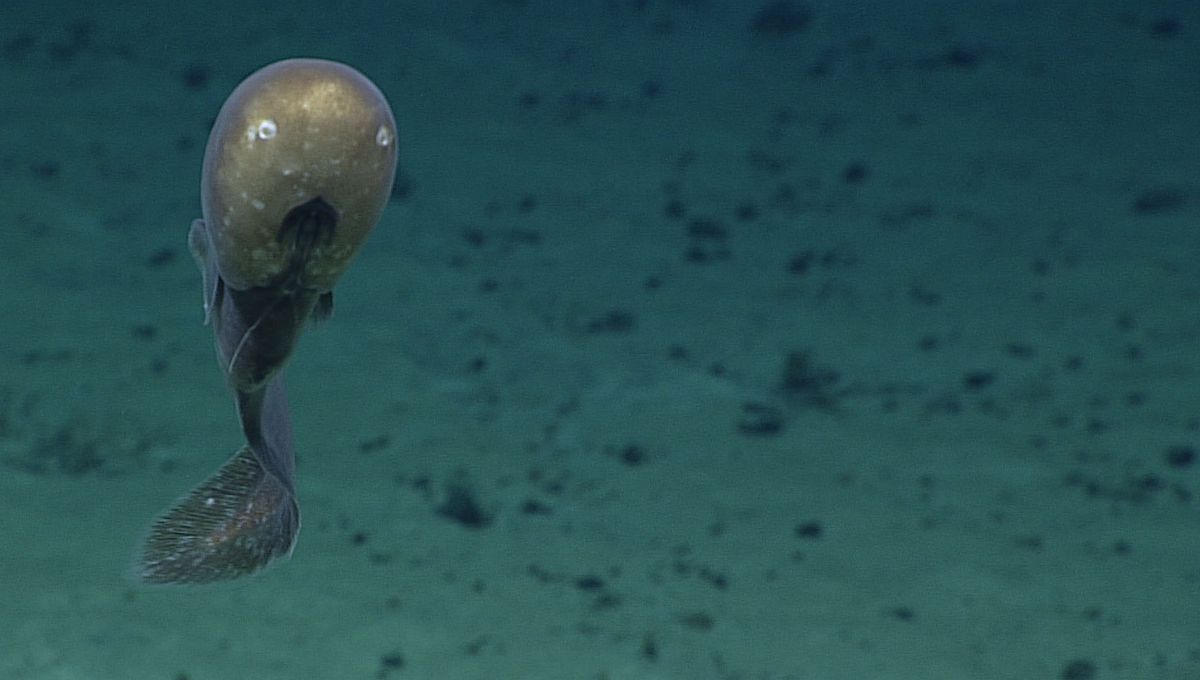
Of all the ghostly creatures lurking in our oceans, a recently spotted deep-sea cusk eel species cosplaying as a giant phantom tadpole might just be our new favorite.
This bizarre creature was seen during E/V Nautilus’ latest expedition, which aims to explore the previously uncharted deep-sea areas of the Cook Islands in the South Pacific. It’s not unusual for the teams aboard the ship to give enthusiastic commentary on what they see with their remotely operated vehicles during their expeditions (it’s one of our favorite things about them), but this fish really did deserve all the wows that they gave it.
While exploring the seafloor, the team spotted something eerie swimming in the distance. As the camera moved closer, the weirdness only intensified as the polliwog-esque creature with no distinguishable facial features came into view. It eventually swam off, though the researchers later located another equally spooky specimen.
But these were no massive amphibians-to-be; these were faceless cusk eels (Typhlonus nasus).
As the name implies, these strange fish have drastically reduced facial features, including what seems to be no eyes. However, as the old saying goes, appearances can be deceiving. “While these deep-sea swimmers’ bulbous faces appear to lack eyes, juveniles have been found to have tiny eyes hidden deep beneath the skin,” the Nautilus Live team explains in the caption of a video capturing the encounter.
It’s not entirely surprising that they’ve got their eyes tucked away; faceless cusks can live as deep as 5,100 meters (16,730 feet) below the surface. That’s within the layer of ocean known as the abyssal zone, and it’s completely devoid of sunlight. There’s not much point in having big ol’ eyes when you spend your time in the dark, so evolution likely decided they were better off ditching them, something that’s happened multiple times in darkness-dwelling eyeless cavefish too.
Their deep-sea home might also explain why, despite being relatively widely distributed, they’re so rarely seen – hence the enthusiasm from the Nautilus team. In fact, faceless cusks were effectively rediscovered in Australia back in 2017, after not a single one had been recorded in waters off the country since 1873.
When it landed on the deck of CSIRO’s RV Investigator, researchers thought they’d found an entirely new species, until sifting through scientific publications revealed it to be T. nasus, and potentially the biggest one ever seen.
Like the Nautilus team, the Investigator researchers were pretty enthusiastic about this freaky-looking fish – even if they did compare its featureless face to a butt.
“This little fish looks amazing because the mouth is actually situated at the bottom of the animal so, when you look side-on, you can’t see any eyes, you can’t see any nose or gills or mouth,” expedition team leader Dr Tim O’Hara told The Guardian at the time. “It looks like two rear-ends on a fish, really.”
E/V Nautilus’ Cook Islands expedition is set to continue through to October 21, so fingers crossed they’ve got plenty more wonderful deep-sea weirdos to come.

Source Link: Watch: Rare Footage Captures Freaky Faceless Cusk Eels Lurking On The Deep-Sea Floor
