• Email Us: [email protected]
  • Contact Us: +1 718 874 1545
  • Skip to main content
  • Skip to primary sidebar

Medical Market Report

  • Home
  • All Reports
  • About Us
  • Contact Us

Watch Rare Footage Of The Giant Phantom Jellyfish, A 10-Meter-Long “Ghost” That’s Only Been Seen Around 100 Times

January 5, 2026 by Deborah Bloomfield

Plunge 1,000 meters (3,300 feet) below the ocean’s surface, and there can be found the midnight zone, where the complete lack of sunlight and extreme cold and pressure have led to the evolution of all manner of ethereal weirdos. One of the rarest members of the gang? The giant phantom jellyfish (Stygiomedusa gigantea).

The rest of this article is behind a paywall. Please sign in or subscribe to access the full content.

“Giant” is an appropriate descriptor for this deep-sea dweller. It’s not the biggest jellyfish in the ocean – that title likely goes to the whopper that is the lion’s mane jelly – but its bell (the main part of a jelly’s body) can be over a meter (3.3 feet) wide.

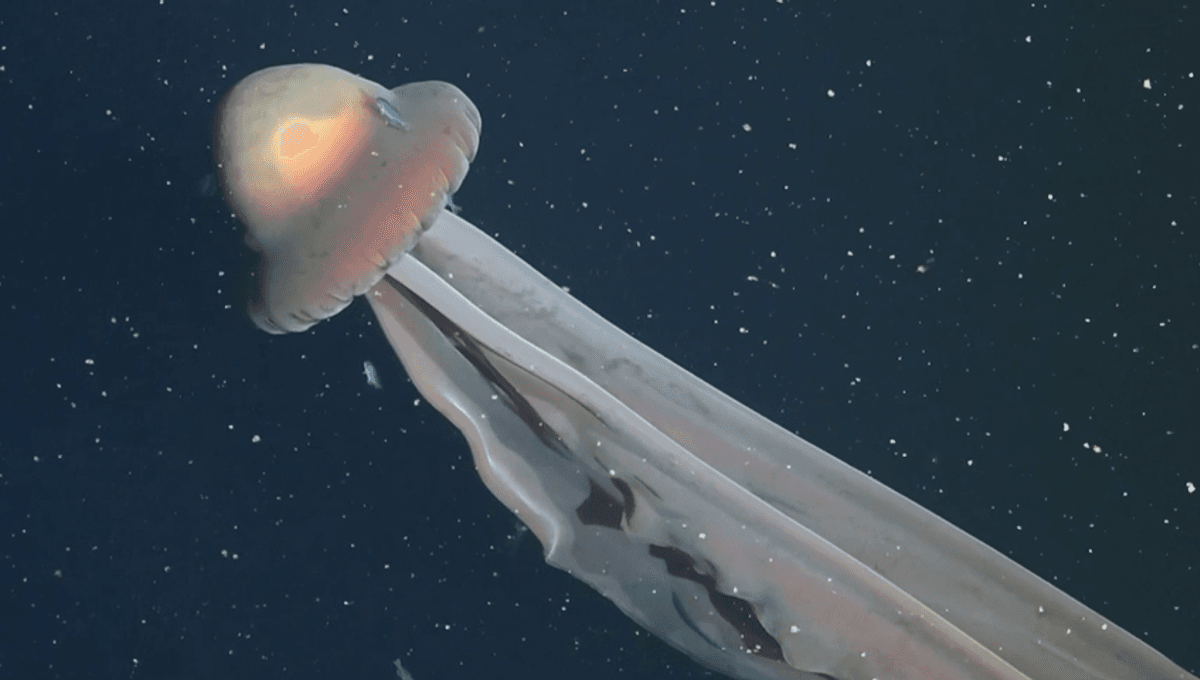
Its four oral arms are also impressive, reaching more than 10 meters (33 feet) long. Yep, you read that right – oral arms. Giant phantom jellyfish have these rather than the stinging tentacles we might typically associate with jellyfish, and they use them to grab onto their prey and guide it towards their mouths (new fear unlocked).

These ribbon-like appendages were out on form in a recent video captured by ROV pilots with the Schmidt Ocean Institute, who spotted the giant jelly during an exploration of the Colorado-Rawson submarine canyon, a deep seep off the coast of Argentina.

It’s here where you can really see where the “phantom” part of its name comes from; the jelly really does look pretty ghostly as its translucent reddish-orange body gently pushes and swirls its way through the water.

As well as being pretty mesmerizing to watch, it turns out that this is also a rare spot. Since the giant phantom jellyfish was first discovered in 1899, it’s only been spotted around 100 times. That’s not entirely surprising; while it can be seen closer to the ocean surface (the one spotted by Schmidt Ocean was recorded 253 meters [830 feet] down, for example), it’s usually found in the midnight zone, and can even live as far down as 6,700 meters (21,980 feet). It’s only relatively recently that we’ve had the technology to get down that far.

The infrequency with which it’s seen also means that scientists don’t know that much about the giant phantom jelly. In fact, scientists didn’t even recognize it as a species until 60 years after it was discovered.

What we do know, however, is that there are records of it in all oceans except the Arctic, with the greatest number of records coming from the Southern Ocean; researchers captured footage of the giant jelly there, off the coast of the Antarctic Peninsula, back in 2022.

As for everything else about this ocean giant? That remains a mystery, at least for now.

Deborah Bloomfield
Deborah Bloomfield

Related posts:

  1. Hai Robotics picks up $200M for its warehouse robot
  2. Garcia jumps back into action after Ryder Cup letdown
  3. Nuclear Football: Who Actually Has The Nuclear Launch Codes?
  4. 87 Satellites Sent To Space In The Last 24 Hours – Space Is Becoming Ever More Crowded

Source Link: Watch Rare Footage Of The Giant Phantom Jellyfish, A 10-Meter-Long "Ghost" That's Only Been Seen Around 100 Times

Filed Under: News

Primary Sidebar

  • US Just Killed NASA’s Mars Sample Return Mission – So What Happens Now?
  • Art Sleuths May Have Recovered Traces Of Da Vinci’s DNA From One Of His Drawings
  • Countries With The Most Narcissists Identified By 45,000-Person Study, And The Results Might Surprise You
  • World’s Oldest Poison Arrows Were Used By Hunters 60,000 Years Ago
  • The Real Reason You Shouldn’t Eat (Most) Raw Cookie Dough
  • Antarctic Scientists Have Just Moved The South Pole – Literally
  • “What We Have Is A Very Good Candidate”: Has The Ancestor Of Homo Sapiens Finally Been Found In Africa?
  • Europe’s Missing Ceratopsian Dinosaurs Have Been Found And They’re Quite Diverse
  • Why Don’t Snorers Wake Themselves Up?
  • Endangered “Northern Native Cat” Captured On Camera For The First Time In 80 Years At Australian Sanctuary
  • Watch 25 Years Of A Supernova Expanding Into Space Squeezed Into This 40-Second NASA Video
  • “Diet Stacking” Trend Could Be Seriously Bad For Your Health
  • Meet The Psychedelic Earth Tiger, A Funky Addition To “10 Species To Watch” In 2026
  • The Weird Mystery Of The “Einstein Desert” In The Hunt For Rogue Planets
  • NASA Astronaut Charles Duke Left A Touching Photograph And Message On The Moon In 1972
  • How Multilingual Are You? This New Language Calculator Lets You Find Out In A Minute
  • Europa’s Seabed Might Be Too Quiet For Life: “The Energy Just Doesn’t Seem To Be There”
  • Amoebae: The Microscopic Health Threat Lurking In Our Water Supplies. Are We Taking Them Seriously?
  • The Last Dogs In Antarctica Were Kicked Out In April 1994 By An International Treaty
  • Interstellar Comet 3I/ATLAS Snapped By NASA’s Europa Mission: “We’re Still Scratching Our Heads About Some Of The Things We’re Seeing”
  • Business
  • Health
  • News
  • Science
  • Technology
  • +1 718 874 1545
  • +91 78878 22626
  • [email protected]
Office Address
Prudour Pvt. Ltd. 420 Lexington Avenue Suite 300 New York City, NY 10170.

Powered by Prudour Network

Copyrights © 2026 · Medical Market Report. All Rights Reserved.

Go to mobile version