• Email Us: [email protected]
  • Contact Us: +1 718 874 1545
  • Skip to main content
  • Skip to primary sidebar

Medical Market Report

  • Home
  • All Reports
  • About Us
  • Contact Us

Watch The Highest Resolution View Of A Solar Flare Down To An Incredible 21 Kilometers

August 26, 2025 by Deborah Bloomfield

The Daniel K. Inouye Solar Telescope has been a game-changer. It has delivered some of the highest resolution views we have ever taken of the Sun. Now, it has provided the highest resolution observations of coronal loops during a solar flare.

The rest of this article is behind a paywall. Please sign in or subscribe to access the full content.

The solar flare in question was a respectably strong X1.3-class flare. It took place last year on August 8, 2024, at 20:12 UT as it was ramping up to the solar maximum. Coronal loops are arches of plasma that follow the magnetic lines of the Sun. As they twist and snap, the magnetic energy can heat up plasma to millions of degrees, producing a bright flare. The precise thickness of these loops was uncertain until now. The new observations suggest the loops averaged 48.2 kilometers (30 miles) in width and are perhaps as thin as just 21 kilometers (13 miles).

“This is the first time the Inouye Solar Telescope has ever observed an X-class flare,” lead author Cole Tamburri, a graduate researcher at the University of Colorado Boulder, said in a statement. “These flares are among the most energetic events our star produces, and we were fortunate to catch this one under perfect observing conditions.”
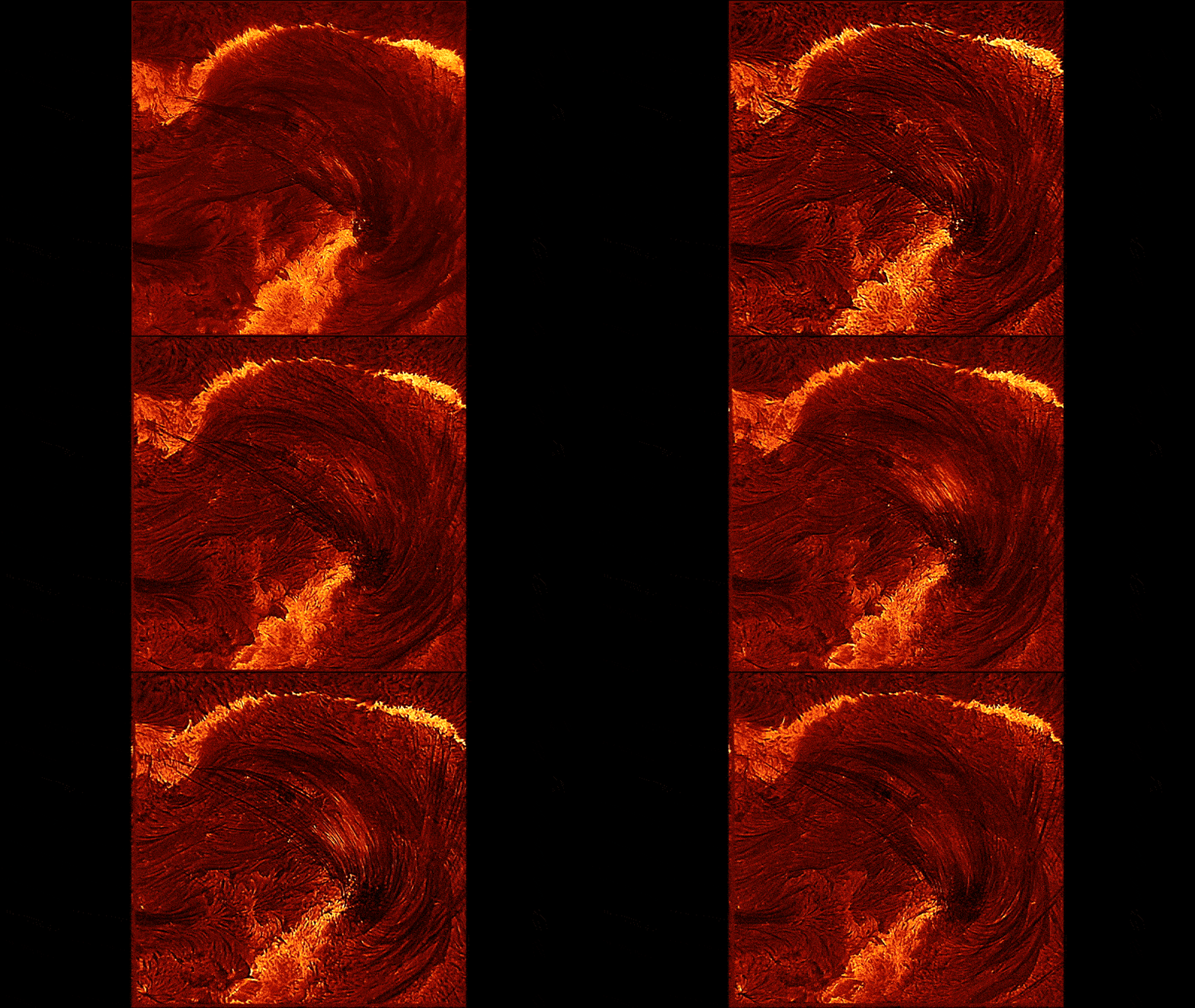
the main image in motion showing the dark filements stretching between the bright ribbons.

The coronal loop filaments stretching across the Sun, in a video sped up 100 times.

Image Credit: NSF/NSO/AURA

When the flare was emitted last August, the Sun was reaching its maximum, and Inouye was among the brand-new instruments studying this peak of activity. It more than delivered on its potential with these observations.

“Before Inouye, we could only imagine what this scale looked like,” Tamburri explains. “Now we can see it directly. These are the smallest coronal loops ever imaged on the Sun.”

“Knowing a telescope can theoretically do something is one thing,” Maria Kazachenko, a co-author of the study and National Solar Observatory scientist, notes. “Actually watching it perform at that limit is exhilarating.”

The work is providing incredible insights into how these magnetic arcs are happening, as we can see in the video above, which has been sped up 100 times. The observations suggest that the loop images are singular structures, not bundles of smaller magnetic objects.

“If that’s the case, we’re not just resolving bundles of loops; we’re resolving individual loops for the first time,” Tamburri adds. “It’s like going from seeing a forest to suddenly seeing every single tree.”

“We’re finally peering into the spatial scales we’ve been speculating about for years,” says Tamburri. “This opens the door to studying not just their size, but their shapes, their evolution, and even the scales where magnetic reconnection—the engine behind flares—occurs.”

The study is published in The Astrophysical Journal Letters.

Deborah Bloomfield
Deborah Bloomfield

Related posts:

  1. Chanel strikes playful note for spring
  2. Roman Military Camps In Arabia Spotted Using Google Earth, Suggesting Desert Conquest
  3. The Ancient “Wheel Of Ghosts” Has Turned 40 Meters Since It Was Built 5,000 Years Ago
  4. “Land Of The White Jaguar”: 327-Year-Old Letter Leads Researchers To Lost Ancient Maya City

Source Link: Watch The Highest Resolution View Of A Solar Flare Down To An Incredible 21 Kilometers

Filed Under: News

Primary Sidebar

  • Your Daily Coffee Might Be Keeping You Young – Especially If You Have Poor Mental Health
  • Why Do Cats And Dogs Eat Grass?
  • What Did Carl Sagan Actually Mean When He Said “We Are All Made Of Star Stuff”?
  • Lonesome George: The Giant Tortoise Who Was The Very Last Of His Kind
  • Bermuda Sits On A Strange, 20-Kilometer-Thick Structure That’s Like No Other In The World
  • Time Moves Faster Up A Mountain – And That’s Why Earth’s Core Is 2.5 Years Younger Than Its Surface
  • Bio-Hybrid Robots Made Of Dead Lobsters Are The Latest Breakthrough In “Necrobotics”
  • Why Do Some Italians Live To 100? Turns Out, Centenarians Have More Hunter-Gatherer DNA
  • New Full-Color Images Of Interstellar Comet 3I/ATLAS, As We Are Days Away From Closest Encounter
  • Hilarious Video Shows Two Young Andean Bears Playing Seesaw With A Tree Branch
  • The Pinky Toe Has A Purpose And Most People Are Just Finding Out
  • What Is This Massive Heat-Emitting Mass Discovered Beneath The Moon’s Surface?
  • The Man Who Fell From Space: These Are The Last Words Of Cosmonaut Vladimir Komarov
  • How Long Can A Bird Can Fly Without Landing?
  • Earliest Evidence Of Making Fire Has Been Discovered, X-Rays Of 3I/ATLAS Reveal Signature Unseen In Other Interstellar Objects, And Much More This Week
  • Could This Weirdly Moving Comet Have Been The Real “Star Of Bethlehem”?
  • How Monogamous Are Humans Vs. Other Mammals? Somewhere Between Beavers And Meerkats, Apparently
  • A 4,900-Year-Old Tree Called Prometheus Was Once The World’s Oldest. Then, A Scientist Cut It Down
  • Descartes Thought The Pineal Gland Was “The Seat Of The Soul” – And Some People Still Do
  • Want To Know What The Last 2 Minutes Before Being Swallowed By A Volcanic Eruption Look Like? Now You Can
  • Business
  • Health
  • News
  • Science
  • Technology
  • +1 718 874 1545
  • +91 78878 22626
  • [email protected]
Office Address
Prudour Pvt. Ltd. 420 Lexington Avenue Suite 300 New York City, NY 10170.

Powered by Prudour Network

Copyrights © 2025 · Medical Market Report. All Rights Reserved.

Go to mobile version