• Email Us: [email protected]
  • Contact Us: +1 718 874 1545
  • Skip to main content
  • Skip to primary sidebar

Medical Market Report

  • Home
  • All Reports
  • About Us
  • Contact Us

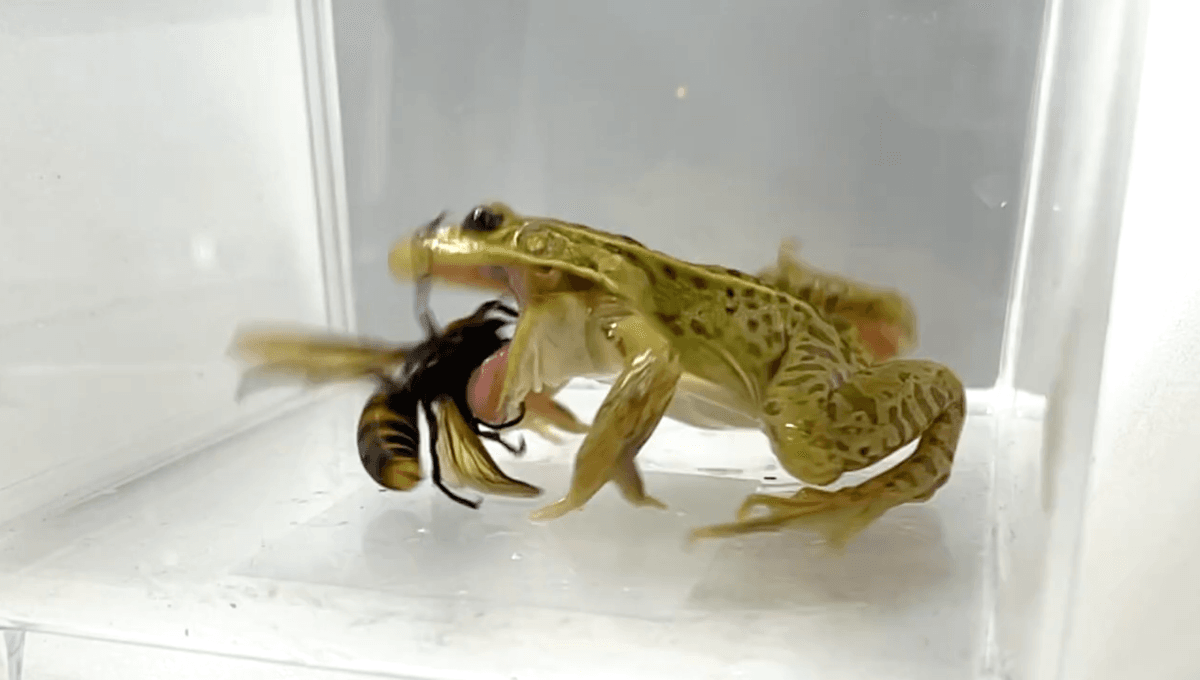
Watch The World’s Most Metal Frog Take Down A Giant “Murder Hornet”

December 10, 2025 by Deborah Bloomfield

Giant hornets are typically not a force to be reckoned with. With size and a venomous sting capable of taking down a human on their side, there’s a good reason why they’re often called “murder hornets”. But now, new research has discovered an animal that snacks on these beasties like it’s no big deal – and even caught it on camera.

The rest of this article is behind a paywall. Please sign in or subscribe to access the full content.

The animal in question? A black-spotted pond frog (Pelophylax nigromaculatus). Previous work had already identified hornet remains in the stomach contents of this species, so it was already assumed they were likely capable of attacking and eating them. The question left unanswered was how; were these frogs just really good at avoiding getting stung, or did they have some sort of tolerance to it?

“Although stomach-content studies had shown that pond frogs sometimes eat hornets, no experimental work had ever examined how this occurs,” said Kobe University ecologist Shinji Sugiura in a statement.

Sugiura was about to change that. In the new study, he first placed individual pond frogs in a clear plastic cage, then presented them with a worker hornet of one of three species: the yellow hornet (Vespa simillima), the yellow vented hornet (V. analis), or the Asian giant hornet (V. mandarinia), the latter of which is the largest hornet species in the world.


Capturing the interactions on camera, Sugiura found almost all of the frogs actively attacked the hornets, with a 93 percent snacking success rate for V. simillima, 87 percent for V. analis, and 79 percent for V. mandarinia.

All the while, they were being stung; in one part of the footage, after a frog had successfully eaten a hornet, the stinger can be seen embedded in the frog’s mouth. And yet, the frogs studied came out of the ordeal seemingly unbothered and with a tasty snack in their belly. In other words, these unsuspecting pond frogs appear to be highly tolerant to the hornet’s sting.

“While a mouse of similar size can die from a single sting, the frogs showed no noticeable harm even after being stung repeatedly. This extraordinary level of resistance to powerful venom makes the discovery both unique and exciting,” said Sugiura, who suggested that black-spotted pond frogs could become a model organism for investigating venom tolerance and pain resistance in vertebrates.

Future work, he said, could examine “whether pond frogs have physiological mechanisms such as physical barriers or proteins that block the pain and toxicity of hornet venom, or whether hornet toxins have simply not evolved to be effective in amphibians, which rarely attack hornet colonies.”

The study is published in Ecosphere.

Deborah Bloomfield
Deborah Bloomfield

Related posts:

  1. Bolivian president calls for global debt relief for poor countries
  2. 4,000-Year-Old Tablet Shows Teachers Have Reached For The Red Pen For Centuries
  3. New Google Game Is A Fun Way To Learn About The Lunar Cycle
  4. When You Hack A Shark, You’re Exploiting A Glitch Billions Of Years In The Making

Source Link: Watch The World’s Most Metal Frog Take Down A Giant “Murder Hornet”

Filed Under: News

Primary Sidebar

  • A Giant Volcano Off The Coast Of Oregon Failed To Erupt On Time. Its New Schedule: 2026
  • Here Are 5 Ways In Which Cancer Treatment Advanced In 2025
  • The First Marine Mammal Driven To Extinction By Humans Disappeared Only 27 Years After Being Discovered
  • The Planet’s Oldest Bee Species Has Become The World’s First Insect To Be Granted Legal Rights
  • Facial Disfiguration: Why Has The Face Been The Target Of Punishment Across Time?
  • The World’s Largest Living Reptile Can “Surf” Over 10 Kilometers To Get Between Islands
  • In 1962, A Geologist Went Into A Cave. 2 Months Later, He’d Accidentally Invented A New Field Of Biology.
  • The Ancient Remains Of A 3-Ton Shark Indicate A New Point Of Origin For Gigantic Lamniform Sharks
  • The Biggest Landslide In Recorded History Happened Quite Recently And Pretty Close To Home
  • Meet The Amami Rabbit, A Goth Bunny That’s Also A Living Fossil
  • The Largest Native Terrestrial Animal In Antarctica Is Both Smaller And Tougher Than You’d Expect
  • The Freaky Reason Why You Should Never Store Tomatoes And Potatoes Together
  • Hominin Vs. Hominid: What’s The Difference?
  • Experimental Alzheimer’s Drug Could Have The Power To Halt Disease Before Symptoms Even Start
  • Al Naslaa: What Made This Enormous Boulder In Saudi Arabia Split In Two? Nobody’s Quite Sure
  • The Amazon Is Entering A “Hypertropical” Climate For The First Time In 10 Million Years
  • What Scientists Saw When They Peered Inside 190-Million-Year-Old Eggs And Recreated Some Of The World’s Oldest Dinosaur Embryos
  • Is 1 Dog Year Really The Same As 7 Human Years?
  • Were Dinosaur Eggs Soft Like A Reptile’s, Or Hard Like A Bird’s?
  • What Causes All The Symptoms Of Long COVID And ME/CFS? The Brainstem Could Be The Key
  • Business
  • Health
  • News
  • Science
  • Technology
  • +1 718 874 1545
  • +91 78878 22626
  • [email protected]
Office Address
Prudour Pvt. Ltd. 420 Lexington Avenue Suite 300 New York City, NY 10170.

Powered by Prudour Network

Copyrights © 2026 · Medical Market Report. All Rights Reserved.

Go to mobile version