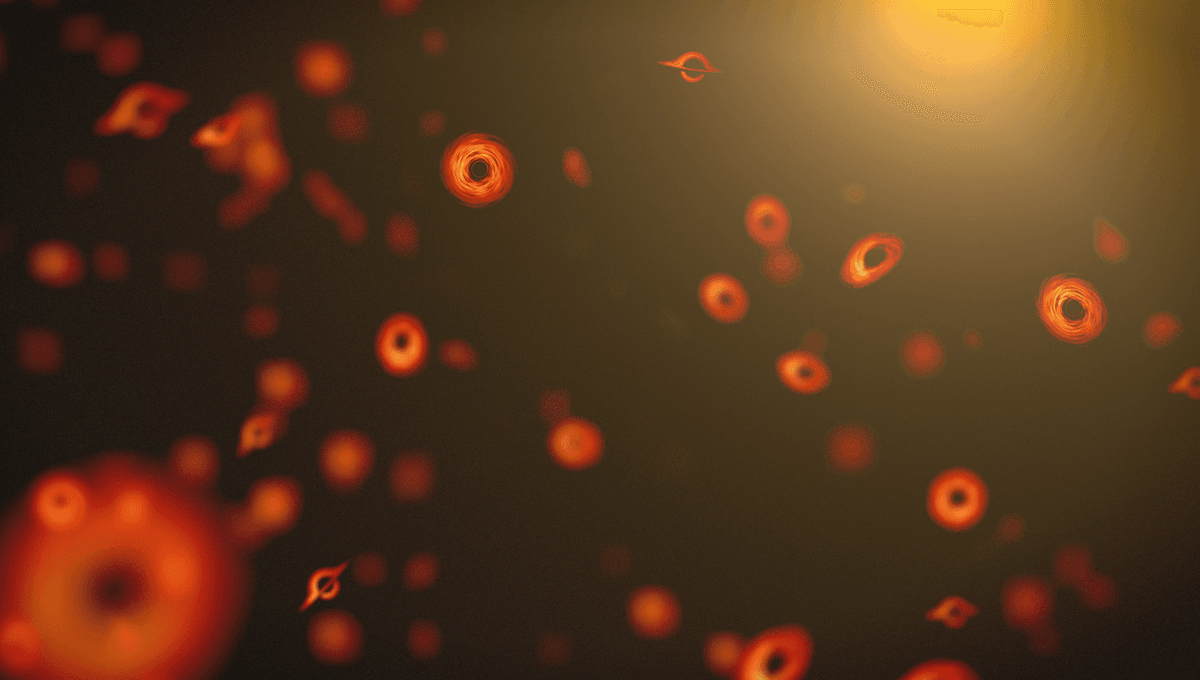
Black holes can lose mass and energy over time. They release Hawking radiation. The smaller they are, the more radiation they emit, so the hotter they get. The end scenario is the black holes exploding into nothing. Could we observe such an exploding black hole? Maybe, if a bunch of conditions are met. If they are, we could see them with current instruments within a decade.
The rest of this article is behind a paywall. Please sign in or subscribe to access the full content.
First of all, you need a primordial black hole (PBH). These are black holes that formed in the immediate aftermath of the Big Bang. Several hypotheses have proposed their existence, but we have no certainty that they indeed exist. If they do exist, they are the most likely to explode. They are not that big, and they have had almost 14 billion years to evaporate.
“The lighter a black hole is, the hotter it should be and the more particles it will emit. As PBHs evaporate, they become ever lighter, and so hotter, emitting even more radiation in a runaway process until explosion. It’s that Hawking radiation that our telescopes can detect,” co-author Andrea Thamm, assistant professor of physics at UMass Amherst, said in a statement.
But if you take a standard hypothetical PBH, you wouldn’t get that many explosions. It has been theoretically estimated that one would happen every 100,000 years. That is a long time to wait around.
Researchers wondered if there were scenarios where the explosion might happen more often, and found an intriguing one that has to do with another unsolved mystery of the universe: dark matter.
Dark matter is a hypothetical substance that permeates the universe. There is a lot of evidence supporting its existence, but we do not know what it is. It only interacts gravitationally, so we cannot see it. Several studies have suggested that, like we have different forces and particles of matter, there might be a dark sector equivalent for dark matter.
It is possible, at least theoretically, for black holes to have an electric charge. This work proposes that instead of having a regular electric charge, PBHs have a dark electric charge, so they would interact via a dark photon – just as photons mediate the regular electromagnetic force – and with an electric charge from a heavy dark electron.
If a population of such hypothetical black holes were to exist, then their explosion rate wouldn’t be once every 100,000 years. It would be closer to one every decade. More importantly, if these kinds of black holes were to exist, their explosion would be detectable with current instruments and reveal properties of the universe we have no other way to test.
“We know how to observe this Hawking radiation,” explained Joaquim Iguaz Juan, a postdoctoral researcher in physics at UMass Amherst. “We can see it with our current crop of telescopes, and because the only black holes that can explode today or in the near future are these PBHs, we know that if we see Hawking radiation, we are seeing an exploding PBH.”
Theoretical studies of what might be out there are very important, as they can help look for the right signals. And given the universe’s fondness to throw us curveballs, even when we do not find what we were looking for, we can find something else.
A paper describing this scenario is published in Physical Review Letters.

Source Link: We Could See A Black Hole Explode Within 10 Years – Unlocking The Secrets Of The Universe
