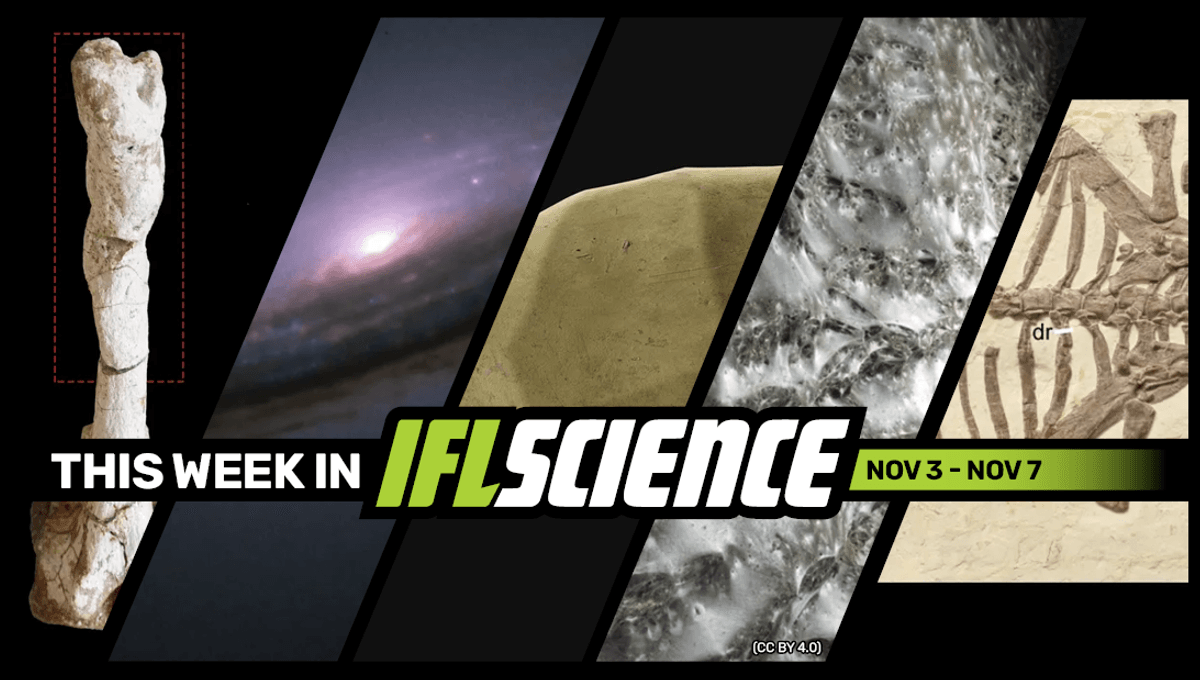
This week, remarkable new findings suggest the universe’s expansion may be slowing down, a new site reveals that Oldowan tools saw early humans through 300,000 years of battling the elements, and a 115-million-year-old fossil is the first-ever ankylosaur hatchling to be discovered. Finally, we ask: could you eat dinosaur meat? And if so, what would it taste like?
The rest of this article is behind a paywall. Please sign in or subscribe to access the full content.
Create an IFLScience account to get all the biggest science news delivered straight to your inbox every Wednesday and Saturday.
At Last, We May Finally Have A Way To Tell Female Dinosaurs From Males
There’s plenty of rough sex in the animal kingdom, but dinosaur copulation may have been so violent that it literally broke the spine of the female. Ironically, though, that’s wonderful news for palaeontologists, as the love scars left behind by these prehistoric couplings may finally enable us to distinguish between male and female specimens. Read the full story here
The Universe’s Expansion May Be Slowing Down, Not Speeding Up, Remarkable New Findings Suggest
For almost a century, we have known that the universe is expanding. For several decades, evidence has suggested that the expansion of the universe is accelerating. Crucial to those estimates were the use of standard candles, celestial events of the same luminosity that can be used to measure cosmic distances like milestones on a road. A famous standard candle is a Type Ia supernova, but new research suggests that it might not be as standard as we thought. And this might be a big problem. Read the full story here
Oldowan Tools Saw Early Humans Through 300,000 Years Of Fire, Drought, And Shifting Climates, New Site Reveals
A new site in one of the most important basins for humanity’s evolution has provided evidence of occupation over an unprecedented period dating back 2.75 million years. Across 300,000 years, early humans used Oldowan tools – the earliest known stone tools – to maintain a similar lifestyle in the face of a harsh and changing climate. Read the full story here
World’s Largest Spider Web, Created By 111,000 Arachnids In A Cave, Is Big Enough To Catch A Whale
In a dank cave below the Albanian-Greek border, scientists have uncovered a spider web that’s technically big enough to catch a whale. Stretching 106 square meters (1,140 square feet), the spindly structure is likely to be the biggest web of its kind ever found. You may (or may not) be pleased to hear that this is not the work of a single creature. The researchers looked at the density of arachnids in the colony and estimated it was formed of roughly 111,000 spiders. Read the full story here
This Is The Only Known Ankylosaur Hatchling Fossil In The World
A new study has become the first-ever to definitively identify an ankylosaur hatchling. The specimen is around 115 million years old and belongs to the species Liaoningosaurus paradoxus, for which we’d previously only found juveniles. We’re still yet to find a Liaoningosaurus adult, and as for why? Read the full story here
TWIS is published weekly on our Linkedin page, join us there for even more content.
Feature of the week:
Could We Eat Dinosaur Meat? (And What Would It Taste Like?)
Dinosaurs, birds, and crocodiles all sit within the Archosauria, a clade of “ruling reptiles” made up from diapsids with single openings on each side of the skull just in front of the eyes. This is why phylogenetic bracketing often borrows inspiration from birds and crocodiles to make decisions about how dinosaurs might have looked and sounded, but what if we wielded it for something less noble? What if, really, we just want to know what dinosaurs would have tasted like? We asked an expert to find out. Read the full story here
More content:
Have you seen our e-magazine, CURIOUS? Issue 40, November 2025, is available now. This month, we asked, “How Do We Predict The Weather?” – check it out for exclusive interviews, book excerpts, long reads, and more.
PLUS, the We Have Questions podcast – an audio version of our coveted CURIOUS e-magazine column – continues. In episode 14, we ask, “Can Burying Scientists Alive In The Snow Help Us Protect Polar Bears?”
The Big Questions podcast concludes season 5 with a special bonus episode: Searching For Nessie: IFLScience Takes On Cryptozoology.

Source Link: We May Finally Have A Way To Tell Female Dinosaurs From Males, World's Largest Spider Web Is Big Enough To Catch A Whale, And Much More This Week
