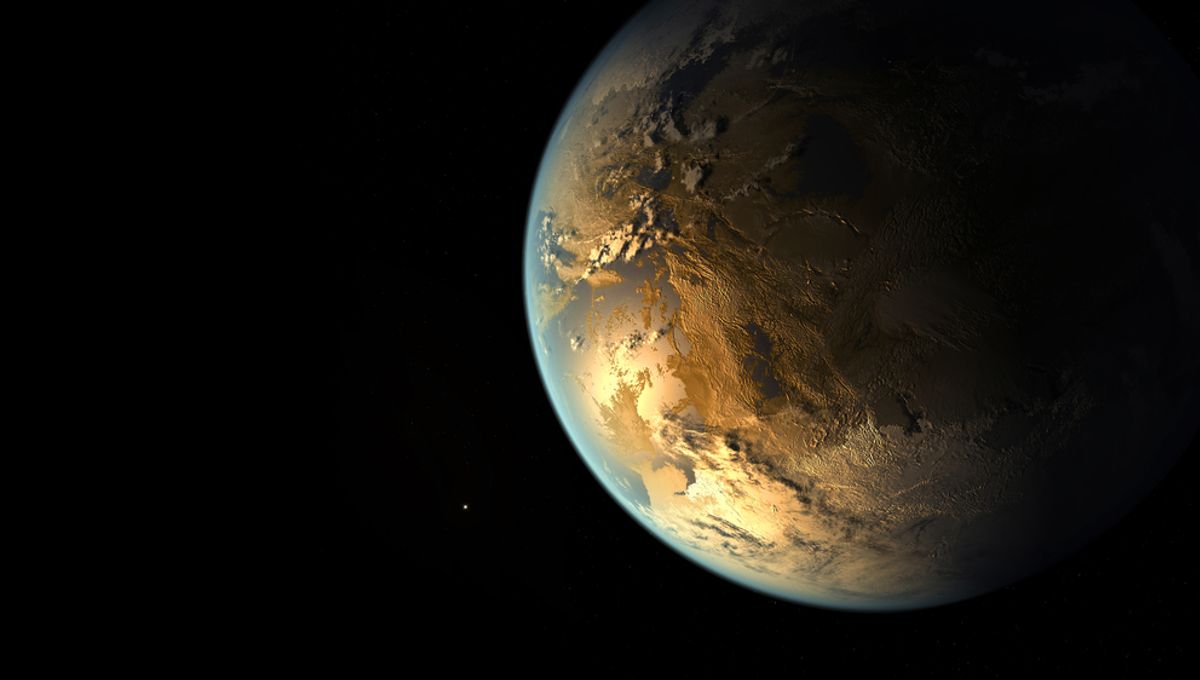
Astronomers have cast their nets wide searching for habitable planets, and a team at the University of Georgia, Athens, argues that may be too broad to be useful. What we need, they suggest, is not simply to find planets that could support life, but to seek out those that could support the life we can detect, a much narrower subset. They provide a starting point in how to do that, focusing on what they call the “photosynthetic habitable zone” (PHZ) and identifying five planets in it.
A star’s habitable zone is currently defined as the area receiving the right amount of sunlight to support liquid water – not so much it all boils away, or so little it all freezes. This definition can be a bit vague because the amount of greenhouse gases in a planet’s atmosphere can shift where the boundaries lie. Nevertheless, it’s good enough that we get excited every time an Earth-like planet is found within this zone, something advances in astronomical equipment are making quite frequent.
However, as a team led by Dr Cassandra Hall argue in a preprint paper submitted to the Astrophysical Journal, it doesn’t really matter if a planet is capable of supporting life if we can’t detect it from here. Imagine, for example, aliens orbiting Tau Ceti trying to work out if there was life in the Solar System. They might see Mars as potentially habitable, but there would be no way they could detect any life there at that distance – we’re not sure even with rovers on the surface. Earth, on the other hand, would be much easier.
That’s because life on Earth is so abundant it has dramatically changed the atmosphere in ways non-biological processes could not. The search for similarly altered atmospheres is the next frontier in hunting alien life, but Hall and co-authors note; “Such a detection would likely require a dedicated study, occupying a large amount of telescope time.” Hundreds of transits across the face of the planet’s star would need to be combined.
Until we have dozens of JWSTs or Extremely Large Telescopes in operation, we can’t afford to be wasteful with such time, and need to pick our targets carefully.
The PHZ can also be tricky to define. The authors conclude; “In the most ideal conditions for life and no atmospheric and greenhouse effects, the photosynthetic habitable zone is almost as broad as the habitable zone. On the other hand, if conditions for life are anything less than excellent and atmospheric attenuation and greenhouse effects are even moderate, the photosynthetic habitable zone is concentrated at larger separations around more massive stars.”
Greenhouse effects are almost certainly not something we will know for a system before we devote extensive telescope time to it, and possibly not even then. The length of the planet’s day, another factor the authors think may shrink the PHZ if less than ideal, may also be unknown. Consequently, it’s safest to focus on areas that will be in the PHZ under a range of conditions.
Many of the habitable zone planets we have found are expected to be “tidally locked”, with one side permanently facing their star. There has been great debate about whether such planets are indeed habitable. In some cases there should be a twilight ring where temperatures might be suitable, in colder cases the area directly pointed at the star might have appropriate warmth. However, the authors write; “Our analysis indicates that the PHZ predominantly exists outside the tidal locking radius for all cases, suggesting that the search for life elsewhere in the Universe should be focused around non-tidally locked planets.”
Out of 29 known rocky planets in the habitable zone, the authors find only five to be consistently in the PHZ for all likely variables; Kepler-452 b, Kepler-1638 b, Kepler-1544 b, and Kepler-62 e and f. If we’re going to invest a lot of telescope time in trying to identify planetary atmospheres, these look like the places to start.
The work relies on the assumption biochemistry on planets operates similarly to our own, but as the authors note, where it doesn’t we might not recognize the products, so there is little point looking.
The preprint is available on ArXiv.org. H/T Discover Magazine.
An earlier version of this article was published in February 2023.

Source Link: We Should Search For Life Alien Life In The “Photosynthetic Habitable Zone”
