As this is written, the Jupiter Icy Moons Explorer (Juice) mission is taking images of interstellar comet 3I/ATLAS, providing an angle Earth-based telescopes can’t offer. Yet if you look at a map of the Solar System, you might wonder why on earth Juice is in this location, well-suited to spotting the cometary interloper as it passes by. After all, Juice was launched 2.5 years ago on a mission to the outer Solar System, and yet it’s currently barely further from the Sun than the Earth is, albeit on the other side. Indeed, on November 2, when observations started, Juice was actually inside the Earth’s orbit, having apparently gone backwards.
The reason Juice is taking such a roundabout route is that it’s using multiple gravity assists to get to Jupiter. That’s typical behavior for a space mission heading anywhere further away than Mars. The alternative, to head for the target directly, takes much more fuel and would therefore be far more expensive.
In fact, gravity assists are so important for space travel beyond Earth’s neighbors that they can determine whether a mission occurs at all. The Voyager missions, one of NASA’s highlights, were a product of the fact that the outer planets were aligned sufficiently that we could use each one’s gravity to send Voyager 2 on to the next, known as the “grand tour”. Fifty years after Voyager 2 launched, we have not been back to the ice giants, despite all our advances in space technology, partly because the opportunity for such a double assist has not returned.
How does a gravity assist work?
The simple explanation for gravity assists is that, in passing, a spacecraft uses a planet’s gravity to speed it up, or slow it down, as required. Authors who don’t want to be distracted from describing a mission’s objectives use language like this all the time, but it’s probably left a lot of people puzzled.
For example, if you visit a museum and pass by one of those models of a gravity well where you can roll balls or coins around a surface stretched like space-time by a major mass, you can’t use them to accelerate. Your ball gets faster as it drops towards the well, but loses that speed again as it passes out, along with a little lost to friction.
The reason passing a spacecraft around the edge of a planet’s gravity well is different is that planets are in motion around the Sun. That motion is as important as the gravity. From the perspective of someone on a planet visited by a spacecraft, things look very much like that museum exhibit – the path of the craft is shifted by the encounter, but its speed does not change. To everyone else, however, including observers on other planets, the planet’s gravity pulls the spacecraft along with it.
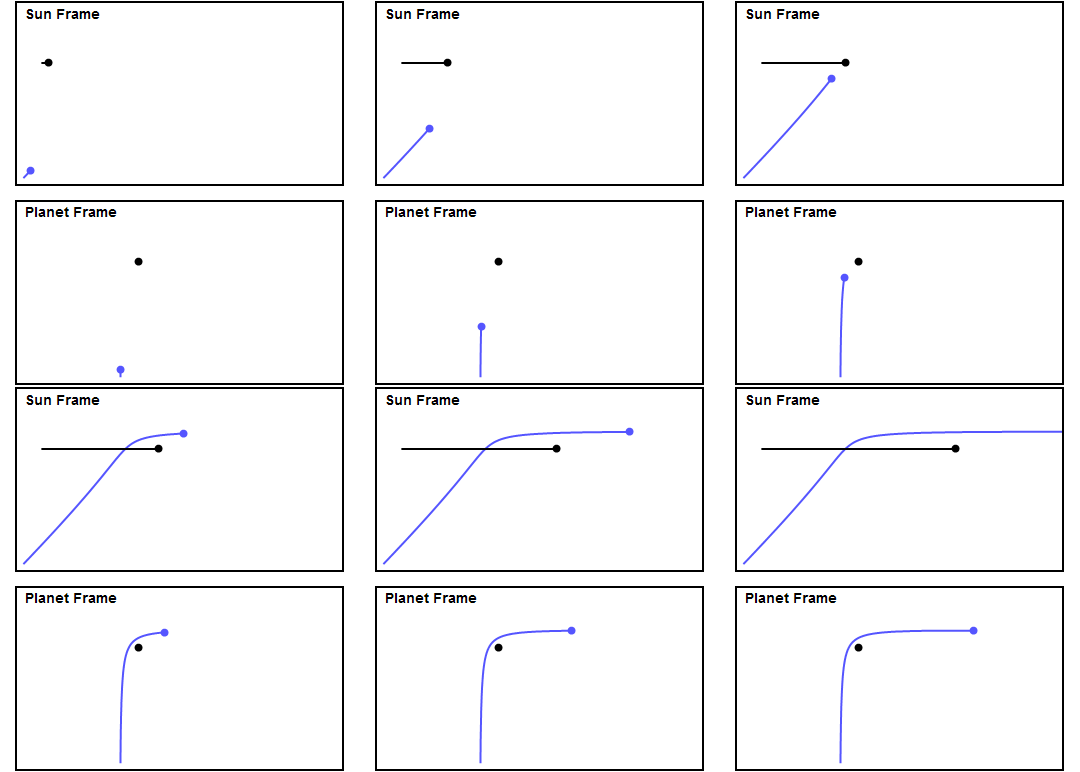
A stationary planet would not give a spacecraft extra velocity, as the planet frame reveals, but the motion relative to the Sun gives the mission extra speed.
A little of the planet’s angular momentum is transferred to the spacecraft, but being so much more massive, the planet experiences no noticeable change. Meanwhile, for the spacecraft, the effect is large. Depending on the relative alignment of the spacecraft and planet, the encounter can either increase or decrease speed relative to the Sun.
The acceleration such an encounter provides is not infinite, which is why many missions now require several assists. To become the fastest-moving craft humans have ever made (relative to the Sun), the Parker Solar Probe has undergone seven fly-bys of Venus, each raising its speed a little higher. Extra speed can also be gained by firing rockets when closest to the planet, maximizing the gain in kinetic energy for the amount of fuel burned.
The long and winding road
Gravity assists are so useful that it’s often worth going in the opposite direction from your target, just so you can grab the extra velocity an assist can provide.
Voyager 2’s use of each giant planet in turn made sense, but it was the exception. The need to use Jupiter and Saturn required Voyager 2’s launch at an angle compared to a direct mission to Uranus, but it was always making its way out of the Sun’s gravity well.
That’s not the case for subsequent missions. Galileo, Cassini, and Juice, on the other hand, all went inward to Venus to eventually reach planets further from the Sun than Earth. It’s also common for craft to make fly-bys of Earth, returning to where they came, to build up speed. These missions need to use the inner planets for gravity assists, when the Voyagers didn’t, because their goal is to orbit Jupiter or Saturn, not just pass by.
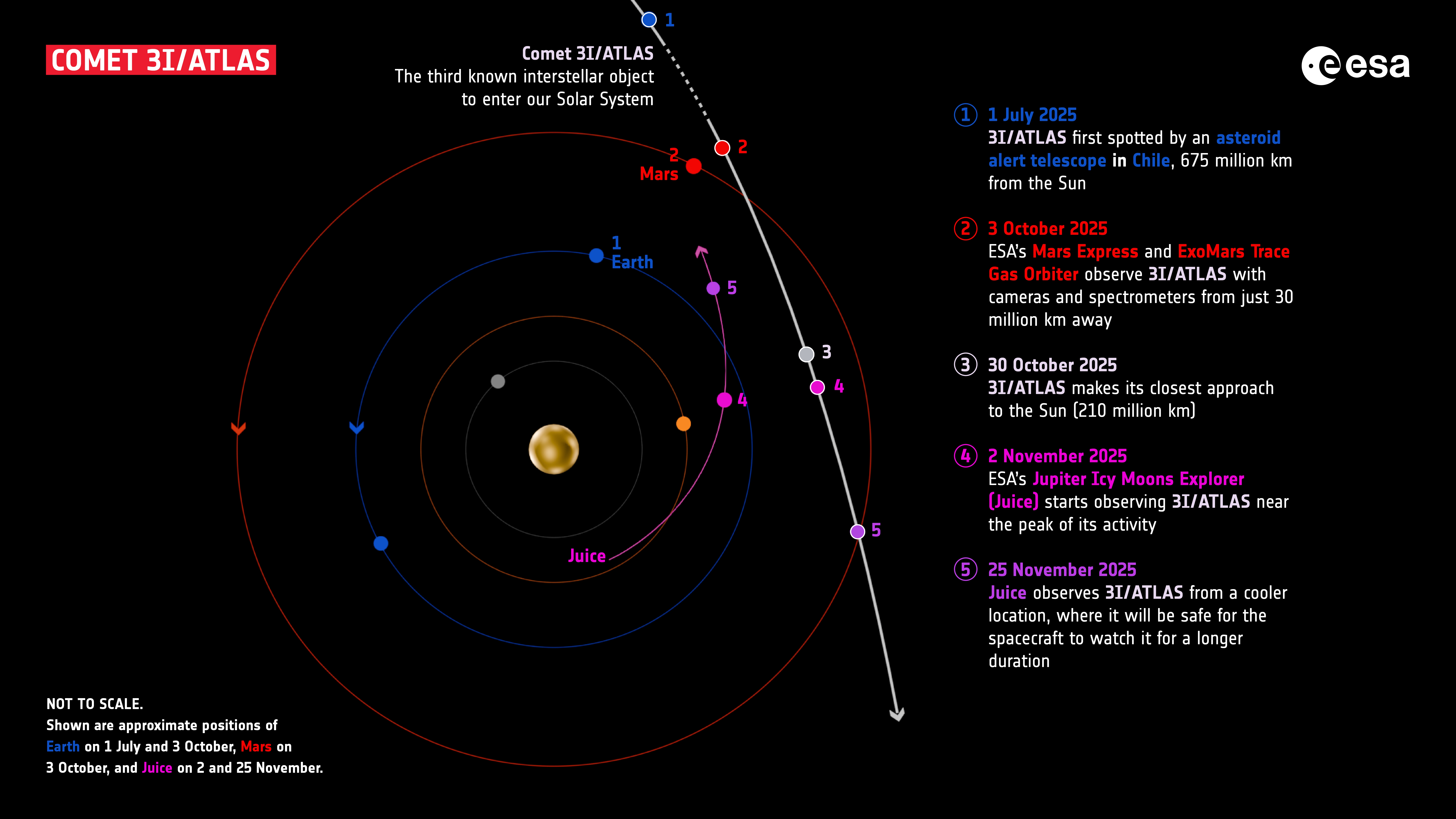
Juice is only well-positioned to check out 3I/ATLAS because it’s not on a direct route to Jupiter, instead having recently done a fly-by of Venus.
Image credit: ESA
Juice was launched in 2023, but revisited Earth’s vicinity 16 months later to gain speed, using a close approach to the Moon to pick up a little extra while it was at it. Juice is not done yet, however, with another scheduled close encounter with its home planet next year, before finally heading outwards, using Mars as the last stepping stone to its target. Once there, Juice will repeatedly use the gravity of Jupiter’s moons to adjust its speed relative to Jupiter.
NASA has demonstrated that so many assists are not strictly necessary. The Europa Clipper will make do with two (a completed one of Mars, and one of Earth in a year’s time). Yet the Clipper was launched after ESA’s Juice, and will get there first, all going well. That makes it seem like all these fly-bys, particularly the Earth-Moon double, are just showboating. However, the Clipper was launched aboard a rocket capable of giving it a much more powerful starting push.

Source Link: What Are Gravity Assists And Why Do Spacecraft Use Them So Much?
