The Earth’s Lagrange points are vital for the future of astronomy, possibly space exploration and some even say preventing a climate disaster. So what are they, how do they differ from each other, and how can they be used?
Newton’s most famous insight involved the fact that the same force that could make an apple fall to Earth could also keep the Moon in the sky, so long as it was moving fast enough. Under most circumstances, orbital speed is the only way to stop something in space from suffering the apple’s fate.
However, once you allow for the fact that the Earth’s gravity interacts with the Sun’s, it turns out there are places where stillness doesn’t mean crashing to Earth shortly after. At least if you define the lack of motion relative to Earth not the Sun.
At these locations the gravity of the Earth and Sun balance sufficiently that a low-mass object experiences little net force. The points are named after Joseph-Louis Lagrange, although Leonhard Euler beat him to the discovery of three of them, for his work describing them as the outcomes of the three body-problem where on body’s mass was trivial.
The points are usually known as L1 to L5, although as we will see only two of them really fit the usual designation of places something can be parked indefinitely.
L4 and L5, The Stable Lagrange Points
Had Euler and Lagrange not discovered them, we would have been alerted to the existence of the Lagrange Points L4 and L5 around Jupiter through the discovery of the Trojan Asteroids. That would probably have led to the realisation Earth has them to. The original Trojans sit 60 degrees ahead and behind Jupiter in its orbit, and in most cases have done so for millions or billions of years, although the term Trojan now covers asteroids at other planets’ Lagrange points.
The spacecraft Lucy is on its way to check Jupiter’s largest Trojans out, so we expect to soon know much more about the asteroids themselves, but their longevity proves L4 and L5’s stability. Without any impetus, space rocks that happen to wander into the Lagrange points’ vicinity, end up maintaining steady orbits almost indefinitely, at least if the Sun-planet mass ratio is large enough.
Jupiter does everything on a bigger scale than the other planets, and consequently there is much more room around the exact L4 and L5 spots where orbits are stable. Combined with proximity to the asteroid belt, this has provided Jupiter with a far more impressive set of Trojans than the inner planets.
Nevertheless, every planet other than Mercury has at least one Trojan, and the Earth has two that we know of.
Trojans occur because planets, particularly Jupiter, don’t orbit the centre of the Sun. Instead, they orbit what is known as the barycentre, a point that represents the two objects’ centre of mass.
The smaller planets’ barycentres lie within the Sun, indeed close to its core. The barycentre of the Sun-Jupiter system, however, is just outside the Sun, allowing for intriguing headlines about how Jupiter doesn’t orbit the Sun. Small objects with insignificant gravity of their own can orbit the barycentre, at the L4 and L5 points for the planet, whether it’s inside the Sun or not.
L1 and L2: The Important Lagrange points.
Between the Earth and the Sun there is a point where the gravity of the two combines so that objects there travel more slowly than would normally occur for an object at that distance. Consequently, it takes a full year to orbit the Sun, despite being at a distance normally associated with a shorter orbit, and it doesn’t speed ahead of the Earth.
This point is known as L1, and because the Sun’s gravity is so much greater than Earth’s it occurs about 1 percent of the way along a line from our planet to the Sun. That’s 1.5 million kilometres from the centre of the Earth.
There are no asteroids at L1 because this Lagrange point is not stable. Objects that stray a little way from the point gradually, and then more rapidly, move further from it as the forces stop cancelling out, rather than being drawn back to a stable point.
Nevertheless, spacecraft placed near L1 need to only adjust their positions occasionally, using tiny amounts of fuel, to work their way back when they drift away. This is a major contrast to a spacecraft located almost anywhere else, and has made L1 an ideal spot for a mission to study the Sun, while still remaining close enough to Earth to be able to continuously send back the data. Five existing instruments use the L1 vicinity, and NASA plans to put three more there this year.
People dreaming of a quick fix to climate problems have proposed placing thin shields or clouds of dust at L1 to stop a small portion of the Sun’s light from reaching Earth, balancing the warming effects of greenhouse gases. The practicality of this idea is questionable, to say the least, but variations reappear frequently.
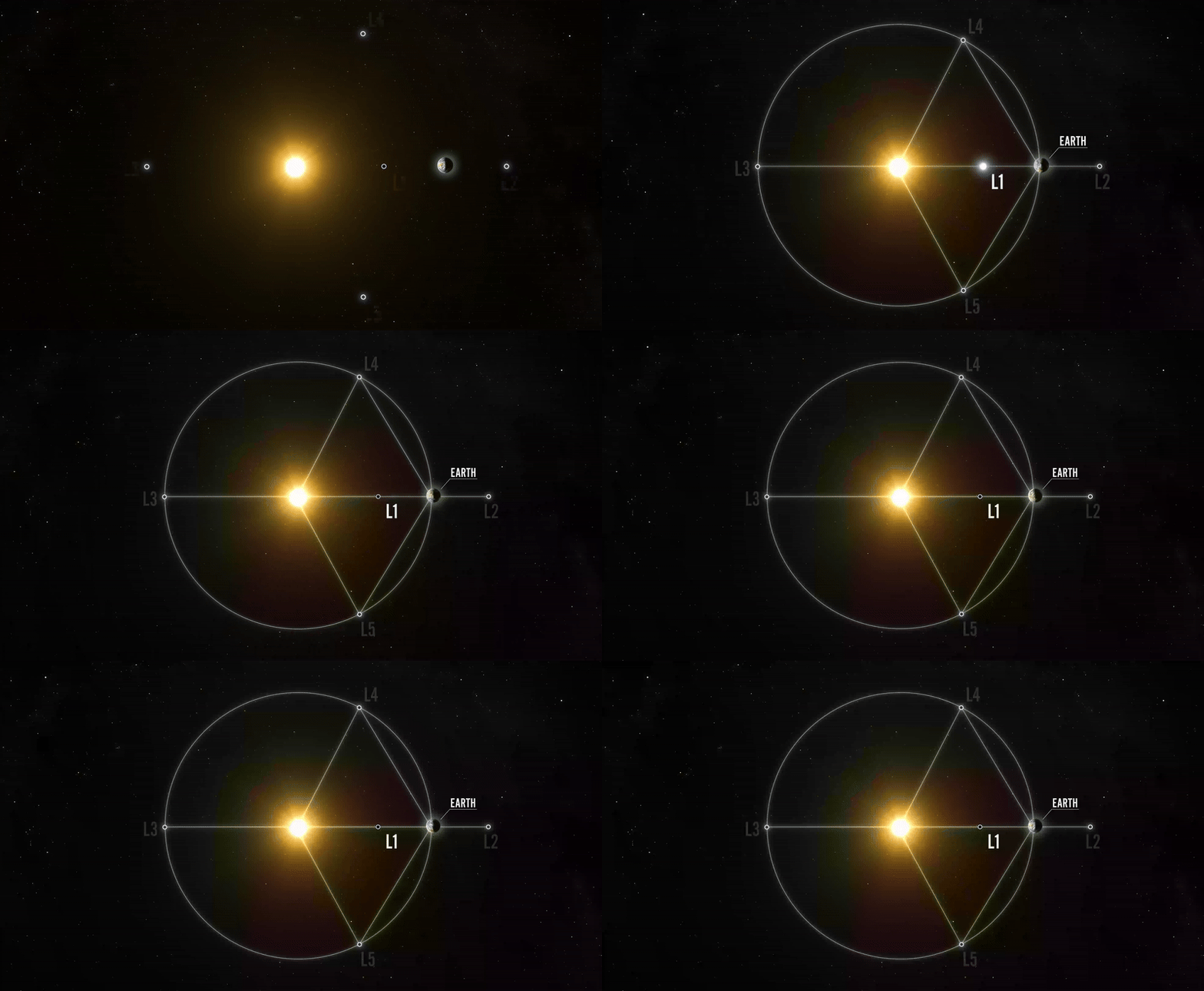
The locations of the Lagrange points for the Earth-Sun system, but other pairs of bodies have them in equivalent spots.
Image Credit: NASA
Directly on the other side of the Earth from the Sun lies L2. Here the addition of Earth’s gravity to that of the Sun makes an object orbit faster, so it also goes around the Sun in a year, rather than taking longer as objects further out normally do.
L2 became famous when the JWST was placed there. Technically the JWST doesn’t sit exactly in L2, but it takes advantage of the near-complete balancing of gravitational forces, available nearby. This means only occasional course corrections are required, and the small amount of propellant still available to the telescope could last a long time.
Other human-made occupants of L2 include the Euclid Mission and one day the Nancy Grace Roman Space Telescope.
By the way, moons have their own Lagrange points. As far as we know none have acquired their own mini-Trojans, but it has been suggested that the L1 of the Earth-Moon system is the best place to build a future giant spaceship to the stars.
L3 The Forgotten Lagrange Point
L3 sits on the other side of the Sun, directly opposite the Earth. Other than the subject of a modest 80’s hit song, this Lagrange point mostly attracts attention when conspiracy theorists dig up the idea that there is a counter-planet located there. Often it is suggested that said planet is populated by people with evil intent towards the Earth.
Prior to the development of space travel, there was no way to disprove the possibility of a planet at L3, since the Sun permanently blocks our view. However, there was also no reason to think such a planet existed. After all, if there was anything of more than trivial size at the L3 of any of the other planets, we’d have spotted it long ago, so why should Earth’s be different?
More recently, many spacecraft on missions to other planets have had plenty of opportunity to spot an object at L3 if it was there, and yet none have been detected. Of course, to the sort of people who believe things like this, that just indicates NASA is covering up its existence.

Source Link: What Are Lagrange Points, And Why Are They Important?
