 Is our universe all there is, or could there be more? Is our universe just one of a countless multitude, all together in an all-encompassing multiverse?
And if there are other universes, what would they be like? Could they be habitable?
This might feel like speculation heaped upon speculation, but it’s not as crazy as you might think.
My colleagues and I have been exploring what other parts of the multiverse might be like – and what these hypothetical neighbouring universes can tell us about the conditions that make life possible, and how they arise.
What-if universes
Some physicists contend that a burst of rapid expansion at the cosmic dawn known as inflation makes some form of multiverse inevitable. Our universe would really just be one of many.
In this theory, each new universe crystallises out of the seething background of inflation, imprinted with its own unique mix of physical laws.
If physical laws similar to ours govern these other universes, then we can come to grips with them. Well, at least in theory.
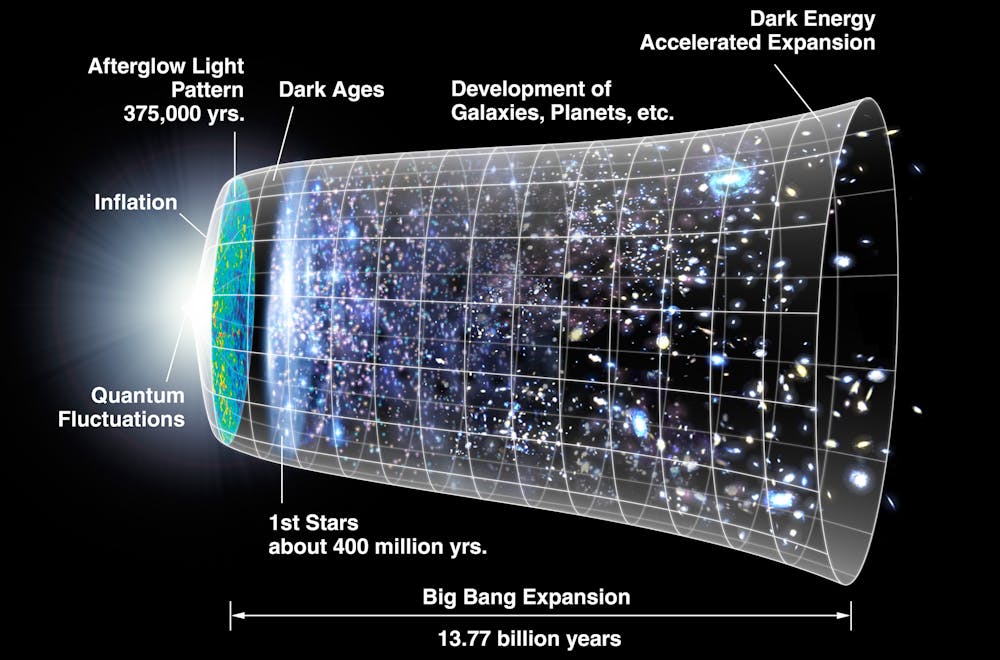
Within our universe, physics is governed by rules that tell us how things should interact with each other, and constants of nature, such as the speed of light, that dictate the strengths of these interactions. So, we can imagine hypothetical “what-if” universes where we change these properties and explore the consequences within mathematical equations.
This might sound simple, but the rules we tinker with are the fundamental makeup of the universe. If we imagine a universe where, say, the electron is a hundred times heavier than in our universe, then what would its consequences be for stars, planets and even life?
What does life need?
We recently tackled this question in a series of papers where we considered habitability across the multiverse. Of course, habitability is a complex concept, but we think life requires a few choice ingredients to get going.
Complexity is one of those ingredients. For life on Earth, that complexity comes from the elements of the periodic table, which can be mixed and arranged into a myriad of different molecules. We are living molecular machines.
But a stable environment and a steady flow of energy are also essential. It is no surprise that Earthly life began on the surface of a rocky planet, with an abundance of chemical elements, bathed in the light of a long-lived stable star.
Tweaking the fundamental forces
Do similar environments exist across the extent of the multiverse? We started our theoretical exploration by considering the abundance of chemical elements.
In our universe, other than primordial hydrogen and helium that were formed in the Big Bang, all elements arise through the lives of stars. They are either generated through the nuclear reactions in stellar cores, or in the supreme violence of supernovae, when a massive star tears itself apart at the end of its life.
All these processes are governed by the four fundamental forces in the universe. Gravity squeezes the stellar core, driving it to immense temperatures and densities. Electromagnetism tries to force atomic nuclei apart, but if they can get close enough, the strong nuclear force can bind them into a new element. Even the weak nuclear force, which can flip a proton into a neutron, plays an important role in the ignition of the stellar furnace.
The masses of the fundamental particles, such as electrons and quarks, can also play a pivotal role.
So, to explore these hypothetical universes, we have many dials we can adjust. The changes to the fundamental universe flow through to the rest of physics.
The carbon–oxygen balance
To tackle the immense complexity of this problem, we chopped the various pieces of physics into manageable chunks: stars and atmospheres, planets and plate tectonics, the origins of life, and more. And then we pinned the chunks together to tell an overall story about habitability across the multiverse.
A complex picture emerges. Some factors can strongly influence the habitability of a universe.
For example, the ratio of carbon to oxygen, something set by a particular chain of nuclear reactions in the heart of a star, appears to be particularly important.
Straying too far from the value in our universe, where there are roughly equal amounts of the two elements, results in environments where it would be extremely difficult for life to emerge and thrive.
But the abundance of other elements appears to be less important. As long as they are stable, which does depend on the balance of the fundamental forces, they can play a pivotal role in the building blocks of life.
More complexity to explore
We have only been able to take a broad-brush approach to unravel habitability across the multiverse, sampling the space of possibilities in very discrete steps.
Furthermore, to make the problem manageable, we had to take several theoretical shortcuts and approximations. So we are only at the first stage of understanding the conditions for life across the multiverse.
In the next steps, the full complexity of alternative physics of other universes needs to be considered. We will need to understand the influence of the fundamental forces at the small scale and extrapolate it to the large scale, onto the formation of stars and eventually planets.
A word of caution
The notion of a multiverse is still only a hypothesis, an idea that has yet to be tested. In truth, we don’t yet know if it is an idea that can be tested.
And we don’t know if the physical laws could be different across the multiverse and, if they are, just how different they could be.
We may be at the start of a journey that will reveal our ultimate place within infinity – or we may be heading for a scientific dead end.
Geraint Lewis, Professor of Astrophysics, University of Sydney
This article is republished from The Conversation under a Creative Commons license. Read the original article.

Source Link: What Are The Best Conditions For Life? Exploring The Multiverse Can Help Us Find Out
