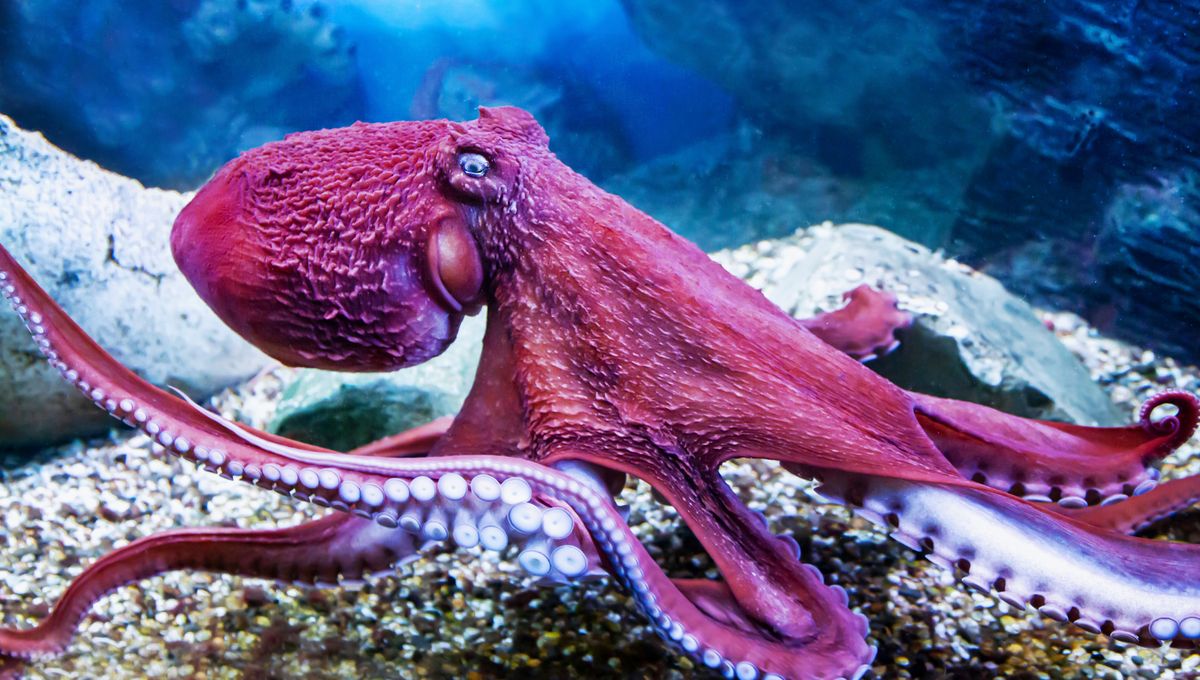
For evidence of evolution’s sheer barminess, look no further than the humble octopus. It’s boneless, beaked, and many-brained; it has blue blood, three hearts, and eight arms; it can change color and shape at will, and comes equipped with an ink sac for defense (or, presumably, calligraphy).
It is, in total, so weird that people have genuinely suggested it could be extraterrestrial in origin. And yet, despite being so very different from most every other form of life, it possesses a striking intelligence – one that can seem oh so familiar at times.
“I remember reading one [anecdote] about a lab where all the fish were going missing from their tank,” recalled Jon Ablett, senior curator of mollusks and cephalopods at the Natural History Museum, London in 2018. “The staff set up a little video camera and it turned out that one of the octopuses was getting out of its tank, going to the other tank, opening it, eating the fish, closing the lid, going back to its own tank and hiding the evidence.”
We know what you’re thinking: that’s cute, but nothing my dog can’t do. And sure, but octopuses can also do things like navigate mazes and use tools for shelter. They can learn skills just from watching someone else, and hold petty grudges against individuals even if those individuals aren’t other octopuses. They’ve built multiple entire octopus cities – albeit for a very liberal definition of “city”.
They are, in short, almost unbelievably intelligent. But as obvious as this braininess seems to us today, that wasn’t always the case. In fact, at one time, they were considered particularly stupid – and it was all thanks to one guy.
“The octopus is a stupid creature, for it will approach a man’s hand if it be lowered in the water,” declared Aristotle in his The History of Animals, written sometime in the fourth century BCE.
“The octopus as a rule does not live the year out,” he wrote. “It has a natural tendency to run off into liquid; for, if beaten and squeezed, it keeps losing substance and at last disappears. The female after [laying eggs] is peculiarly subject to this […] it becomes stupid; if tossed about by waves, it submits impassively; a man, if he dived, could catch it with the hand; it gets covered over with slime, and makes no effort to catch its wonted prey.”
It’s not exactly a ringing endorsement of what we now know to be a highly intelligent species – but, for a while at least, it caught on. It was repeated uncritically by Pliny some 400 years later, who at least generously admitted that “though [it] is in other respects deemed a stupid animal […] it has a certain kind of sense in its domestic economy.”
Here’s the obvious problem with Aristotle’s logic, though: that drive to investigate a human hand plunged into their environment? That’s curiosity – and today, it’s recognized as exactly the opposite of what Aristotle thought.
“Octopuses meet every criteria for the definition of intelligence,” wrote Lisa Poncet, a biologist in the laboratory of animal and human ethology (EthoS) at the University of Caen Normandie, in a 2021 article for The Conversation. “They show a great flexibility in obtaining information (using several senses and learning socially), in processing it (through discriminative and conditional learning), in storing it (through long-term memory) and in applying it toward both predators and prey.”
And one of the ways that intelligence manifests itself is in the creatures’ unquenchable curiosity: “[They] will spend their time catching hands, nets or any other object introduced to their tank,” Poncet explained.
“From there, it is up to them to decide when to release their catch,” she wrote. Not so stupid after all, hey, Aristotle?

Source Link: What Aristotle Got Wrong About The Octopus
