• Email Us: [email protected]
  • Contact Us: +1 718 874 1545
  • Skip to main content
  • Skip to primary sidebar

Medical Market Report

  • Home
  • All Reports
  • About Us
  • Contact Us

What Did People Think When They First Dug Up Dinosaur Fossils?

January 18, 2023 by Deborah Bloomfield

In 1822, Mary Ann Mantell was accompanying her husband, obstetrician and paleontologist Gideon Mantell, on a visit to a patient, when she noticed something shiny at the side of the road. Looking closer, she found large teeth embedded into the rock.

Her husband Gideon, in a major breakthrough, realized that the fossil belonged to a creature unknown to science, which he would later describe and name Iguanadon after their iguana-like teeth. Later, paleontologist Richard Owen examined a number of fossil sets and concluded that Iguanodon, Megalosaurus, and Hylaeosaurus fossils were from “a distinct tribe or sub-order of Saurian Reptiles” which he termed, rather catchily, “dinosauria“. 

Advertisement

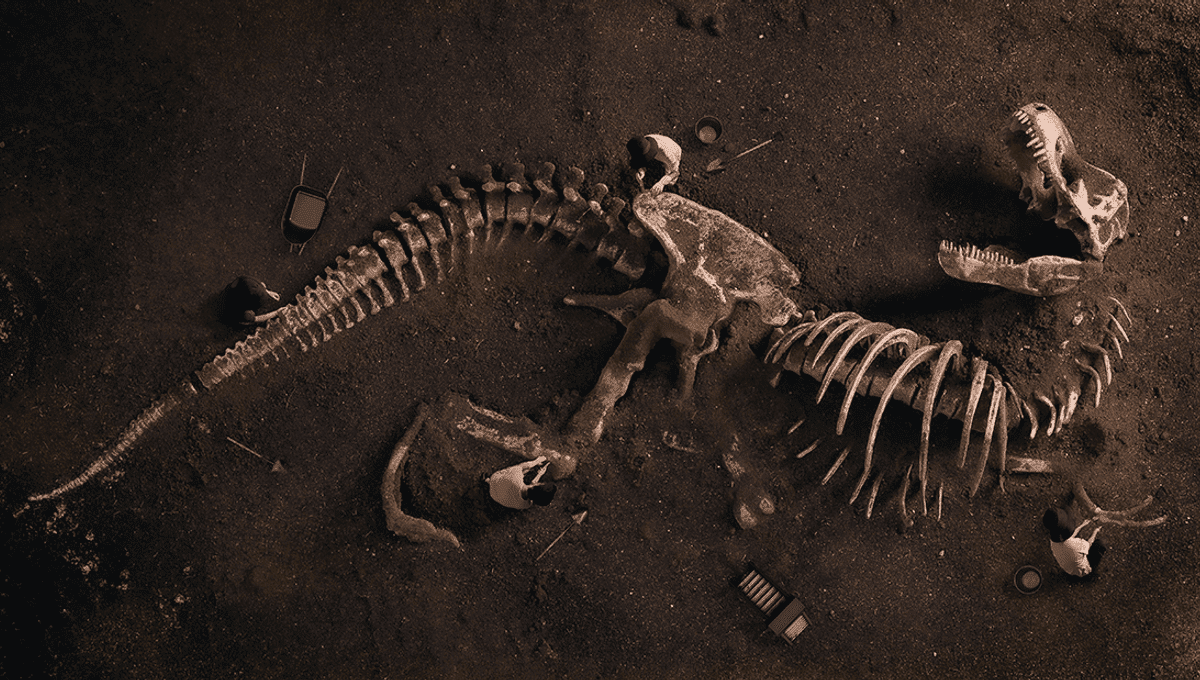
So that’s (roughly) how dinosaurs became recognized for what they were. But these finds were far from humankind’s first encounter with dinosaur fossils, which after all had been strewn around the Earth for hundreds of millions of years before any humans even bothered to show up.

Fossils have likely been discovered throughout human history, despite not being recognized for what they are until relatively recently. In fact, a Megalosaurus fossil was found in the mid-1600s, which at first was thought to be like a human femur, before being described by naturalist Robert Plot in 1677 as the bone of an elephant, brought over to England by the Romans. An illustration of the fossil caught the attention of English physician Richard Brookes, who in 1763 named the fossil scrotum humanum, looking at a fossil of an entirely new species of giant monster from millions of years ago and remarking at how it looks a bit like human testicles. 

Before we realized what dinosaurs were, discoveries of their bones were often attributed to giant versions of known animals, or giant humans. Long before that, it’s been suggested that dinosaur bones inspired the stories of griffins, giants, and dragons. 

Advertisement

Ancient Greek legends of griffins nesting near gold mines in the Gobi Desert, according to classical folklorist Adrienne Mayor, could be an attempt by people to explain fossils they had found there. Parts of the Gobi Desert were once home to a large number of fossils, with Protoceratops looking similar enough in appearance to the mythical creature. Fossils of dinosaurs, seen by a Chinese historian in the 4th century BCE, were labeled as dragon bones, while “dragon bones” were prescribed for ailments from madness to diarrhea. 

We may not have only been unearthing dinosaur bones for as long as we’ve been around, we may have been using them as an attempt to cure the runs.

Deborah Bloomfield
Deborah Bloomfield

Related posts:

  1. Norway coalition talks start, with climate and oil in focus
  2. Indonesian fintech Xendit is now a unicorn, with $150M in fresh funding led by Tiger Global
  3. U.S. Senator Cruz vows to block new Democratic debt ceiling ploy
  4. Yellen says U.S. may exhaust cash by Oct 18 barring debt ceiling rise

Source Link: What Did People Think When They First Dug Up Dinosaur Fossils?

Filed Under: News

Primary Sidebar

  • There Is A Very Simple Test To See If You Have Aphantasia
  • Bringing Extinct Animals To Life: Is Artificial Intelligence Helping Or Harming Palaeoart?
  • This Brilliant Map Has 3D Models Of Nearly Every Single Building In The World – All 2.75 Billion Of Them
  • These Hognose Snakes Have The Most Dramatic Defense Technique You’ve Ever Seen
  • Titan, Saturn’s Biggest Moon, Might Not Have A Secret Ocean After All
  • The World’s Oldest Individual Animal Was Born In 1499 CE. In 2006, Humans Accidentally Killed It.
  • What Is Glaze Ice? The Strange (And Deadly) Frozen Phenomenon That Locks Plants Inside Icicles
  • Has Anyone Ever Actually Been Swallowed By A Whale?
  • First-Known Instance Of Bees Laying Eggs In Fossilized Tooth Sockets Discovered In 20,000-Year-Old Bones
  • Polar Bear Mom Adopts Cub – Only The 13th Known Case Of Adoption In 45 Years Of Study At Hudson Bay
  • The Longest-Running Evolution Experiment Has Been Going For 80,000 Generations
  • From Shrink Rays And Simulated Universes To Medical Mishaps And More: The Stories That Made The Vault In 2025
  • Fastest Cretaceous Theropod Yet Discovered In 120-Million-Year-Old Dinosaur Trackway
  • What’s The Moon Made Of?
  • First Hubble View Of The Crab Nebula In 24 Years Is A Thing Of Beauty… With Mysterious “Knots”
  • “Orbital House Of Cards”: One Solar Storm And 2.8 Days Could End In Disaster For Earth And Its Satellites
  • Astronomical Winter Vs. Meteorological Winter: What’s The Difference?
  • Do Any Animal Species Actively Hunt Humans As Prey?
  • “What The Heck Is This?”: JWST Reveals Bizarre Exoplanet With Inexplicable Composition
  • The Animal With The Strongest Bite Chomps Down With A Force Of Over 16,000 Newtons
  • Business
  • Health
  • News
  • Science
  • Technology
  • +1 718 874 1545
  • +91 78878 22626
  • [email protected]
Office Address
Prudour Pvt. Ltd. 420 Lexington Avenue Suite 300 New York City, NY 10170.

Powered by Prudour Network

Copyrights © 2025 · Medical Market Report. All Rights Reserved.

Go to mobile version