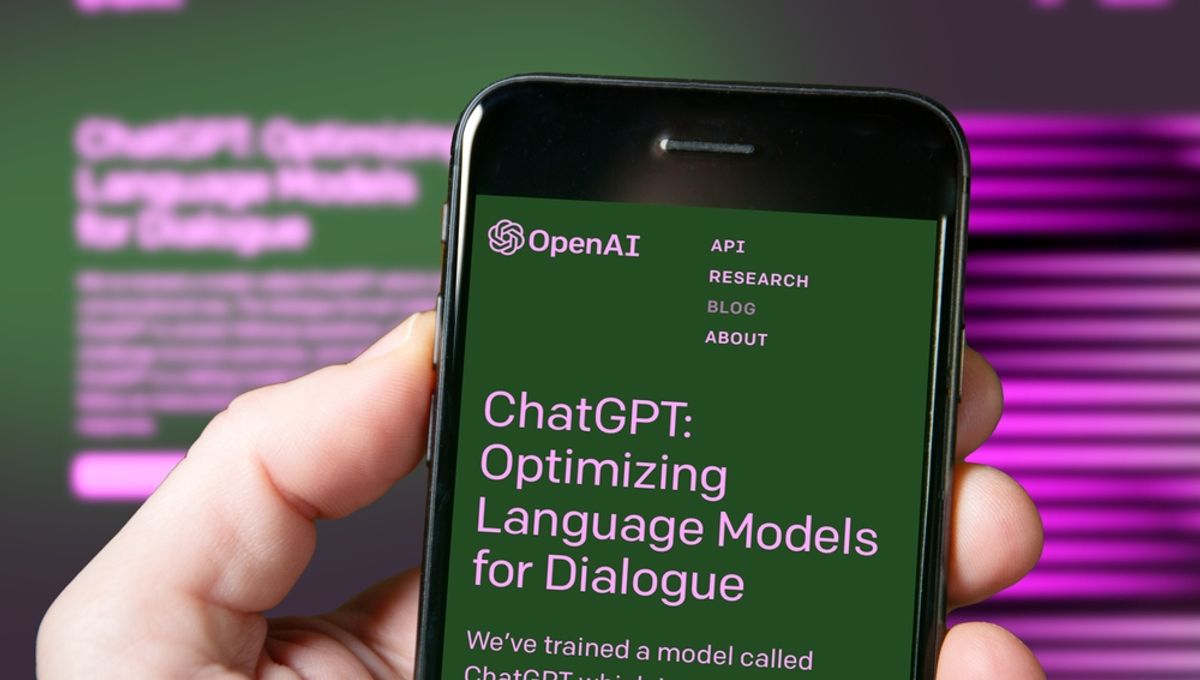
It’s hard to scroll through a news website and not see “ChatGPT” somewhere. Since being publicly released on November 20, 2022, the precocious chatbot has ranked 100 million monthly active users and has skyrocketed in some of Google’s most searched terms.
Despite its popularity, remarkably few people can tell you what the “GPT” in ChatGPT stands for off the top of their heads: it’s “Generative Pre-trained Transformer.”
Developed by OpenAI, ChatGPT is a computer program that uses artificial intelligence (AI) to have text-based conversations with human users. Ask it any question (within reason) or give it a request and ChatGPT will respond with a block of text that can feel remarkably natural and human-like.
More technically speaking, it’s a large language model-based chatbot, meaning it’s fed unbelievable amounts of text-based data – such as books, news articles, and web pages – from which it learns how to construct sentences.
It can be used for all kinds of purposes, such as writing computer code, serving as a virtual assistant chatbot, content generation, and even writing news articles (with mixed success).
With a healthy dose of irony, we asked OpenAI’s ChatGPT to give a breakdown of the term “Generative Pre-trained Transformer”. It replied:
“Generative Pre-trained Transformer” is a term that describes the key features and characteristics of the language model architecture. Let’s break down the meaning of each component:
1) Generative: In the context of natural language processing, “generative” means that the model is capable of generating new text that resembles human language. It can produce coherent and contextually appropriate sentences, paragraphs, or longer texts based on the patterns it learned during training.
2) Pre-trained: “Pre-training” refers to the initial phase of training the model on a large dataset containing vast amounts of text from the internet or other sources. During pre-training, the model learns to predict the next word in a sentence based on the preceding words. This process enables the model to capture the statistical patterns and relationships present in the data.
3) Transformer: The “Transformer” is a specific type of deep learning architecture introduced in the paper “Attention Is All You Need” by Vaswani et al. in 2017. It utilizes self-attention mechanisms to process input sequences in parallel, allowing the model to consider the importance of different words in the input when generating output. Transformers have become popular in natural language processing tasks due to their ability to handle long-range dependencies and their parallelization capabilities.”
Beautifully put, ChatGPT. Please don’t steal my job just yet.
Beyond OpenAI’s ChatGPT, there are a few other GPTs out there. There’s BloombergGPT, which uses similar AI technology to OpenAI’s ChatGPT but has been specifically trained on data related to finance and the financial industry. There’s also GPT-Neo, an open-source large language model inspired by OpenAI’s GPT-3.
For now, OpenAI and ChatGPT are the most recognizable names of the “Generative Pre-trained Transformer” field, but there are plenty of other companies vying to compete for the top spot.
All “explainer” articles are confirmed by fact checkers to be correct at time of publishing. Text, images, and links may be edited, removed, or added to at a later date to keep information current.

Source Link: What Does The "GPT" In ChatGPT Actually Stand For?
