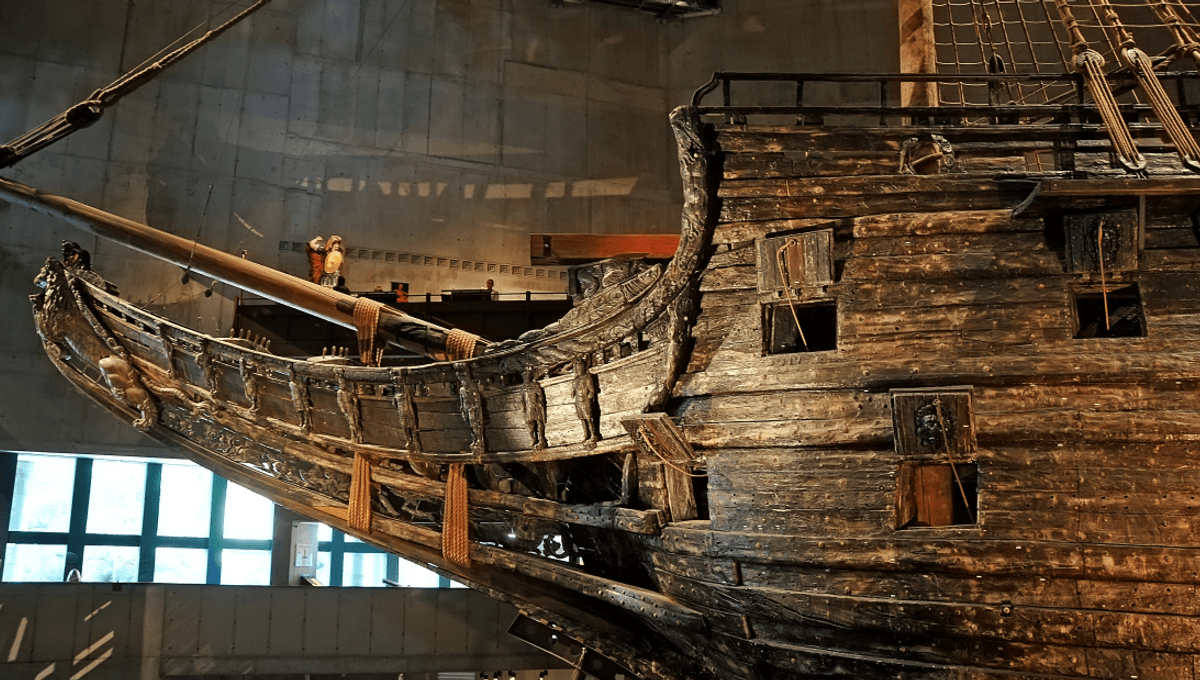
Ask someone to name a maritime disaster and chances are they’ll say Titanic, but compared to the Vasa, it did quite well. It took a several-ton iceberg to end the doomed Atlantic crossing, but for the Vasa, all it took was a bit of wind.
Thought to be the most expensive ship of its time, Vasa was to be the pride of the Swedish fleet and among the most powerfully armed vessels in the world. After many delays, it would finally embark on its maiden voyage on August 10, 1628. A journey that would be over in a matter of minutes.
Vasa set sail in the late afternoon in calm conditions. As it was passing Tegelviken, a gust of wind filled the sails, tipping it on its side. It wasn’t much, but it was enough for water to start gushing in through open gunports on Vasa’s lower deck.
The captain ordered that the gunports be closed, but it was too late. The ship was already sinking. It had sailed less than a nautical mile and, within a few minutes, was on the seabed 32 meters (105 feet) below the surface.
It’s thought there were around 150 people on board, 30 of whom died due to being trapped inside the ship. So, what was Vasa’s fatal error?
Why did the Vasa sink?
Vasa was designed by Henrik Hybertsson, an experienced shipbuilder with several warships already under his belt. At the time of Vasa’s creation, we didn’t have the calculations used today to ensure a ship’s safety before it sets sail, so we were often only learning of design flaws by the time large ships were on the water.
It’s thought that where Hybertsson went wrong was in building a hull that was too small below the waterline compared to the weight of the hull above it. It meant the ship was speedy but off balance with a high center of gravity that made it vulnerable to even light wind. There might have been time to correct the mistake had the gunports not been left open when Vasa set sail.
Raising the Vasa
It lingered on the seabed for centuries until marine engineer Anders Franzén rediscovered the wreck in 1956. He amassed a salvage team, and in 1961, the Vasa was raised 333 years after it sank.
Some creative suggestions were put forward as to how it could be raised from the seabed, including filling the hull with ping pong balls, but in the end, it was achieved with a combination of high-pressure water jets, pontoons, and steel cables. It was a lengthy process lasting several years, but on April 24, 1961, the Vasa was finally out of the water.
We’ve learned from submerged cities that cold water is great for preservation, and despite being full of mud, the Vasa was in remarkable condition. Much of the ship’s exterior, including its sails, remained intact and can be seen today at the Vasa Museum, where the ship is stored (the only place in the world you can explore a preserved 17th-century ship).
On board, the skeletons of at least 17 people were found along with over 40,000 objects, including cannons, coins, and musket shot. Other remains were found where Vasa sank on the seabed, and a lengthy multi-disciplinary project has been underway ever since to marry up the bones and restore their identity.
The wood of the ship has been treated with a kind of wax that’s common in lipstick, but there are still concerns for its survival, as its wood was found to have weakened by as much as 80 percent since it was raised. The race is on to find a way to preserve it, but you can explore Vasa in its entirety in a fantastic series put together by the Vasa Museum.

Source Link: What Happened To The Vasa? Arguably The Least Successful Ship In History
