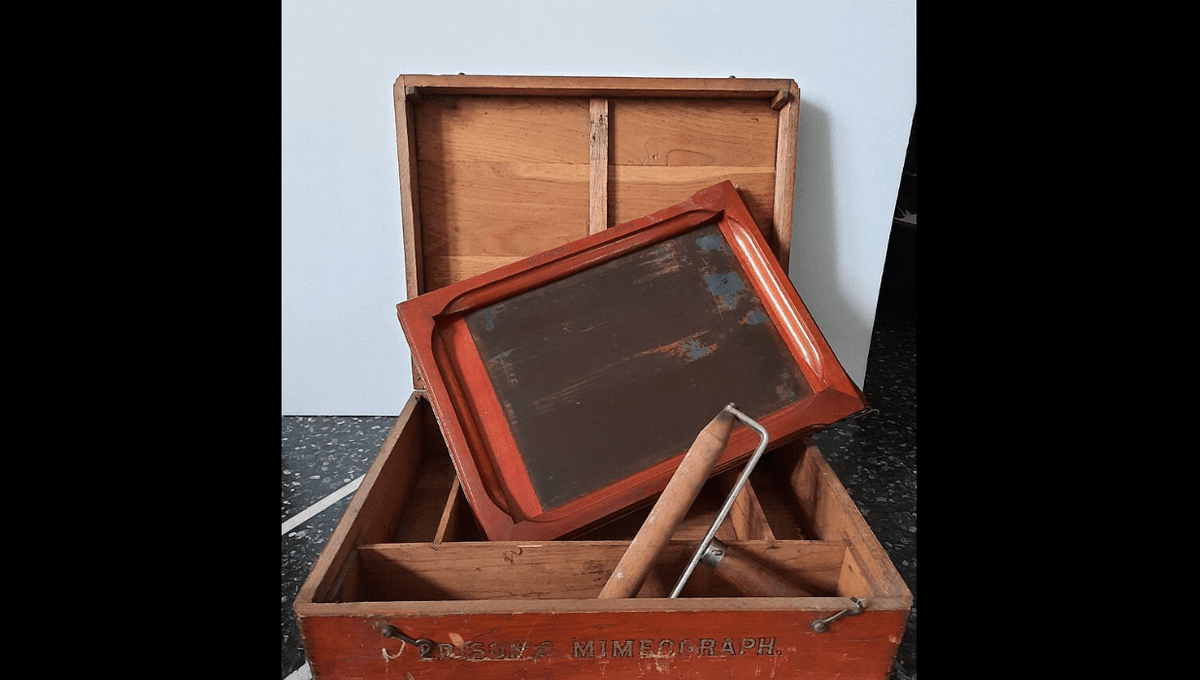
Have you ever heard of a mimeograph machine? Unless you’re reasonably old or have a particular interest in the ways people used to duplicate information, we wouldn’t be surprised if you hadn’t – but it made a particularly big mark (or perhaps, ink splatter) on the history of printing.
What is a mimeograph and how does it work?
For those wondering what on Earth a mimeograph machine is, it was, in essence, the forebear to the modern-day photocopier – people used it to make copies of written information using good old ink, paper, and a stencil.
With either an electric pen, as it first started out, or with a typewriter, the desired information was etched out onto a blank stencil. The stencil could then be inserted into an ink press with a blank piece of paper, pushed down, and the ink would then be pushed through onto the paper below, making a copy of whatever was crafted into the stencil material.
Who invented the mimeograph machine?
The first person to file a patent for a version of the mimeograph machine in the US was the infamous American inventor and businessmen Thomas Edison, who did so in 1876. This first iteration of the machine involved using an electric pen to cut the stencils, followed by the use of a flatbed ink press.
Edison’s work was then built upon by fellow inventor Albert Blake Dick, who made improvements to the stencils by making them out of waxed paper, patented it, and released what he named the Edison Mimeograph in 1887.
Over the years, others also made improvements to the process, such as swapping the flatbed duplicator for a rotating cylinder – which could feature a motor or a hand-crank – with an automatic ink feed. Later versions were also capable of using typewriters to cut out the stencils.
Was the mimeograph machine popular?
The mimeograph machine took off in popularity because for one, getting your hands on one of the machines was more affordable, and thus accessible to far more people, than going to a print shop to get copies made, or persuading one of the big-name presses to do it for you. Back in 1950, a mimeograph machine cost somewhere between $50 to $100, about $600 to $1,300 in today’s money.
It was also relatively easy to use, and it could make copies quickly, sparking the wider production of handmade poetry books and zines. “It’s not so much different from blogging or tweeting now,” Kyle Schlesinger, a typography professor at the University of Houston-Victoria told National Geographic.
Mimeography is now used far less in a day and age where many people have photocopiers and printers in their homes, but hey, maybe when your printer stages a protest for the fifth time in a week, it might be worth considering.

Source Link: What Is A Mimeograph Machine?
