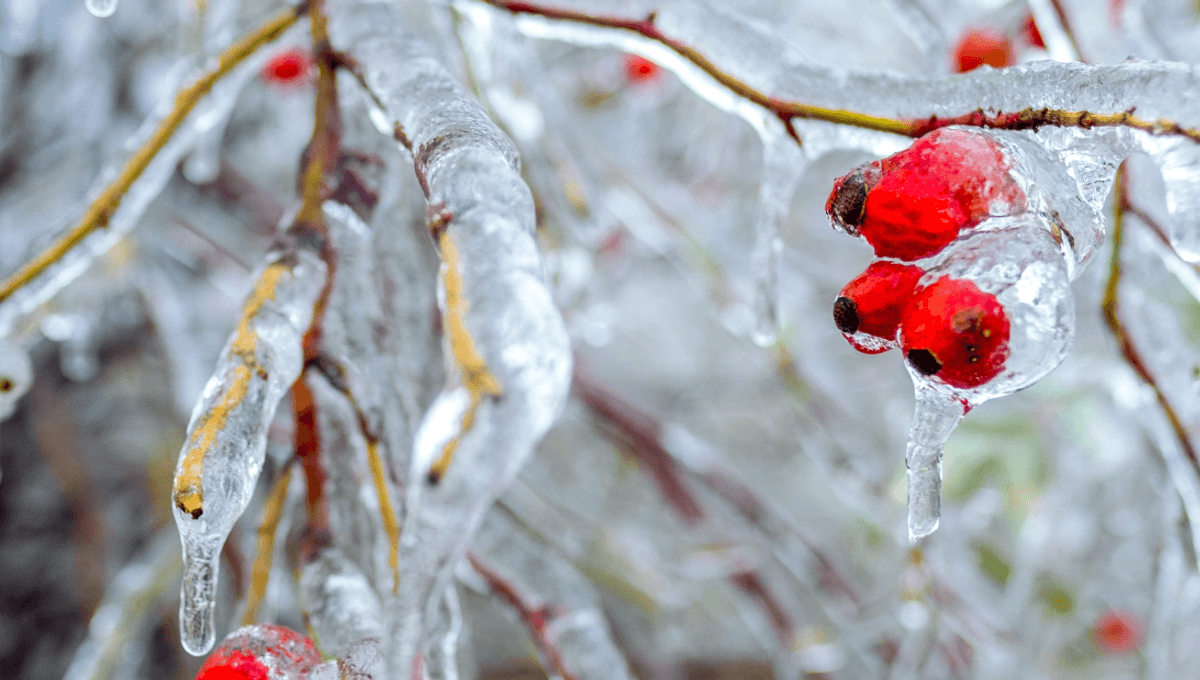
Winter is hard work, but it’s also bloody beautiful. Hair ice, Moon bows, and those peculiar ice pancakes – it all gets a bit wacky when the temperature drops, but my most recent obsession is glaze ice.
If you’ve ever seen a branch locked inside a crystal-clear popsicle, then congratulations, you’ve seen glaze ice. It can form around berries, flowers, branches, and leaves. It’s incredibly beautiful in botanical settings, but it’s also considered to be the most dangerous form of ice by land, sea, and air. So, what is it?
What is glaze ice?
Glaze ice is a crystal-clear coating of ice that forms when a supercooled droplet (or “freezing rain”) solidifies around an object. It occurs when pockets of air closer to the ground are colder than pockets of air above it. As rain moves from the warmed air to the colder air, it gets supercooled without freezing. That is, until it lands on something that’s below or slightly above freezing and it forms this glaze.
Glaze ice is also known as clear ice and that crystal-clear reputation is a direct result of how it freezes. Firstly, it freezes slowly, with only small parts of the supercooled droplet freezing on impact. The rest of the water then spreads out and mixes with other droplets until they also freeze, creating thin layers of compact ice with no air bubbles trapped inside.
As a reminder, a big part of the reason some ice or snow looks white is to do with air bubbles (although snow does sometimes look blue, why is that?), and a lack of air bubbles also explains why glacier caves are so blue. Air bubbles weaken ice, which is why glaze ice is strong, heavy, and very dangerous.
Why is glaze ice so dangerous?
Small amounts of glaze ice on trees aren’t cause for concern, but as it gathers, it gets heavier and has been known to break off large tree limbs. These falling limbs can disrupt powerlines, but glaze ice can also form around the powerlines themselves, causing outages and blackouts.
Glaze ice is responsible for that dreaded “black ice” that road users fear. It’s particularly hazardous because it’s hard to see, but it makes its presence very known when you try to walk or drive on it. Unlike snow, glaze ice has no traction, so conditions are slippery in the extreme. Storms that trigger glaze ice formation are often associated with an uptick in ER visits as people get into road accidents and fall over.
For aircraft, glaze ice can form around the wings of a plane, resulting in loss of lift, an increase in drag, rapid weight changes for the aircraft, and disruptive vibrations. This all threatens the plane’s stability, which is why they have built-in de-icing technologies and treatments to prevent build-up on the aircraft.
Glaze ice can even impact ships and is considered a significant maritime hazard as it can rapidly alter the weight distribution of a vessel and increase the risk of capsizing and sinking. When there’s freezing spray in the air, glaze ice can quickly lock up critical equipment, as well as glue on to the edge of the vessel if steps aren’t taken to prevent build-up.
So, don’t be fooled by glaze ice’s beauty. Yes, it makes even a blade of grass look like a beautiful piece of popsicle art, but if glaze ice is forming, you probably want to be safe at home on the sofa.

Source Link: What Is Glaze Ice? The Strange (And Deadly) Frozen Phenomenon That Locks Plants Inside Icicles
