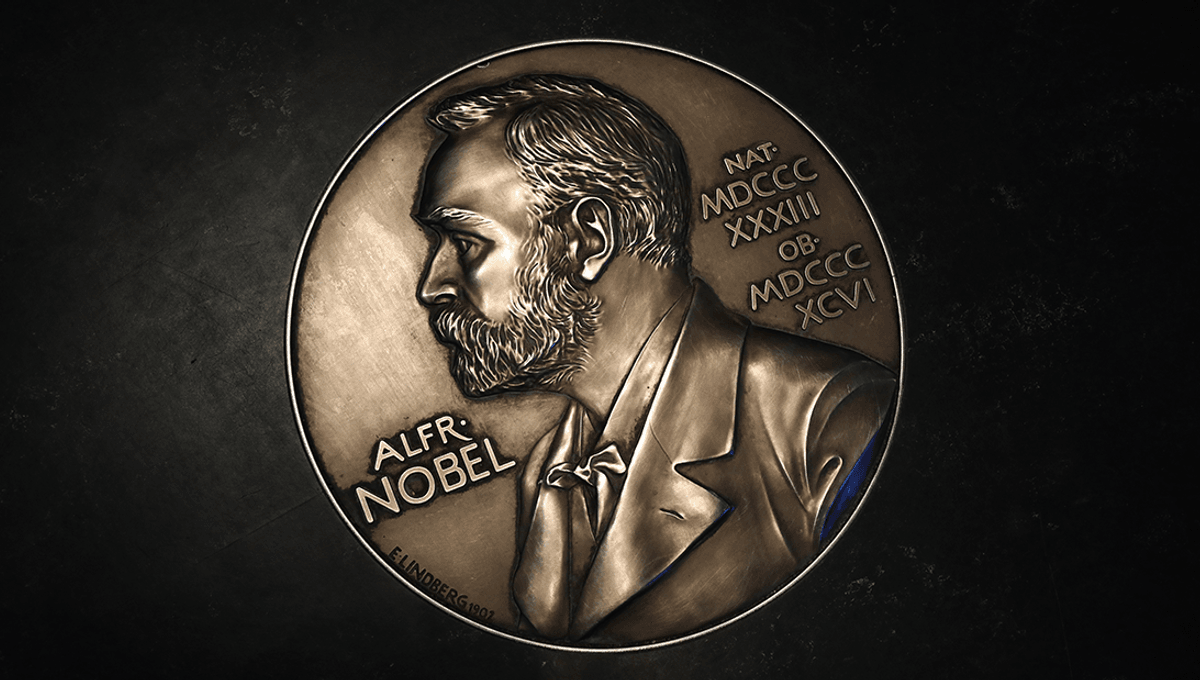
Albert Einstein, recipient of the Nobel Prize in physics for his work on the photoelectric effect and the great physicist behind general and special relativity, once said: “The exaggerated esteem in which my lifework is held makes me very ill at ease. I feel compelled to think of myself as an involuntary swindler.”
Given his great achievements in physics, he may have been suffering from imposter syndrome; the feeling that you are incompetent or a fraud, while everyone else around you is there on their own merit.
While reassuring that even Einstein felt like this, other Nobel Prizewinners have not responded in the same manner to recognition of their own achievements. In fact, there’s a term called “Nobel disease” or sometimes “Nobelitis” to describe the sometimes wacky and unscientific views that Nobel Prizewinners have gone on to develop, following their win.
There’s a surprisingly long list of Nobel Prizewinners who have expressed pseudoscientific beliefs after their win, usually straying away from their field of expertise. These include scientists, noted in their field, who went on to develop interests in psychic research, extrasensory perception, and one winner who believed he had been visited by a talking, motorcycling, glowing green raccoon.
In one chapter of the book Critical Thinking in Psychology, researchers listed a number of such cases. While some developed mundane and grim pseudoscientific beliefs, such as James Watson’s widely debunked beliefs regarding race and intelligence, many developed much more “fun” versions of “Nobel disease”.
Pierre Curie, for instance, won the Nobel Prize in physics for the discovery of radium and polonium, before going on to participate in seances and believing that investigating the paranormal could help us answer questions about magnetism. As if Casper didn’t have enough on his plate, now he’s got to manage all the magnets. Joseph Thomson, who won the same Prize for his discovery the electron, developed a similar interest in psychic phenomena and was a member of the Society for Psychical Research for 34 years.
Charles Richet, who won the Prize in physiology or medicine in 1913, meanwhile, is the man responsible for the word “ectoplasm”, which he believed could be expelled from mediums during seances. In reality, any essence being produced is merely a trick by mediums. One medium, Helen Duncan, would swallow a line of cheesecloth and then regurgitate it on demand, sometimes attaching rubber gloves or magazine portraits to it to make it look spookier. A trick, you’d hope, which would not get past someone with a Nobel Prize in medicine.
Sometimes the “disease” can be harmful. Richard Smalley, who won the Prize in chemistry for discovering a third form of carbon in 1996, went on to argue against evolution, while others have advocated in favor of eugenics, lobotomies, and harmful practices and ideas around autism.
Then there was Dr Kary Mullis, who won a share of the 1993 Nobel Prize in chemistry. Following his win, he expressed skepticism about climate change, and the role of HIV in AIDS, as well as belief in the heavily debunked idea of astrology. As well as this, he claimed that he saw a glowing racoon which talked to him.
“I encountered a glowing green raccoon riding a neon orange motorcycle at my cabin in the woods of northern California around midnight one night in 1985,” Mullis once reportedly said. “The raccoon proceeded to metamorphose into a singing dolphin at the stroke of midnight.”
So, why do so many Nobel Prizewinners end up with such pseudoscientific beliefs? According to one winner, Paul Nurse, it could partly be to do with external pressure from the media and other groups, urging Prizewinners to step outside of their area of expertise.
“In the eyes of many people, I had suddenly become a world leading expert on almost everything. This was rather a shock. It is not that I am an overly modest person and I do know something about biology and science more generally, but an expert on everything, assuredly I am not,” Nurse explained in a piece for the Independent advising other Prizewinners to stay clear of this path.
“You will be inundated with requests to comment on a wide range of issues, to sign letters and petitions and to generally lend your name to causes, some noble, other less so,” he added. “But do not be tempted to stray too far from your specialist knowledge or from science more generally.”
In their review of Prizewinners, the team above had their own suggestion.
“A number of cognitive errors, including bias blind spot and the senses of omniscience, omnipotence, and invulnerability; personality traits such as narcissism and excessive openness; and the ‘guru complex’ may predispose highly intelligent individuals to disastrous critical thinking errors,” the team wrote, citing, as well as many Prizewinners, Isaac Newton’s love of alchemy and strange religious beliefs.
While this is an interesting idea, they point out we do not have any data on whether Nobel Prizewinners are more inclined to such pseudoscientific beliefs. Though interesting that Nobel Prizewinners are not immune to such thinking, don’t put off your prizewinning research – it is not a real disease.

Source Link: What Is "Nobel Disease", And Why Do So Many Prizewinners Go On To Develop It?
