Have you ever wondered what the heaviest object in the universe is? Unfortunately, it’s not a question that is really possible to settle, but we can give you an answer, or answers, to a very similar one: what is the most massive object known?
The reason we’ve shifted from seeking the heaviest object to the most massive one is that mass is an intrinsic property. Heaviness is usually understood as a measure of weight, which depends on the gravitational field an object is in. Candidates for the heaviest objects might be something massive falling into a black hole and experiencing the immense fields in its vicinity, but they wouldn’t last long and our knowledge of them is limited.
The most massive object is more realistically measurable, but still depends quite a bit on your definition.
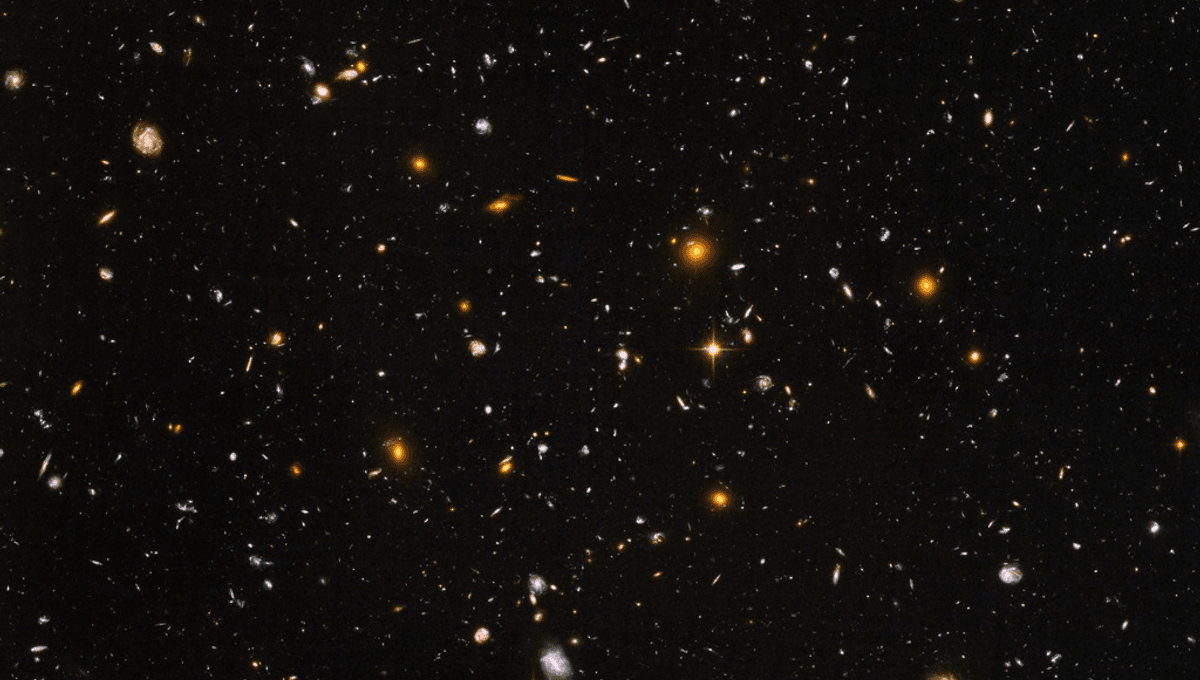
The universe contains objects so massive they are well beyond our comprehension, and any record we find is likely to be exceeded as more powerful telescopes peer ever further away.
Black holes are one example of truly massive objects – they’re certainly the densest. The very name of supermassive black holes at the core of galaxies is a bit of a clue that these are candidates to consider.
At the heart of the Milky Way lies Sagittarius A*, with a mass around 4 million times that of the Sun. That, however, is puny compared to the recently imaged, and reimaged, M87*, whose mass is around 1,000 times greater, despite lying in a galaxy only about twice as massive as our own.
Even M87* however, is overshadowed (if that is the right word for an object light can’t escape) by Phoenix A, rated the most massive black hole in a 2016 survey that doesn’t seem to have been beaten. Indeed, the estimated 100 billion solar masses given in that study may even exceed the theoretical limit for black hole size.
As a sidenote, if you’re wondering how we know the masses of objects 8.6 billion light-years away (or even just 50 million light-years in M87*’s case) we can measure the speeds of objects orbiting them, or measure the rate at which they are feeding on surrounding gas.
So, case closed? Well, not necessarily. Because all these black holes are in galaxies that are, by definition, much larger and more massive than the holes at their core. You can regard a galaxy as a collection of stars, planets and black holes that happen to be grouped together, or you can see them as a single object. In the latter case then even our own Milky Way, at about 800 billion solar masses, contains far more mass than any black hole we know, or are ever likely to find.
Measuring the mass of galaxies is harder than for compact objects like black holes. NGC 4889 is regarded as the likely candidate for the most massive galaxy within 300 light-years of Earth, but estimates range from 8 to 15 trillion solar masses. There’s even more uncertainty for more distant galaxies.
Even that, however, may not be the end of the question. If a galaxy counts as an object, what about a collection of galaxies, like the Local Group that contains the Milky Way, or the Virgo Cluster? The entire Local Group almost certainly has less mass than NGC 4889, but galaxy clusters can include hundreds of galaxies, including some very big ones.
If your definition of “object” extends to galactic clusters, then what about the vast filaments that stretch across the cosmos like strands of a web? Perhaps the largest of those deserves to win our title.

Source Link: What Is The Heaviest Object In The Universe?
