Although Uranus and Neptune are full of gas, their compositions have important differences from Jupiter and Saturn, while being quite similar to each other. Planetary scientists are keen to send a spacecraft to at least one of them, but the funding is uncertain, and it will take many years to get there even if approved. In the meantime, the European Space Agency (ESA) has attempted to replicate their atmospheres to simulate what a probe would experience on entering either Ice Giant’s atmosphere.
Like their larger counterparts, Uranus and Neptune are composed primarily of hydrogen and helium. However, while their methane concentrations are low (2.3 and 1.5 percent respectively) they’re 3-8 times higher than those the Galileo and Cassini spacecraft encountered on entering Jupiter and Saturn. All other gasses are trace.
In the near future at least, any mission to either ice giant is likely to be led by NASA, but the ESA is keen to participate.
At the hypersonic plasma T6 Stalker Tunnel at Oxford University and the High Enthalapy Flow Diagnostics Group’s plasma wind tunnels at the University of Stuttgart, suitable gasses were fired at a solid object, producing these images.
The shapes chosen are likely intended to model what a future spacecraft might look like when it takes its final dive, not something designed to appeal to those already amused by one planet’s name.
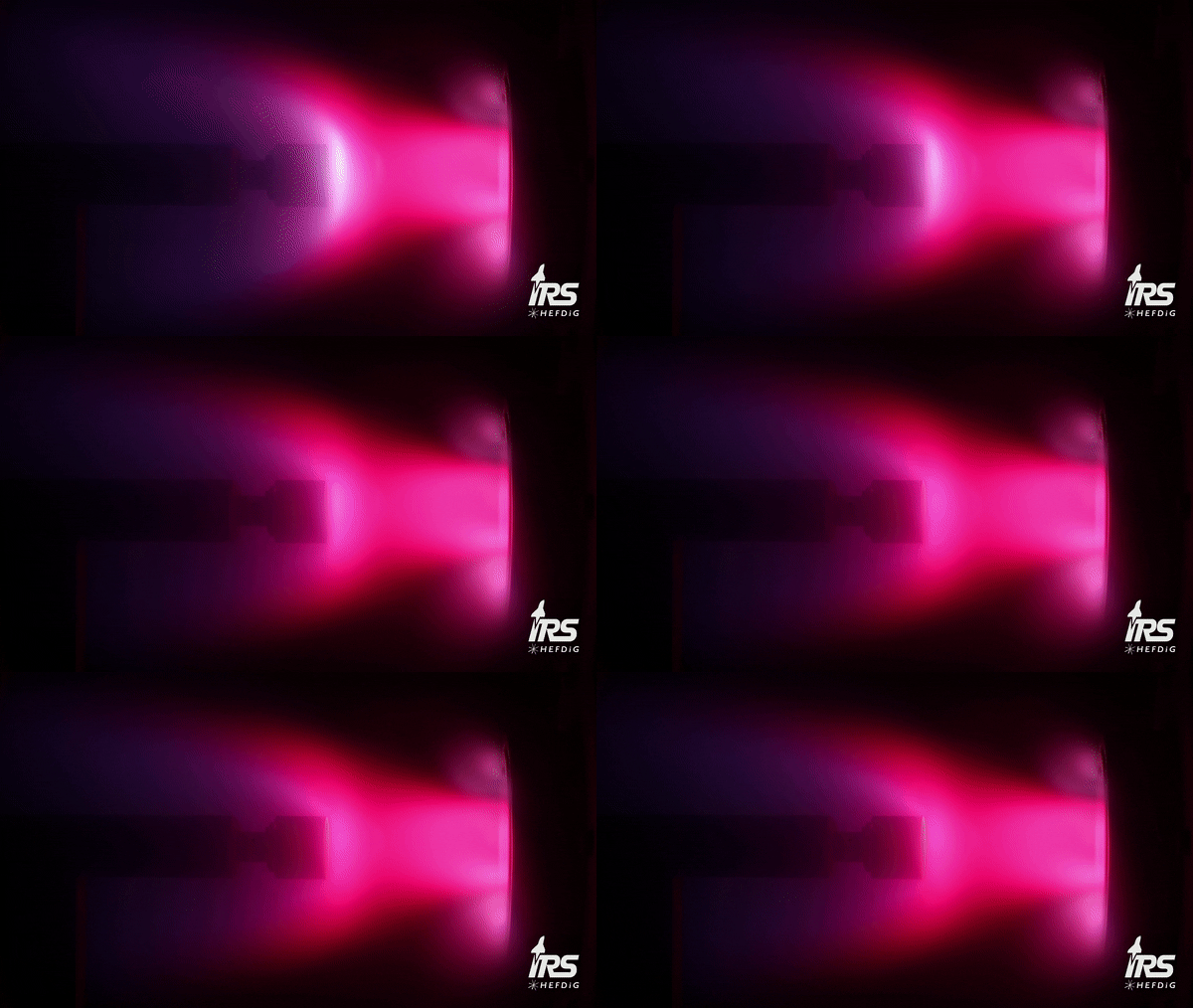
A wind tunnel reveals the heat experienced when a model space probe experiences the shock of encountering Uranus or Neptune’s atmosphere.
Image Credit: University of Stuttgart’s High Enthalpy Flow Diagnostics Group
Along with their outer gasses, Uranus and Neptune are believed to have giant oceans of supercritical liquids. No probe will last long inside, just as Cassini didn’t on encountering Saturn, but we want the craft to survive as long as possible to maximize the information it can obtain.
“The challenge is that any probe would be subject to high pressures and temperatures, and therefore would require a high-performance thermal protection system to endure its atmospheric entry for a useful amount of time,” said ESA’s Louis Walpot in a statement. “To begin designing such a system we need first to adapt current European testing facilities in order to reproduce the atmospheric compositions and velocities involved.”
Walpot previously noted; “The aim of the activity was to adapt current ground-based facility to simulate relevant H2/He/CH4 atmospheric condition on the probe in ground test facilities, which were not yet available in Europe and no plasma facility exists to simulate a H2/He/CH4 environment.”
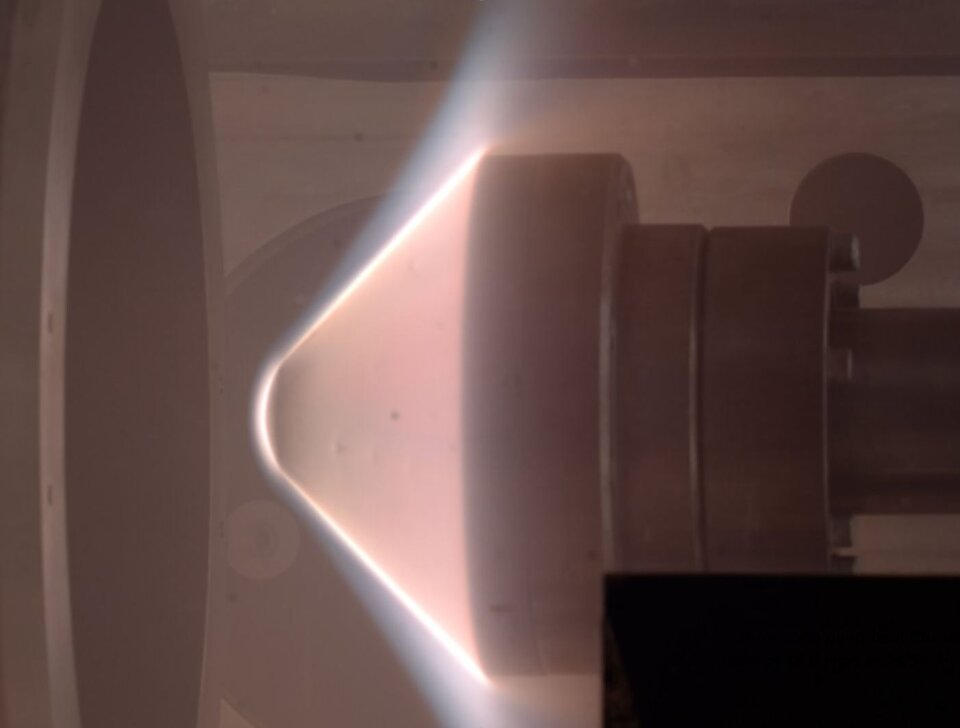
A scaled-down model of the Galileo probe that entered Jupiter going into an atmosphere more like Uranus or Neptune
Image Credit: University of Oxford
Unless substantially altered by rockets – which would mean carrying a lot of extra fuel – a future spacecraft would enter either planet at close to its orbital speed, or about 24 km/s (54,000 mph). Neither facility has been able to reach that yet. However, by pushing the plasma past the model probe at 19 km/s (43,000 mph) the research team is getting close.
The facility can measure the heat the probe experiences both from convection and radiation. The experiments revealed that even small amounts of methane change the radiation spectrum around the region experiencing the shock compared to conditions dominated by hydrogen and carbon.

Source Link: What It Looks Like To Fall Into Uranus (Or Neptune)
