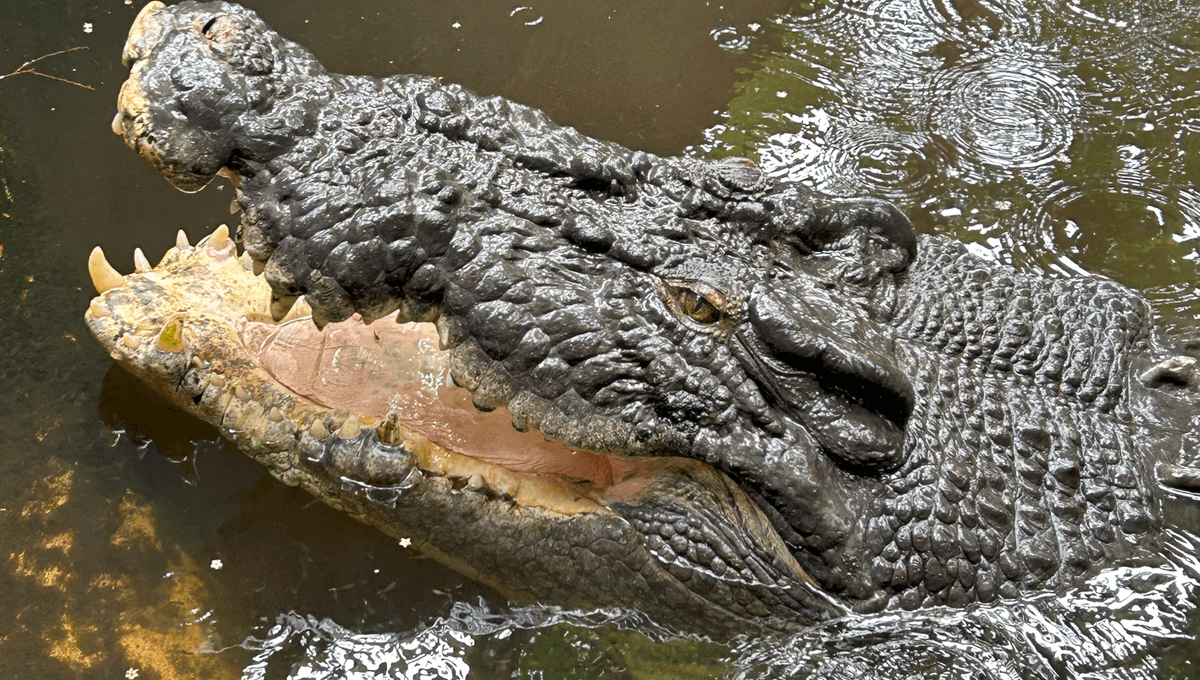
Cassius the crocodile cheated death for more than a century until his wild life finally caught up with him last year in Australia. Now, experts dealing with his necroscopy have revealed what ultimately led to the giant’s demise.
The 5.5-metre (nearly 18-foot) saltwater crocodile died in November 2024 at the Marineland Melanesia wildlife park on Green Island off the coast of Cairns, where he had been housed for four decades. At the grand age of around 110-120, he was one of the oldest known crocodiles in captivity.
Strangely enough, the world-famous reptile had been given the all-clear just a few weeks before his death by veterinarians, who noted he appeared “bright, alert and happy”. Then, out of the blue, he passed away.
Speaking to ABC News, the Darwin-based Centre for Crocodile Research says its necropsy revealed that Cassius died of an infection related to an injury he had suffered in the wild more than 40 years ago.
The injury triggered an infection that became sealed inside a tough fibrous capsule, lying dormant for decades. Over time, that protective bubble broke down and eventually ruptured, allowing the infection to swarm through the crocodile’s body.
Dr Sally Isberg, Managing Director at the Centre for Crocodile Research, told the media outlet that while so-called fibriscesses are “well-documented” in crocodiles, Cassius’ case was extraordinary due to how long the infection was contained.
With further snooping, the team concluded that the hidden infection may have been linked to an injury sustained in the 1980s when Cassius was struck by a boat propeller, resulting in the loss of his front left leg, part of his snout, and the end of his tail.
“What we didn’t know was that the rib cage had also been damaged in that injury,” said Dr Isberg.
“The reason was that everything was perfectly healed — there were no signs of infection or recent scarring. Upon necropsy, his left rib was distended compared to his right one, so longer,” she added.
“This is a perfect example of the effect of old age — he was no longer able to continue that fibrous casing around that infection.”
Cassius was captured in 1984 in the Finniss River near Darwin and transported by road and boat, eventually arriving at Marineland Melanesia in 1987. Owing to his size and power, he was named after Cassius Clay, the birth name of boxer Muhammad Ali.
He was recognized as the world’s largest captive crocodile for some time, according to Guinness World Records, although the title was snatched by an even larger individual called Lolong in 2012.
But the legacy of Cassisu lives on. The taxidermied body of the Aussie beast (still missing its left leg and tail tip) has just arrived home to Marineland Melanesia, where it is now on display at a new exhibition.

Source Link: What Killed One Of The World's Biggest Crocs? A Necropsy Of Cassisus Suggests A Hidden Killer
