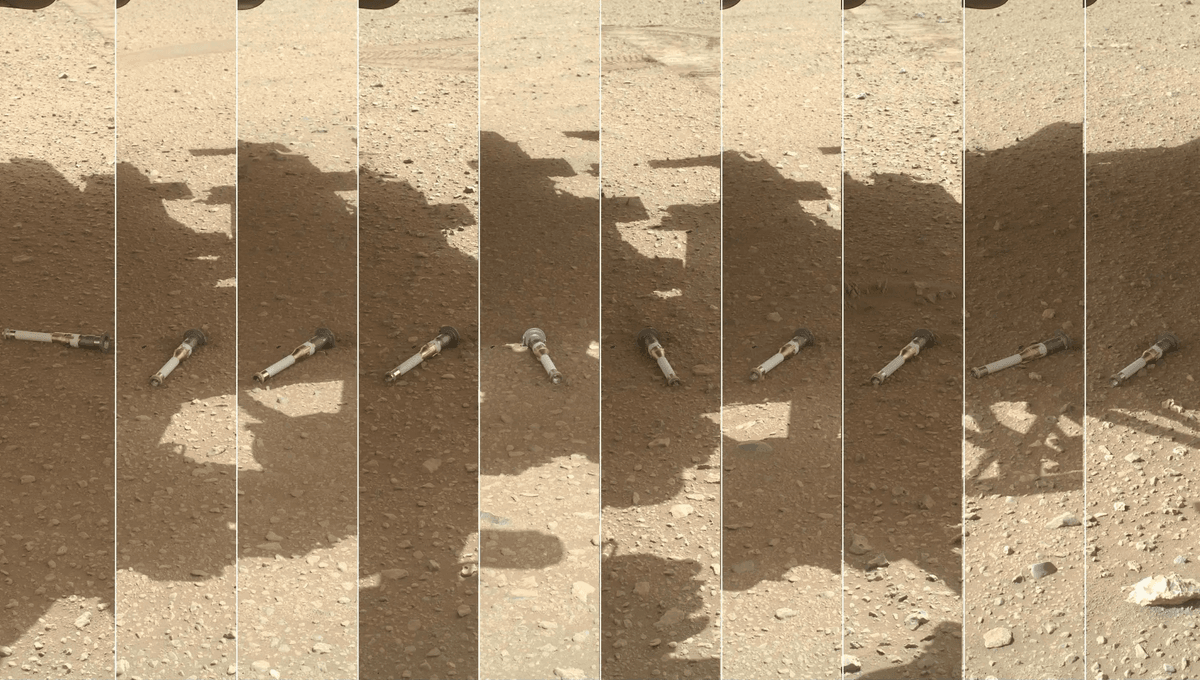
NASA has announced the next steps for its beleaguered Mars Sample Return mission, the ambitious plans to retrieve multiple samples collected on the Red Planet, so they can be analyzed by more sophisticated labs on Earth. The mission was deemed too expensive, with a price tag of $11 billion dollars, and it would take too long, with the samples coming back in 2040.
In a press conference, outgoing NASA Administrator Bill Nelson announced that the agency is now looking at two paths forward to bring down the costs of one crucial step: delivering the ascension vehicle to the surface of Mars. This rocket will be filled with the samples collected by Perseverance before being shot into space. The delivery of the samples to the ascension vehicle was going to be done by Mars helicopters but it’s not clear if that is still the plan.
To save on costs, the ascension vehicle will be smaller and not solar-powered. This allows for the two paths forward. One is to use the sky crane method, which was employed to bring both the Curiosity and Perseverance rovers down to the surface of Mars. The other is to use a private company to develop a lander that can get to the surface of Mars.
“Pursuing two potential paths forward will ensure that NASA is able to bring these samples back from Mars with significant cost and schedule saving compared to the previous plan,” Nelson, who will be replaced as administrator in a few weeks when the new administration swears in, said in a statement.
“These samples have the potential to change the way we understand Mars, our universe, and – ultimately – ourselves. I’d like to thank the team at NASA and the strategic review team, led by Dr Maria Zuber, for their work.”
The ascension vehicle will be filled with 30 sample canisters, most containing rocks but also soil and atmosphere samples. It will shoot into space where it will encounter a different spacecraft, one from the European Space Agency, which will ferry the samples back to Earth, where they will crash land somewhere (safer than using a parachute).
Nelson stated that $300 million would be required from Congress this year. The sky crane plan is estimated to cost between $6.6 billion and $7.7 billion. The commercial option might be slightly cheaper, between $5.8 billion and $7.1 billion. With the new plan the earliest we might get the samples is 2035, the latest 2039. The decision on which path to take won’t come until the second half of 2026, and will be a decision of the next administration.
While the cost is high and the timeline long, it is imperative to stress why this mission is important. Perseverance has been studying the rocks and soil around an ancient river delta on Mars. One of them is so exciting it has been considered a possible biosignature, the first tentative step in the discovery of whether some life forms ever existed on Mars. Only by using labs on Earth, can we get better analysis on that and all the other samples.

Source Link: What Next For NASA’s Beleaguered Mars Sample Return Mission – Will We Get Them Before 2040?
