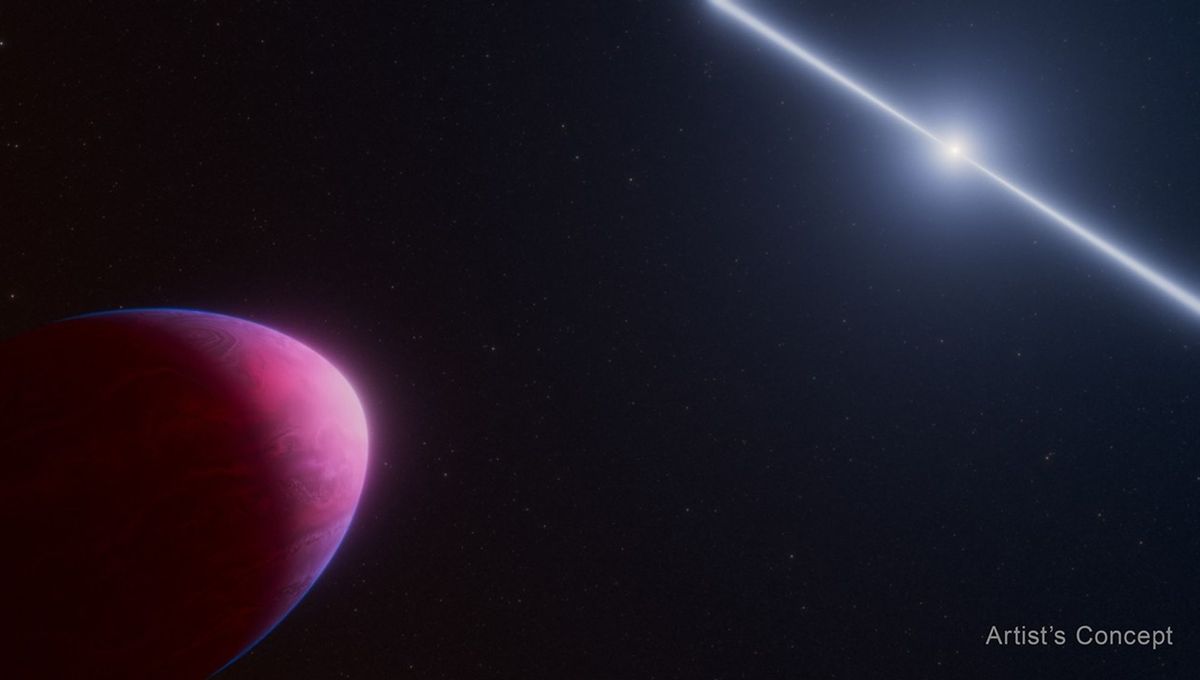
Since the 1990s, humanity has discovered some truly bizarre exoplanets. Very hot, very big, orbiting multiple stars, or at a weird angle. Still, no matter how familiar you are with the strange worlds out there, you are not ready for the utter all-you-can-eat weirdness of exoplanet PSR J2322-2650b.
PSR J2322-2650b is already peculiar because it orbits a pulsar, a pulsating neutron star which is the end product of certain types of supernova. Pulsars are the collapsed core of a massive star compressed into a sphere smaller than a city but weighing as much as our Sun, which blasts space with powerfully intense radiation. Around this extreme environment, there is a planet.
The planet has about the mass of Jupiter orbiting the pulsar in just 7.8 hours. Their separation is about 1 percent of the Earth-Sun distance, and the pull of gravity of the pulsar is so strong that the planet’s shape is distorted. It is not round but shaped more like a lemon.
Weird, weird, weird. Though this is not what JWST has just discovered. The space telescope found that the planet’s atmosphere is made of helium and pure carbon. Carbon that likely rains as diamonds in the deeper layers of the planet. No other known planet has this bizarre atmosphere. There is no explanation for it.
“This was an absolute surprise,” co-author of a new study on PSR J2322-2650b, Peter Gao of the Carnegie Earth and Planets Laboratory in Washington, said in a statement. “I remember after we got the data down, our collective reaction was ‘What the heck is this?’ It’s extremely different from what we expected.”
Pulsars emit a lot of radiation, in particular high-energy gamma-rays and radio waves pulses. That light is invisible to JWST, which studies the universe in infrared, but it affects the planet’s atmosphere. Those effects are visible in infrared, revealing the composition of the planet.
“This system is unique because we are able to view the planet illuminated by its host star, but not see the host star at all,” explained Maya Beleznay, a third-year PhD candidate at Stanford University in California who worked on modeling the shape of the planet and the geometry of its orbit. “So we get a really pristine spectrum. And we can study this system in more detail than normal exoplanets.”
“The planet orbits a star that’s completely bizarre — the mass of the Sun, but the size of a city,” said the University of Chicago’s Michael Zhang, the principal investigator on the study. “This is a new type of planet atmosphere that nobody has ever seen before. Instead of finding the normal molecules we expect to see on an exoplanet — like water, methane, and carbon dioxide — we saw molecular carbon, specifically C3 and C2.”
Carbon molecules could only be dominant in an atmosphere if there is little to no nitrogen and oxygen. Carbon would react with these elements otherwise. This is the first one out of 150 worlds whose atmosphere has been characterized that has this composition.
We do not know how this bizarre world came to be. Quickly rotating pulsars orbited by small stars can enter a black widow system, where the pulsar steals material from the companion, the material helps the pulsar speed up, producing winds that blast the star, eventually destroying the star.
But PSR J2322-2650b is not a star; it definitely has a planetary mass. Brown dwarfs, objects that form like stars but are not big enough to initiate nuclear fusion at their core, need to be at least 13 times the mass of Jupiter. This world is truly a puzzle.
“Did this thing form like a normal planet? No, because the composition is entirely different,” said Zhang. “Did it form by stripping the outside of a star, like ‘normal’ black widow systems are formed? Probably not, because nuclear physics does not make pure carbon. It’s very hard to imagine how you get this extremely carbon-enriched composition. It seems to rule out every known formation mechanism.”
One of the co-authors, Roger Romani of Stanford University and the Kavli Institute for Particle Astrophysics and Cosmology, has put forward a possible mechanism suggesting that maybe this now planet-sized object is the stripped core of a star. The now dead star has developed an atmosphere that is utterly bizarre.
“As the companion cools down, the mixture of carbon and oxygen in the interior starts to crystallize,” said Romani. “Pure carbon crystals float to the top and get mixed into the helium, and that’s what we see. But then something has to happen to keep the oxygen and nitrogen away. And that’s where the mystery comes in.”
“But it’s nice to not know everything,” added Romani. “I’m looking forward to learning more about the weirdness of this atmosphere. It’s great to have a puzzle to go after.”
The study is published in The Astrophysical Journal Letters.

Source Link: "What The Heck Is This?": JWST Reveals Bizarre Exoplanet With Inexplicable Composition
