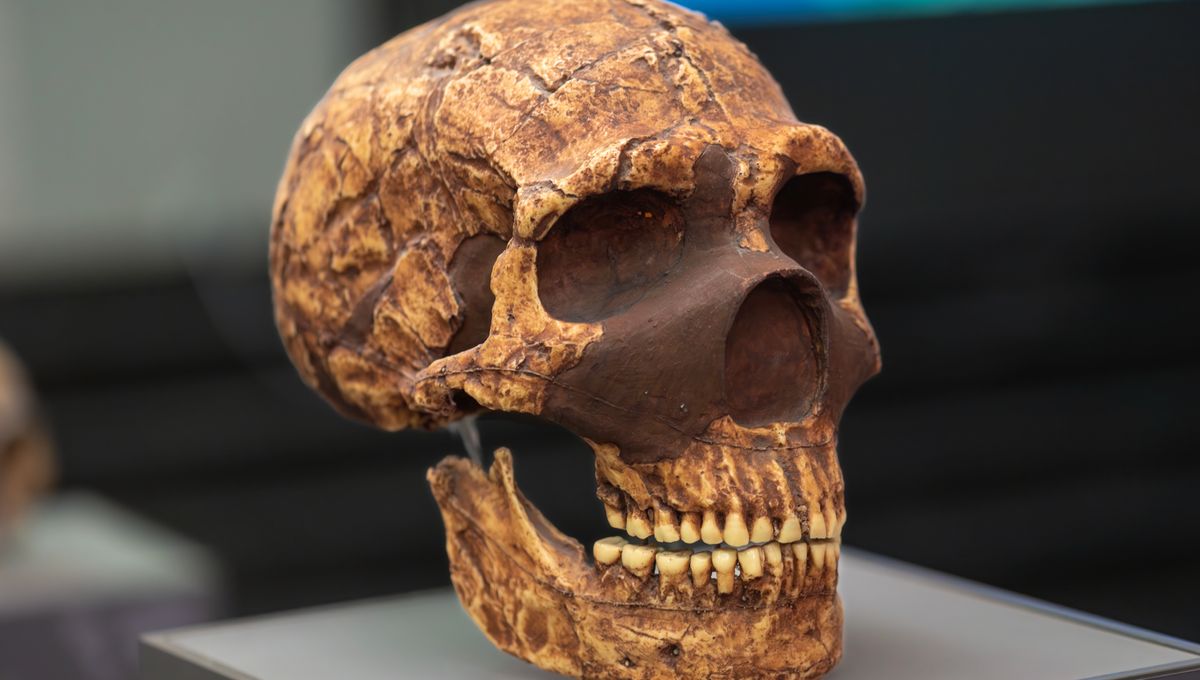
Neanderthals have had a tough time of it. Early humans played a role in their extinction, but the story didn’t end there. Later humans doubled down by using their name as the dictionary definition of dumb.
Were Neanderthals really unintelligent, club-slinging bozos, outcompeted by far more attractive, intelligent, and dashing Homo sapiens? Or could this just be human propaganda?
What we know for certain is that Neanderthals were some of our closest relatives. The earliest Neanderthal fossils we have date from around 430,000 years ago. These hominids lived alongside early Homo sapiens up until around 40,000 years ago, when they disappeared from the fossil record. Early humans have been blamed for their extinction – although whether this was through violence or sex remains unclear.
Recent advances in palaeoanthropology have given us a closer view of the likely structure of the Neanderthal brain. We know that the Neanderthal brain was roughly the same size or bigger than the human brain, but with a different shape. A study of 32 modern humans and 13 Neanderthal skulls suggests that Neanderthals had larger areas of their brains given over to vision. Neanderthals also had larger eyes than modern humans. Their bigger bodies also necessitated more brain space for controlling movement. The authors of this study suggested that this left less cognitive heft to perform complex social processing. This may have meant they were less capable of forming robust social groups.
One other analysis claims that much of the accepted lore about knuckle-dragging Neanderthals comes specifically from this type of comparison, which they say unfairly stacks up Neanderthals against modern humans, rather than other early Homo sapiens. This is akin to saying 18th-century humans were unintelligent dimwits because of their inability to record TikToks.
One analysis that made the fairer comparison of Neanderthal to early Homo sapiens developed 3D reconstructions of both hominids’ brains. The models revealed smaller cerebellums in the Neanderthal brain, which may have diminished their cognitive and social function.
These studies make inferences about the Neanderthal brain from fossil bone structures, rather than using direct insight. That’s because we don’t have a Neanderthal brain lying around to slap on a table and start dissecting. That hasn’t stopped biologists from getting creative in their efforts to reconstruct the Neanderthal mind. The discovery of a sample of Neanderthal DNA in a cave in Germany made things easier.
A recent study published in Science extracted a Neanderthal gene from ancient DNA samples and then inserted it into the brains of ferrets and mice, as well as “mini-brain” organoids made from human stem cells. In brains seeded with Neanderthal DNA, new brain cells formed more slowly during development, suggesting they may have had a lower cognitive peak than Homo sapiens.
The authors of this last paper said that even their innovative approach only hinted at Neanderthals’ reduced cognitive function. While they were definitely outcompeted by early humans, we still lack the scientific basis to back up many decades of roasting the Neanderthal intellect in popular culture.

Source Link: What Were Neanderthal Intelligence and Cognitive Abilities Like?
