When we first started to leave Earth’s atmosphere, strapping test pilots into spacecraft and blasting them into the vacuum of space, we expected there to be a few surprises in store. And we were not disappointed.
For instance, dating back to the Apollo program, many astronauts have reported mysterious bright flashes of light in their eyes. One survey of 59 astronauts found that 47 had seen these flashes while on spaceflights, which were most often noticed before sleep, sometimes disturbing it. The flashes were predominantly described as appearing white and having elongated shapes, usually going in a sideways or diagonal direction but never in the vertical.
The flashes have long been believed to be caused by cosmic rays passing through astronauts’ eyeballs, though the exact mechanism is still unclear, even after NASA conducted tests asking astronauts to wear an Apollo light flash moving emulsion detector (ALFMED) during the Apollo 16 and 17 missions.
“Flashes could be seen with the eyes open or closed when the spacecraft was dark. They discovered that it was not necessary to be dark adapted to see the flashes,” explains a description of the experiment. “This indicates that [Cherenkov radiation] from energetic cosmic rays traversing the eyeball, which had been the most widely accepted explanation for the light flashes, probably did not cause all or most of the flashes because light from this source is quite faint. Some of the flashes observed in space may be caused by direct ionization interactions of cosmic rays with the retina.”
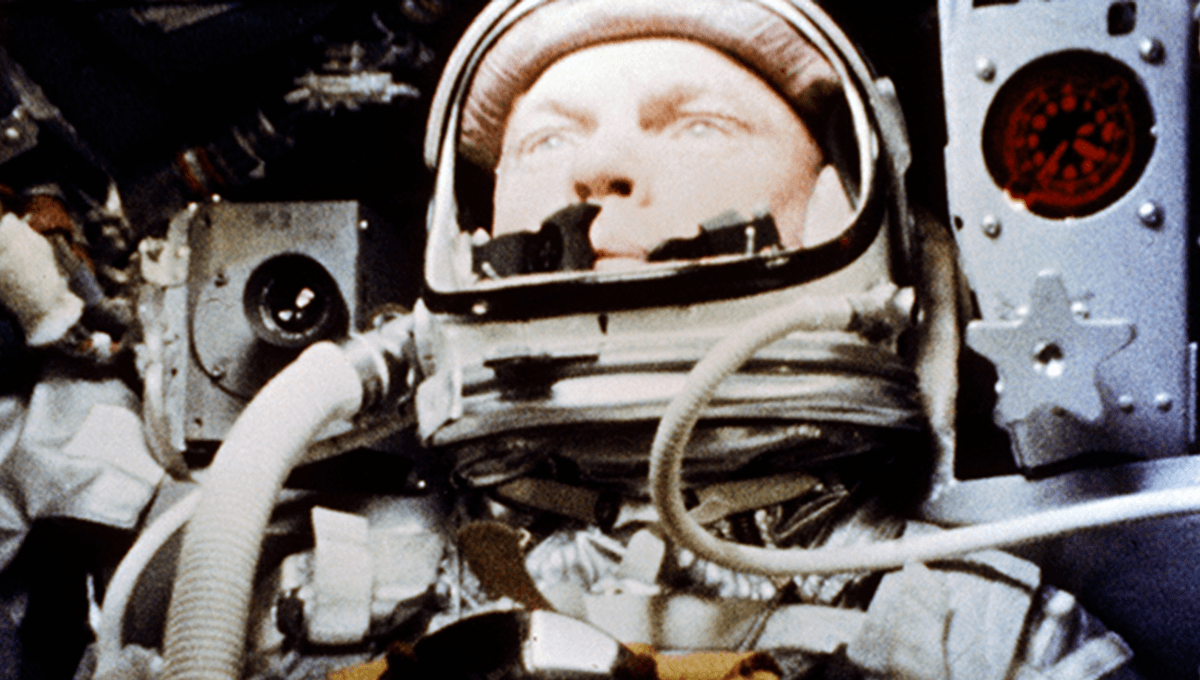
Another mystery that presented itself is the case of John Glenn’s “fireflies”. On February 20, 1962, NASA launched Glenn into Earth orbit on board a Mercury spacecraft named Friendship 7. The mission was simply to orbit the Earth several times, before returning Glenn safely to Earth in a location where he could be found and recovered.
On those fronts it was a resounding success, but the mission was not without surprises. During the first orbit, Glenn reported to NASA that he could see unusual glowing objects outside of his window, something nobody had really expected.
“This is Friendship 7,” Glenn said during that first orbit. “I’ll try to describe what I’m in here. I am in a big mass of some very small particles, that are brilliantly lit up like they’re luminescent. I never saw anything like it. They round a little; they’re coming by the capsule, and they look like little stars. A whole shower of them coming by.”
“They swirl around the capsule and go in front of the window and they’re all brilliantly lighted. They probably average maybe 7 or 8 feet apart, but I can see them all down below me, also.”
NASA’s first concern, of course, was that they could impact on the spacecraft, but Glenn confirmed that he could not hear any impacts on his capsule.
“They’re very slow; they’re not going away from me more than maybe 3 or 4 miles per hour. They’re going at the same speed I am approximately. They’re only very slightly under my speed,” he added.
“They do have a different motion, though, from me, because they swirl around the capsule and then depart back the way I am looking. There are literally thousands of them.”
Glenn explained that the objects, commonly referred to as “fireflies”, appeared just after sunset as he orbited the planet. But as the Sun rose again shortly afterwards (it doesn’t take 24 hours when you are hurtling over the Earth) the objects disappeared from view.
“This is Friendship 7, broadcasting in the blind. Ah, sunrise has come up behind in the periscope. It was brilliant in the scope, a brilliant red as it approached the horizon and came up; and just as the, as I looked back up out the window, I had literally thousands of small, luminous particles swirling around the capsule and going away from me at maybe 3 to 5 miles per hour,” he added during the flight.
“Now that I am out in the bright sun, they seem to have disappeared. It was just as the sun was coming up. I can still see just a few of them now, even though the sun is up some 20° above the horizon.”
While a little unsettling to see on your first mission to space, the mystery was soon solved after Scott Carpenter orbited the Earth later that year, seeing the same phenomenon. NASA determined that the “fireflies” were actually just tiny icy particles traveling alongside the spacecraft, which were illuminated by the Sun at certain angles.
During the trip, Glenn became the third American to go to space, the first human to orbit the Earth, and one of the only people to see this particular phenomenon without knowing what the hell was going on, which must have been quite the experience.

Source Link: What Were The "Fireflies" NASA Astronaut John Glenn Saw As He Orbited The Earth?
