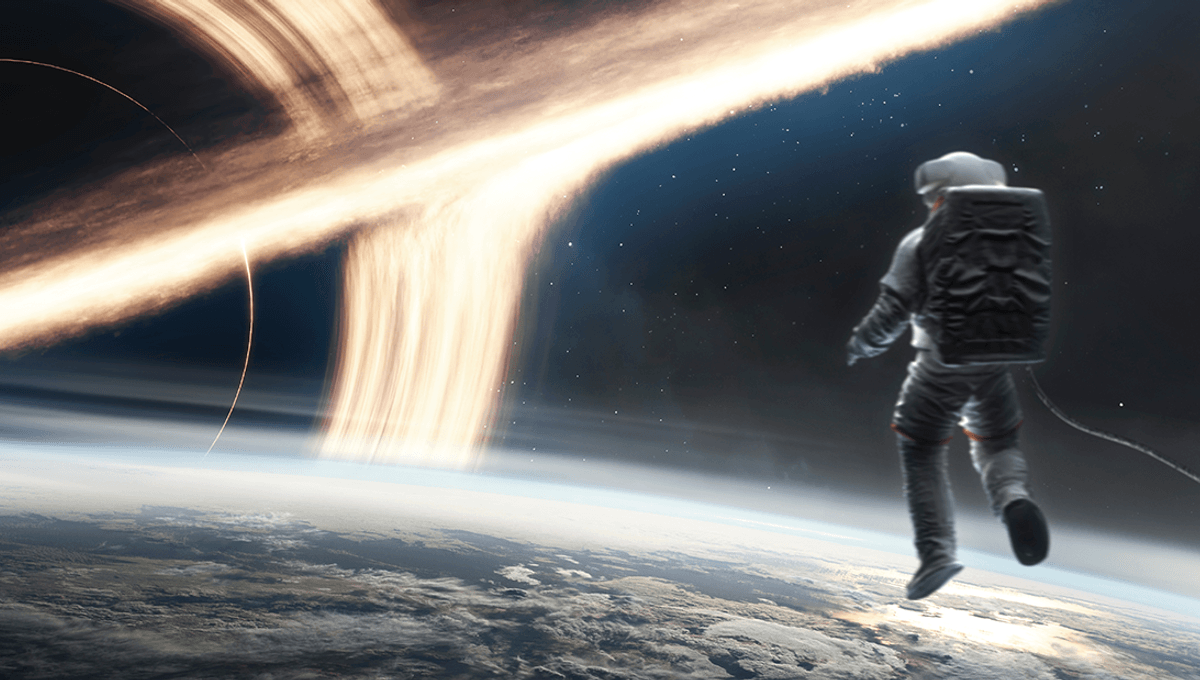
A new paper has explored what would happen if a tiny black hole were to pass through a human body. Rather than a disappointing “not much”, the physicist behind the paper specifically tried to determine the minimum size of such a black hole that would cause “significant injury or death” to the human unlucky enough to collide with it. Rather than being purely for fun, the idea could help constrain the hunt for dark matter, thought to account for around 27 percent of the universe.
First off, what kind of black holes are we talking about? In the current age of the universe, black holes form when gigantic stars run out of fuel and collapse under their own gravity. This places a limit on how small a stellar black hole can be in the current universe; they have to form from large amounts of mass condensed into one small region, and only occur in stars around 20 times the mass of the Sun. These stellar-mass black holes cannot pass through your body, unless your body happens to be larger than 20 solar masses. But falling into one would not end well for you, unless you actually want to “turn into spaghetti“.
Primordial black holes, on the other hand, are hypothetical black holes that are proposed to have formed in the first few seconds of the universe, when all the stuff that would go on to create the stars and galaxies was more tightly packed together.
“In that moment, pockets of hot material may have been dense enough to form black holes, potentially with masses ranging from 100,000 times less than a paperclip to 100,000 times more than the Sun’s,” NASA explains. “Then as the universe quickly expanded and cooled, the conditions for forming black holes this way ended.”
If they did form, it is possible that they could still be out there. There have even been suggestions that primordial black holes smaller than an atom could pass through Earth every day without harm to the planet, or maybe a larger one every thousand years or so. To this day, we have never detected one, though recently a team have put forward a candidate gravitational wave detection of a potential primordial black hole: S251112cm. Importantly, for this paper at least and perhaps in the search for dark matter, these black holes could come in all sorts of sizes, including smaller than your own body.
The new paper took inspiration from a previous paper on Macroscopic Dark Matter, or MACROS, a dark matter candidates which could range in size from tiny grains to asteroid-sized objects.
“In that paper, it was shown that the impact of MACRO dark matter on the human body would be sufficiently destructive that the non-observance of such impacts allows useful limits to be placed on the MACRO mass and cross section,” Robert J. Scherrer, Professor of Physics at Vanderbilt University, explained in the new paper.
Doing the same for primordial black holes, Scherrer reasoned, could place similar constraints on primordial black holes, another contender for what dark matter actually is.
“I knew that I could carry over some of those calculations to the study of primordial black holes,” Scherrer said in a statement. “Recent observations of gravitational radiation from black hole mergers, as well as new images of black holes, have revived interest in the subject of black holes in general. Plus, I remembered reading a science fiction story back in the 1970s where someone dies from having a black hole pass through them—I wanted to see if this would be possible.”
The paper looks at two different effects which could feasibly do damage to human bodies.
“First, the PBH would generate a supersonic shock wave along its path, destroying tissue along the way. Second, tidal gravitational forces would tend to tear apart cells in the body.”
Scherrer calculated the minimum amount of energy it would take to produce damage similar to a bullet passing through a human body, estimating that the mass would need to be around 1.4 × 10¹⁷ grams, a mass similar to an asteroid.
Looking at damage produced by tidal forces gets a little more interesting. First up, what do we mean by tidal forces?
“A tidal force is a difference in the strength of gravity between two points. The gravitational field of the moon produces a tidal force across the diameter of Earth, which causes the Earth to deform. It also raises tides of several meters in the solid Earth, and larger tides in the liquid oceans,” NASA explains. “If the tidal force is stronger than a body’s cohesiveness, the body will be disrupted.”
The tidal forces produced by a tiny black hole would have an interesting effect on human bodies.
“As the PBH passes through the human body, it will exert strong tidal forces in its vicinity. These will produce a tensile force on nearby human cells, and a sufficiently strong force would tear the cells apart,” Scherrer wrote. “The cells most sensitive to this dissociation are likely to be those in the human brain.”
However, calculating the size of black hole which would be needed to rip apart cells in the human brain resulted in a larger black hole than before, at around 7×10¹⁸ – 7×10¹⁹ grams. The shockwave produced would have a more damaging effect than tidal forces.
While fun to know, this could help us constrain the mass of primordial black holes as a dark matter candidate.
“Intriguingly, the smallest PBH mass that can lead to significant human injury lies near the lower bound on PBH [primordial black hole] dark matter,” Scherrer wrote, “raising the possibility that the absence of such events could provide an additional constraint on the PBH abundance, as in the case of MACRO dark matter.”
But assuming that all dark matter is primordial black holes, and that they are at least large enough to cause injury, he found that the number of injuries per year would amount to around 10−18 per year, a truly tiny number.
“Primordial black holes are theoretically possible, but they might not even exist,” Scherrer added in summary. “A sufficiently large primordial black hole, about the size of an asteroid or larger, would cause serious injury or death if it passed through you. It would behave like a gunshot. A smaller primordial black hole could pass through you, and you wouldn’t even notice it. However, the density of these black holes is so low that such an encounter is essentially never going to happen.”
The study is published in the International Journal of Modern Physics D.

Source Link: What Would Happen If A Tiny Primordial Black Hole Passed Through Your Body?
