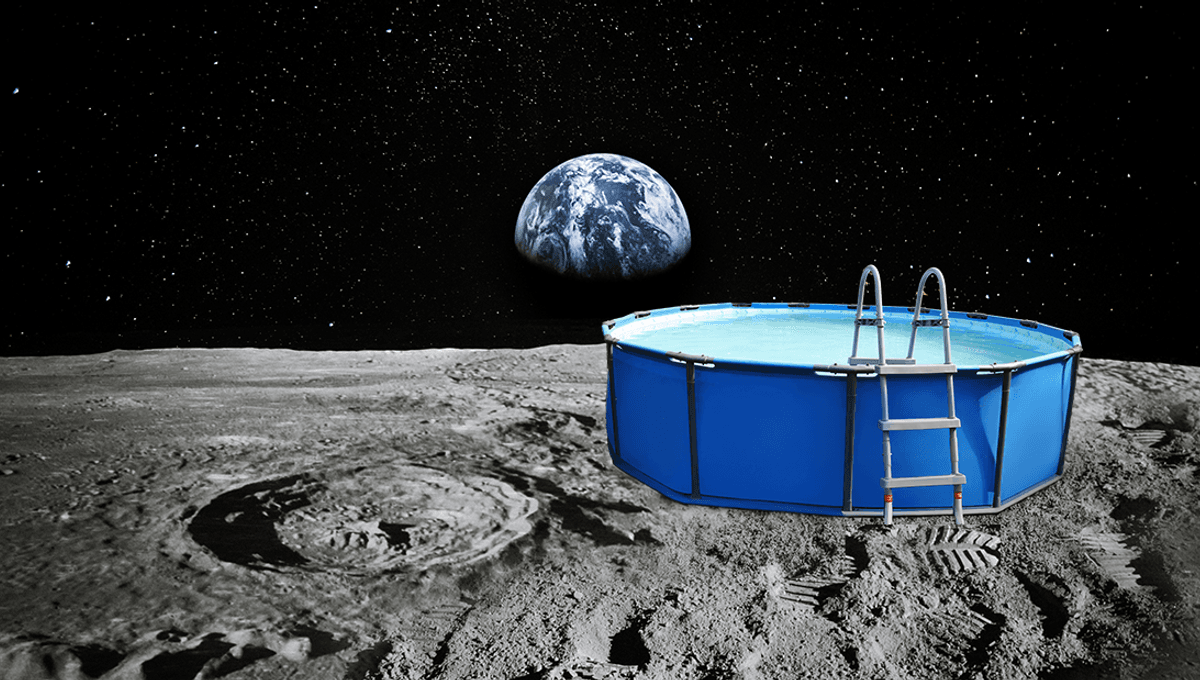
A new video from xkcd cartoonist, science communicator, and author Randall Munroe has posed the age old question; what if we put a pool on the Moon?
While splashing around in water on Earth is enjoyable, it turns out that if NASA got their asses in gear it could be a whole lot more fun.
First off, would it be possible to swim in it? Buoyancy is an upward force in a fluid (any flowing substance, including air) exerted on all bodies within it. The force comes from the pressure within the fluid being greater the further down in the fluid you go. The pressure on the bottom of an object within the fluid is higher than at its top, causing the upward force. If the buoyant force of a fluid is greater than the weight of an object placed within it, the object will float. This will still be true on the Moon, and astronauts being less dense than water, they would be able to float on the Moon pool nicely.
Swimming would also feel pretty similar, with Munroe explaining that the water’s inertia is the main source of drag while swimming, a property that is independent of the gravitational pool you find yourself in. But where it gets really cool is that the low gravity means a sloshier pool, bigger waves, and the opportunity to leap out of the water like dolphins. Which, I’m sure we’ll all agree, is what the Apollo Moon landings were missing.
Another cool aspect referenced in the video is that it could be possible for astronauts to run on the pool. A study in 2012 looked into how various (small) animals run on water. While water striders stay afloat by using surface tension, larger animals like the Basilisk lizard have to resort to the more energy-intensive method of slapping the surface of the water “with sufficient vigor to generate hydrodynamic forces on their driving legs to support their weight”.
Humans have a lot more weight to them, making this option pretty much a nonstarter, at least on Earth.
“Humans would be able to run on water only if they were able to slap water at speeds >30 m/s [98 feet per second], which they estimate would require about 15 times a human’s available muscle power,” the team writes in their study. “However, there are two ways of circumventing these limitations. One way is by reducing gravity, and the other one is by running with flotation devices (giant shoes or fins) as envisaged by Leonardo da Vinci.”
Running the math and conducting low-gravity simulations on Earth, the team found that assuming a stride frequency of 1.7 strides a second, it would be possible for humans to run on water on the Moon, up to a weight limit of 73 kilograms (160 pounds). While “one small step for man, one giant leap for mankind” was cool, maybe one day we’ll hear the far more awesome “look at me, Ma, I’m a pond-skimmer”.

Source Link: What Would Happen If We Put A Swimming Pool On The Moon? It Would Be Pretty Awesome, Actually
