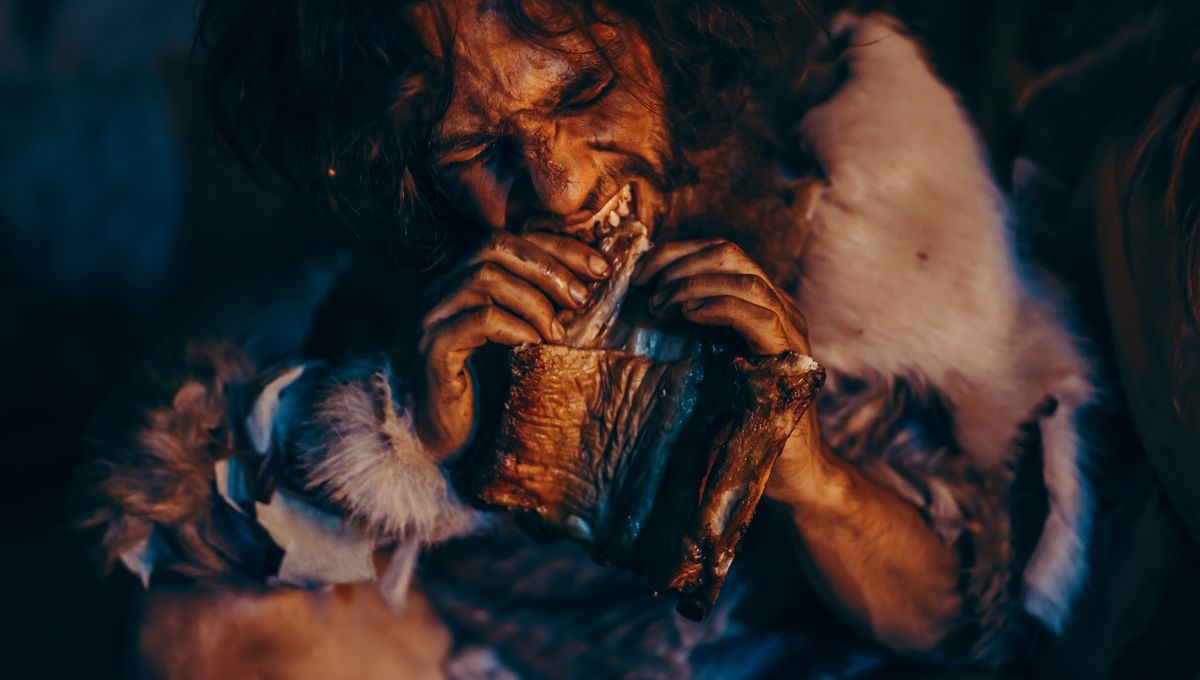
Until recently, it was widely accepted that the earliest members of the Homo lineage were the first hominids to hunt. In particular, Homo erectus – which emerged around two million years ago – is typically credited with developing the taste for meat, yet new studies have begun to challenge this narrative, suggesting that our ancestors may have eaten meat long before the arrival of the Homo genus.
The rest of this article is behind a paywall. Please sign in or subscribe to access the full content.
Did meat make us human?
The idea of H. erectus as the world’s first butcher stems from the fact that the greatest concentration of animal remains bearing cut marks is found at sites dating to less than two million years ago in Tanzania’s Olduvai Gorge. These carnivorous leftovers therefore coincide in both time and space with the appearance of H. erectus in the fossil record, leaving this prehistoric species as the prime culprit.
Based on this observation, anthropologists came up with the “meat made us human” theory, which states that the development of bigger brains in early members of the Homo lineage was linked to the consumption of meat. And for many decades, this idea went largely unopposed, until the discovery of even earlier butchery sites became a bone of contention.
For instance, a recent systematic review of all such sites across East Africa revealed that hominids had been processing animal carcasses since at least 2.6 million years ago, and that the intensity of this activity did not increase when H. erectus arrived on the scene. According to the authors, the idea of carnivory as a defining characteristic of this early human species is something of an illusion based on sampling bias, as for many years archaeologists had been specifically looking for evidence of butchery at sites occupied by H. erectus.
As the new analysis showed, however, hominids pre-dating the emergence of the Homo genus ate meat just as often as H. erectus did, which means that consuming animals probably wasn’t the thing that caused us to grow bigger brains and become human.
Meat-eating prior to 2 million years ago
A small but significant scattering of recent finds has begun to add some much-needed meat to the bones of the theory that our earlier ancestors had developed a taste for flesh prior to the arrival of H. erectus. For instance, the site of Kanjera South in Kenya contains evidence of repeated carnivory by ancient hominids roughly two million years ago, which is slightly older than the kill sites in Olduvai Gorge.
Within the Bouri Formation in Ethiopia, meanwhile, butchered antelope and horse bones have been dated to 2.5 million years ago, significantly extending the history of meat-eating. Frustratingly, though, hominin bones found at the site are too ambiguous to be identified, so we don’t know which of our ancestors consumed these animals.
However, the oldest concrete example of this dietary practice comes from Nyayanga in Kenya, where an unknown hominin species processed the carcasses of hippopotamuses some time between three million and 2.6 million years ago.
It’s currently unclear which members of our family tree were responsible for these early massacres, although it’s noteworthy that fossils attributed to Paranthropus have been found at Nyayanga. What’s certain, though, is that whoever butchered these animals lived long before H. erectus stepped onto the scene.
Ultimately, then, it’s impossible to say exactly when humans became butchers, but as anthropologist John Hawks explains, “I would be very surprised if there were any hominin species that didn’t sometimes eat animal prey.”

Source Link: When Did Humans First Start Eating Meat?
