Our technology and knowledge, just as much as our values and beliefs, have all been shaped by thousands of generations of people stretching back in an unbroken chain. But when did this process of accumulation begin? Or, to put it another way, when did our earliest ancestors start to build on the knowledge of others and make connections that set us apart from other primates?
Cumulative culture, the process of accumulating technical and technological knowledge through social learning, is increasingly understood to be a key factor to our success as a species. The concept was first brought to wider attention in the 1990s, essentially as a way to differentiate human culture from that of other species. Sure, many species have “culture”, but only humans can accumulate modifications over time.
Of course, this idea has been challenged since then, with various non-human species demonstrating forms of cumulative culture, including other primates like chimpanzees, baboons, and macaques, as well as pigeons and other birds, and also whales and dolphins.
Regardless, cumulative culture has still had an important role to play in human development, allowing us to adapt to diverse environments and challenges we have faced. However, it is unclear when this process started in hominin evolution – that is, until recently.
According to researchers Charles Perreault, an associate professor with the School of Human Evolution and Social Change at Arizona State University, and Jonathan Paige, a postdoctoral researcher at the University of Missouri and ASU PhD graduate, cumulative culture began rapidly around 600,000 years ago.
“Our species, Homo sapiens,” Perreault explained in a statement, “has been successful at adapting to ecological conditions — from tropical forests to arctic tundra — that require different kinds of problems to be solved.”
“Cumulative culture is key because it allows human populations to build on and recombine the solutions of prior generations and to develop new complex solutions to problems very quickly. The result is, our cultures, from technological problems and solutions to how we organize our institutions, are too complex for individuals to invent on their own.”
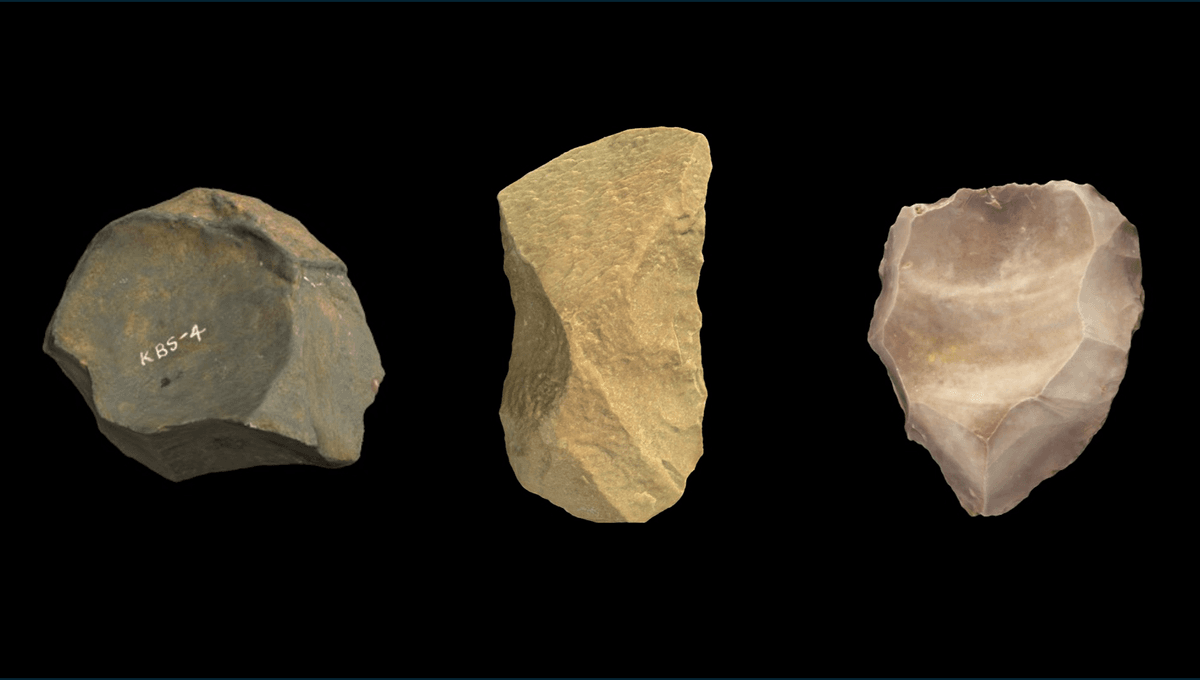
To investigate when this technological turn came about, Paige and Perreault examined differences in the complexity of stone tool manufacturing techniques across the archaeological record for the last 3.3 million years.
In order to establish a baseline for the complexity of stone tool technology that can be created without cumulative culture, the pair examined stone tools made by non-human species, like chimpanzees. They also examined the stone tool-making experiments of inexperienced human flintknappers and the random flaking they produced.
According to the team, the complexities of stone tool technologies can be understood in terms of the number of steps taken in each tool-making sequence. These steps are referred to as procedural units (PU).
The results show that, from around 3.3 to 1.8 million years ago, at the time when australopiths and the earliest Homo species were alive, stone tool-making was within the baseline range of 1 to 6 PUs. Then, from around 1.8 million to 600,000 years ago, this rose to a range between 4 to 7 PUs. However, 600,000 years ago, the complexity of manufacturing rapidly increased to a range of 5 to 18 PUs.
“By 600,000 years ago or so, hominin populations started relying on unusually complex technologies, and we only see rapid increases in complexity after that time as well. Both of those findings match what we expect to see among hominins who rely on cumulative culture,” said Paige.
It is possible that tool-assisted foraging may have led to the start of our cumulative culture. Early hominins – those that lived around 3.4 to 2 million years ago – probably relied on foraging strategies that used tools to strip meat and access the difficult-to-reach bits of food like marrow and organs.
This, over time, may have led to changes, as the authors write: “[a]s cumulative culture begins to produce adaptive know-how, selective pressures on brains and developmental processes facilitate the acquisition, storage, and use of that cultural information”.
Other forms of social learning may have influenced this process, but the researchers believe that it is only in the Middle Pleistocene that evidence of rapid changes in technological complexity and diversity occurs.
This was also the time with more evidence of controlled fire, hearths, and domestic spaces in the archaeological record. These were likely the outcomes of cumulative culture, along with other early technologies like wooden structures created with logs hewn using hafted tools. These tools consisted of stone blades attached to wooden or bone handles.
If Paige and Perreault are correct, then cumulative culture may have begun during the Middle Pleistocene epoch and may have predated the divergence of Neanderthals and modern humans.
The study is published in PNAS.

Source Link: When Did Our Ancient Ancestors Start To Build On The Knowledge Of Others?
