• Email Us: [email protected]
  • Contact Us: +1 718 874 1545
  • Skip to main content
  • Skip to primary sidebar

Medical Market Report

  • Home
  • All Reports
  • About Us
  • Contact Us

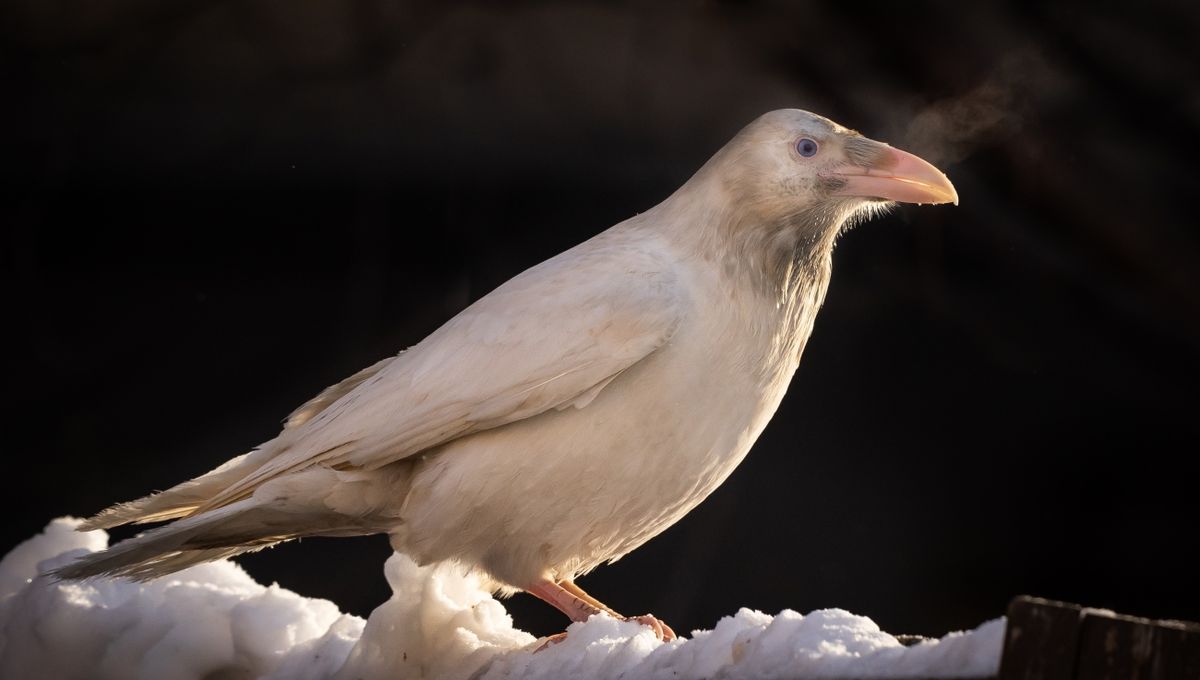
White Raven: This Normally Black Bird Can Be Surprisingly Pale

August 4, 2025 by Deborah Bloomfield

Sometimes, genetics likes to throw a bit of a curveball when it comes to coloration of animals. These quirks can tip the scales in favor of all white or all black fur, feathers, or even skin and can even land somewhere in the middle in a genetic condition known as leucism. 

Recently, the North Island Wildlife Recovery Centre in British Columbia, Canada, shared on social media about the death of their beloved leucistic raven called Blizzard. This is not the only place in North America to see white ravens, as in Anchorage on the Kenai Peninsula, USA, a white raven was seen in winter 2023 and 2024, and was even filmed by a local. 


While leucism is a pretty rare occurrence, it does have some tell tale signs. Unlike albinism, leucism does not affect the eyes but instead can result in patchy (known as particle leucism) or a completely white appearance (known as total leucism). Both conditions are caused by a lack of the substance melanin that normally produces the typical coloration of the feathers; therefore, a lack of this substance can make the feathers appear white. There is some debate as to whether leucism is genetic or occurs during development of the embryo. 

Unfortunately, both albinism and leucism can come with additional health issues. As well as not being of typical coloration, which can cause an increased risk of predation to some species or result in social ostracization in some cases, these conditions can be coupled with skin and eye problems. 

In some species, feathers play an important role in impressing a mate, meaning individuals with feathers not in the typical coloration may struggle with finding a mate. It is even suggested that feathers with less pigment are less robust and can wear down more rapidly impacting flight and the ability to maintain body temperature. 

There are also other types of pigment changes, including melanism, where the animal appears blacker, due to more melanin pigment being present; erythrism, where an animal appears chestnut or bronze instead of their typical colors; or xanthochromism, where there is an excess of yellow pigment often instead of red. 

Deborah Bloomfield
Deborah Bloomfield

Related posts:

  1. Russia moves Sukhoi Su-30 fighter jets to Belarus to patrol borders, Minsk says
  2. French senators to visit Taiwan amid soaring China tensions
  3. Moon’s Magnetic Field Experienced Mysterious Resurgence 2.8 Billion Years Ago Before Disappearing
  4. Operation Sundial: The Terrifying 10-Gigaton Nuclear Weapon That (Thankfully) Never Was

Source Link: White Raven: This Normally Black Bird Can Be Surprisingly Pale

Filed Under: News

Primary Sidebar

  • “Unidentified Human Relative”: Little Foot, One Of Most Complete Early Hominin Fossils, May Be New Species
  • Thought Arctic Foxes Only Came In White? Think Again – They Come In Beautiful Blue Too
  • COVID Shots In Pregnancy Are Safe And Effective, Cutting Risk Of Hospitalization By 60 Percent
  • Ramanujan’s Unexpected Formulas Are Still Unraveling The Mysteries Of The Universe
  • First-Ever Footage of A Squid Disguising Itself On Seafloor 4,100 Meters Below Surface
  • Your Daily Coffee Might Be Keeping You Young – Especially If You Have Poor Mental Health
  • Why Do Cats And Dogs Eat Grass?
  • What Did Carl Sagan Actually Mean When He Said “We Are All Made Of Star Stuff”?
  • Lonesome George: The Giant Tortoise Who Was The Very Last Of His Kind
  • Bermuda Sits On A Strange, 20-Kilometer-Thick Structure That’s Like No Other In The World
  • Time Moves Faster Up A Mountain – And That’s Why Earth’s Core Is 2.5 Years Younger Than Its Surface
  • Bio-Hybrid Robots Made Of Dead Lobsters Are The Latest Breakthrough In “Necrobotics”
  • Why Do Some Italians Live To 100? Turns Out, Centenarians Have More Hunter-Gatherer DNA
  • New Full-Color Images Of Interstellar Comet 3I/ATLAS, As We Are Days Away From Closest Encounter
  • Hilarious Video Shows Two Young Andean Bears Playing Seesaw With A Tree Branch
  • The Pinky Toe Has A Purpose And Most People Are Just Finding Out
  • What Is This Massive Heat-Emitting Mass Discovered Beneath The Moon’s Surface?
  • The Man Who Fell From Space: These Are The Last Words Of Cosmonaut Vladimir Komarov
  • How Long Can A Bird Can Fly Without Landing?
  • Earliest Evidence Of Making Fire Has Been Discovered, X-Rays Of 3I/ATLAS Reveal Signature Unseen In Other Interstellar Objects, And Much More This Week
  • Business
  • Health
  • News
  • Science
  • Technology
  • +1 718 874 1545
  • +91 78878 22626
  • [email protected]
Office Address
Prudour Pvt. Ltd. 420 Lexington Avenue Suite 300 New York City, NY 10170.

Powered by Prudour Network

Copyrights © 2025 · Medical Market Report. All Rights Reserved.

Go to mobile version