• Email Us: [email protected]
  • Contact Us: +1 718 874 1545
  • Skip to main content
  • Skip to primary sidebar

Medical Market Report

  • Home
  • All Reports
  • About Us
  • Contact Us

Whose Ears Look Like That?! Why We Call Corn Cobs “Ears”

July 25, 2023 by Deborah Bloomfield

Corn is a relatively ancient crop; humans began selectively breeding its wild ancestor teosinte in Mexico over 9,000 years ago. Roughly 1,500 and 2,000 years after this, partially domesticated corn varieties continued to spread to Central and South America respectively. But as this popular crop developed, so did its etymology, and now, despite looking nothing like the ears on our heads, both have somehow ended up being called the same thing.

Also known as maize, corn is an edible grain in the grass family Poaceae. But corn isn’t just good at getting stuck in your teeth, it’s also used in livestock feed and even biofuel, making it one of the world’s most widely distributed and productive food crops.

Advertisement

While maize was the name given in the crop’s native home, the British would use the term “corn” to refer to all grain types, while the American colonies would refer to it as “Indian corn”.

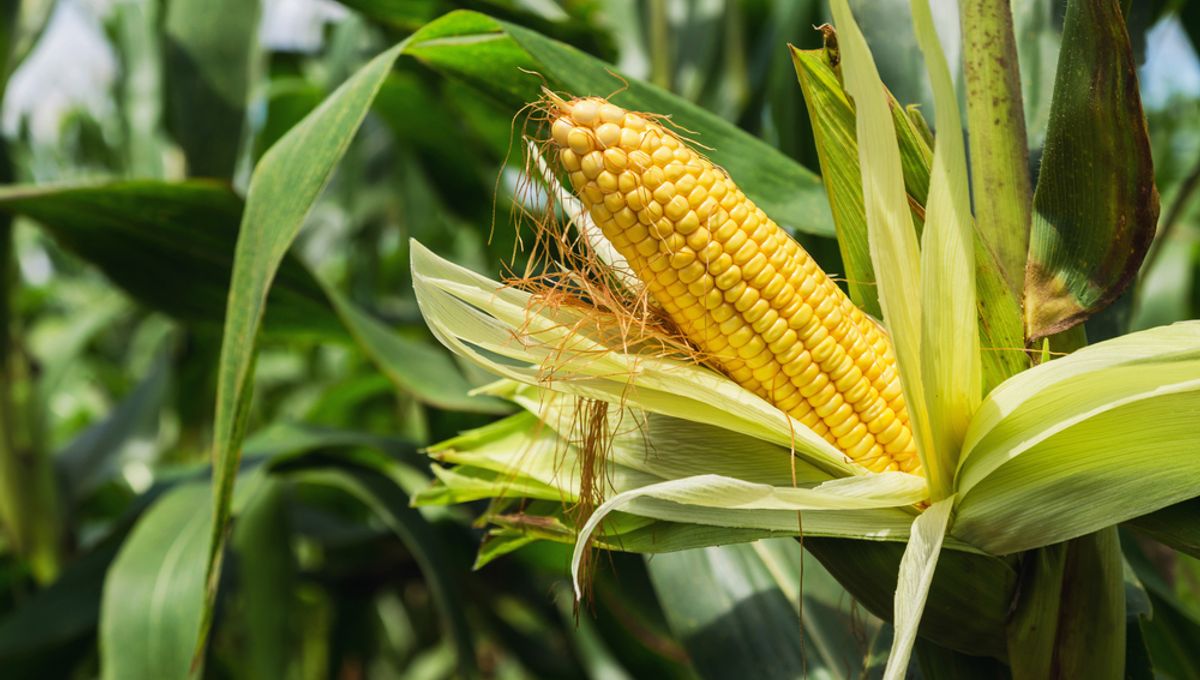
However, the word “ear” is used to refer to a specific part of the plant. With stalks that can reach up to 3 meters (10 feet) high, the male and female parts of the plant both produce the corn cob. The sprouting top of the stalk is the male part of the plant, while the female flower is what grows the ear, which is comprised of kernels and enveloped inside a husk.

But what’s it got to do with an ear?

In a sort of convergent evolution, the taxonomy of both “ears” derived from different sources and ended in the exact same place. The ears that we hear with have an origin in the Old English eare meaning, you guessed it, “ear”. This can be traced back to the same meaning in Proto-Germanic (auso), but the Proto-Indo-European origin of auso is hews, meaning “to see”, which may also be linked to the term for “observe”, keu.

Advertisement

Ear as a part of corn, however, has a root in Proto-Indo-European ak, meaning to be sharp, rise out to a point, or pierce. This, in turn, helped shape the Proto-Germanic akhuz, meaning spike or ear of grain, and from there the Northumbrian Old English æher, and Wet Saxon ear.

The Oxford English Dictionary’s definition of ear in this context is “the part of a cereal plant which contains its flowers or seeds,” meaning the term can refer to the ears of other grains like barley, wheat, and even rice.

Deborah Bloomfield
Deborah Bloomfield

Related posts:

  1. Soccer – FIFA backs down on threat to fine Premier clubs who play South American players
  2. U.S. House passes abortion rights bill, outlook poor in Senate
  3. Soccer-Brighton held to goalless draw by unimpressive Arsenal
  4. Don’t Throw Away The Leaves On Your Lawn This Fall, Say Experts

Source Link: Whose Ears Look Like That?! Why We Call Corn Cobs “Ears”

Filed Under: News

Primary Sidebar

  • The Eschatian Hypothesis: Why Our First Contact From Aliens May Be Particularly Bleak, And Nothing Like The Movies
  • The Great Mountain Meltdown Is Coming: We Could Reach “Peak Glacier Extinction” By 2041
  • Comet 3I/ATLAS Is Experiencing A Non-Gravitational Acceleration – What Does That Mean?
  • The First Human Ancestor To Leave Africa Wasn’t Who We Thought It Was
  • Why Do Warm Hugs Make Us Feel So Good? Here’s The Science
  • “Unidentified Human Relative”: Little Foot, One Of Most Complete Early Hominin Fossils, May Be New Species
  • Thought Arctic Foxes Only Came In White? Think Again – They Come In Beautiful Blue Too
  • COVID Shots In Pregnancy Are Safe And Effective, Cutting Risk Of Hospitalization By 60 Percent
  • Ramanujan’s Unexpected Formulas Are Still Unraveling The Mysteries Of The Universe
  • First-Ever Footage of A Squid Disguising Itself On Seafloor 4,100 Meters Below Surface
  • Your Daily Coffee Might Be Keeping You Young – Especially If You Have Poor Mental Health
  • Why Do Cats And Dogs Eat Grass?
  • What Did Carl Sagan Actually Mean When He Said “We Are All Made Of Star Stuff”?
  • Lonesome George: The Giant Tortoise Who Was The Very Last Of His Kind
  • Bermuda Sits On A Strange, 20-Kilometer-Thick Structure That’s Like No Other In The World
  • Time Moves Faster Up A Mountain – And That’s Why Earth’s Core Is 2.5 Years Younger Than Its Surface
  • Bio-Hybrid Robots Made Of Dead Lobsters Are The Latest Breakthrough In “Necrobotics”
  • Why Do Some Italians Live To 100? Turns Out, Centenarians Have More Hunter-Gatherer DNA
  • New Full-Color Images Of Interstellar Comet 3I/ATLAS, As We Are Days Away From Closest Encounter
  • Hilarious Video Shows Two Young Andean Bears Playing Seesaw With A Tree Branch
  • Business
  • Health
  • News
  • Science
  • Technology
  • +1 718 874 1545
  • +91 78878 22626
  • [email protected]
Office Address
Prudour Pvt. Ltd. 420 Lexington Avenue Suite 300 New York City, NY 10170.

Powered by Prudour Network

Copyrights © 2025 · Medical Market Report. All Rights Reserved.

Go to mobile version