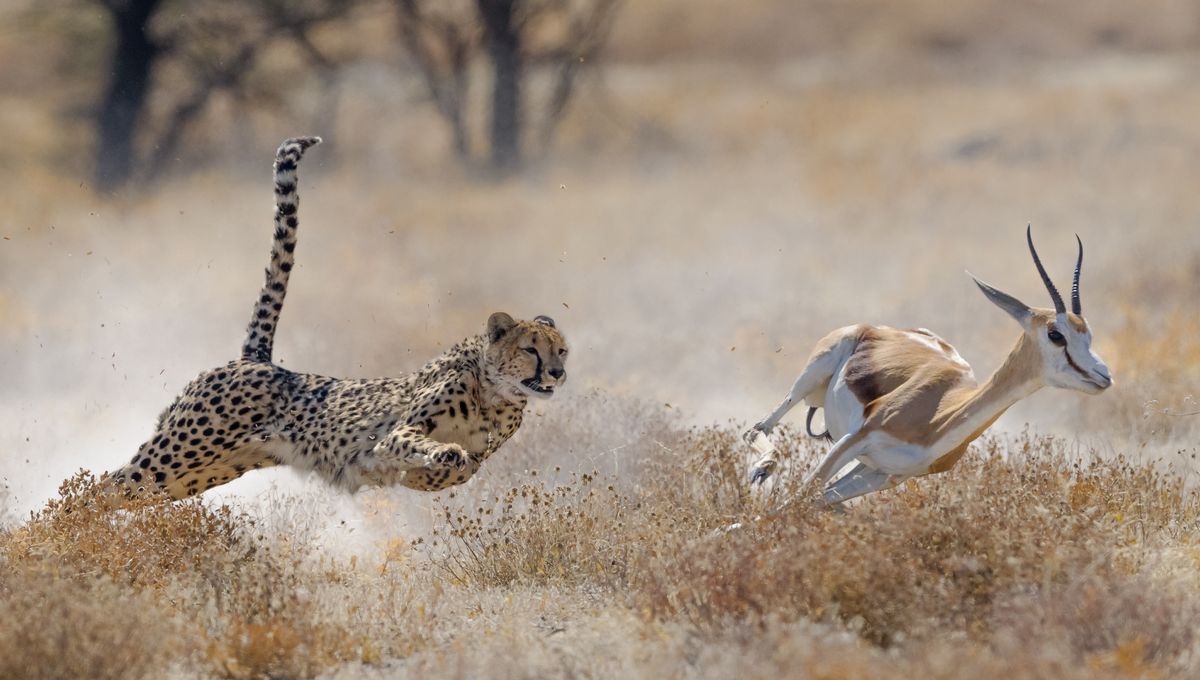
Medium-sized animals dominate the top places in the running section of the animal Olympics, and now we know why, thanks to a new model of muscle performance.
For many important criteria, animals find it’s good to be big. Insects may be able to lift astonishing weights relative to their size, but in absolute terms the biggest animals are also the strongest and usually live the longest as well. Indeed, many measures of animal performance can be predicted from their size using a simple power law – not perfectly, but tolerably well.
Yet when it comes to speed, cheetahs can outrun much larger animals, and they’ve got mid-sized company close to the top of the list, an anomaly that has puzzled zoologists enough to inspire many papers.
“Why does running speed break with the regular patterns that govern most other aspects of animal anatomy and performance?” Dr David Labonte of Imperial College London asked in a statement. Labonte has helped answer that question, showing that there are two limiting factors to running speed, rather than one as had been assumed.
Labonte and co-authors explored the way muscles contract, using this to build a physical model that predicts an animal’s running speed. They confirmed its accuracy by comparing predictions with measurements others have collected on more than 400 species, from insects weighing a 10,000th of a gram (0.000004 ounces) to the largest mammals.
“The key to our model is understanding that maximum running speed is constrained both by how fast muscles contract, as well as by how much they can shorten during a contraction,” co-author Professor Christofer Clemente of the University of the Sunshine Coast explained. “Animals about the size of a cheetah exist in a physical sweet spot at around 50 kilograms [110 pounds], where these two limits coincide. These animals are consequently the fastest, reaching speeds of up to 65 miles per hour [105 kilometers per hour].”
Smaller animals are held back by the first limit Clemente refers to: their muscles just cannot contract fast enough to trouble their mid-sized counterparts. The forces generated by muscle contraction are large relative to the animals’ weight, which is good for overcoming counteracting forces – such as when running uphill – but limits top speeds.
Large animals run into the “work capacity limit”; they just can’t produce forces large enough to accelerate their great masses to high speeds.
“For large animals like rhinos or elephants, running might feel like lifting an enormous weight, because their muscles are relatively weaker and gravity demands a larger cost. As a result of both, animals eventually have to slow down as they get bigger,” Harvard University’s Dr Peter Bishop explained.
The authors compare the situation to the Reynolds number in fluid dynamics, where viscosity dominates at small scales and inertial forces at larger ones.
Cheetahs may be the right size for maximum speed, but there are other reasons they’ve reached the top. One factor, as anyone who has watched a documentary filmed on the African savannah can tell you, is that they have evolved to be sprinters rather than distance runners, going all in on the fast-twitch muscles.
Cheetahs are also spared competition from some creatures of similar size. Large reptiles such as crocodiles cannot match the speeds of their mammalian counterparts.
This fact may be yet another piece of science the makers of the Jurassic Park/World franchise will ignore, but the authors of this study are keen to find out why, although so far they don’t have all the answers.
“One possible explanation for this may be that limb muscle is a smaller percentage of reptiles’ bodies, by weight, meaning that they hit the work limit at a smaller body weight, and thus have to remain small to move quickly,” Dr Taylor Dick of the University of Queensland said. This, however, just moves the question back one step – given the immense advantages of speed, why have large reptiles not evolved limb muscles to match it with mammals?
Then again, maybe those filmmakers are right to not treat the model as gospel. Although it does an excellent job of matching the speed capacities of living species, the model runs into problems at the larger end of the scale, predicting that it should be impossible for a land animal weighing more than 40 tonnes to move. We know that isn’t true, because the titanosaurs got around somehow, and the largest weighed an estimated 70 tonnes. The authors think there must have been something different about the largest dinosaurs’ muscle structure compared with anything living, but they don’t know what it was.
The study is published open access in Nature Communications.

Source Link: Why Cheetahs Are The Fastest Animals On Land
