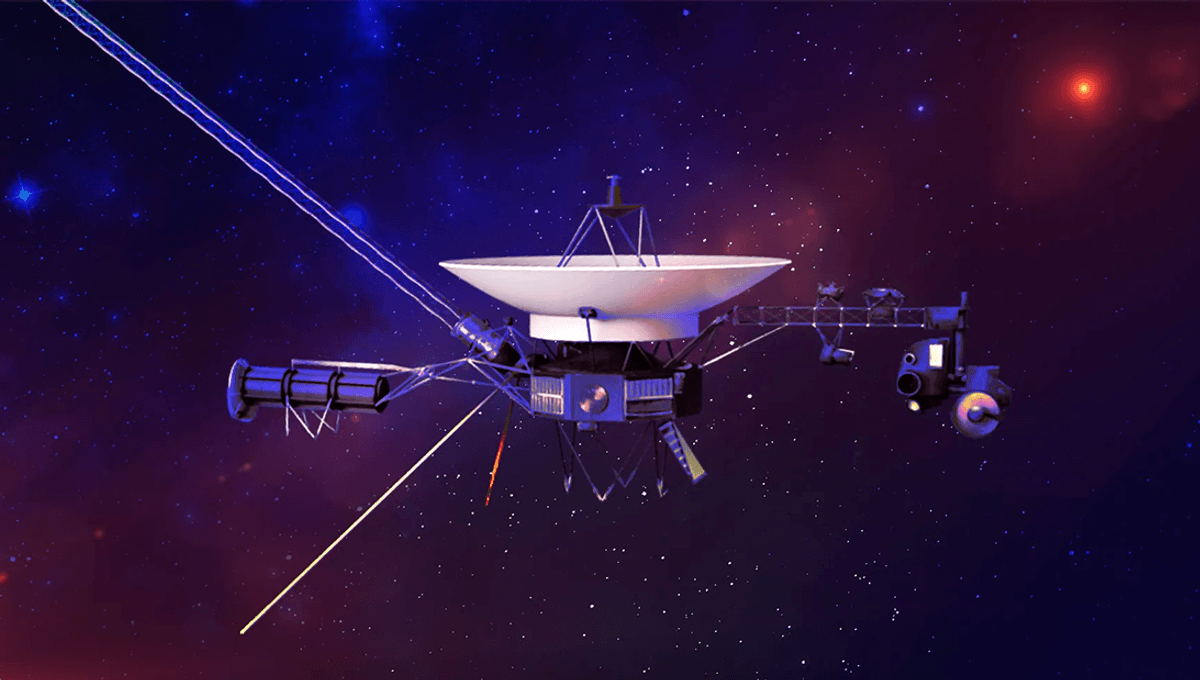
NASA’s Voyager spacecraft (1 and 2), launched in 1977, are both on a trajectory that will take them out of the Solar System, and into interstellar space.
It’s a slow journey. For an obvious example, in November 2026 Voyager 1 will reach one full light-day from Earth, or the amount of time it takes light to travel in a single day, nearly 50 years after it began its journey. The spacecraft will one day cross the Oort cloud, the hypothetical spherical “shell” of of icy bodies surrounding the Solar System, and into interstellar space, but it is a journey that will take it quite a long time.
At the lower range of estimates, the Oort cloud could begin around 1,000 astronomical units (AU) from the Sun, with one AU being the average Earth-Sun distance. If the Oort cloud does begin here, Voyager could reach it in just a few centuries. However, given the sheer scale of the cloud, it will be there for tens of thousands of years.
“Much of interstellar space is actually inside our Solar System,” NASA explains. “It will take about 300 years for Voyager 1 to reach the inner edge of the Oort Cloud and possibly about 30,000 years to fly beyond it.”
The Voyager probes are still capable of producing a little thrust, used to make tiny adjustments to their orientation rather than to, for example, floor it towards Proxima Centauri. They have achieved escape velocity, but due to the gravity of the Sun they are slowing down as they escape. But for the most part, they are currently chugging along at a fairly consistent velocity, relative to the Sun.
“As of Aug. 21, 2024, Voyager 1 was 164.7 AU from Earth – the farthest object created by humans – moving at a velocity of 38,026.79 mph (17.0 km/second) relative to the Sun,” NASA explains.
That “relative to the Sun” part is key, because relative to the Earth its velocity can differ significantly, as the Earth is moving through the Solar System too. Throughout the year, because of the Earth’s changing position as we orbit the Sun, the gap between Earth and Voyager closes a little.
The Earth is moving at around 30 kilometers per second (18.6 miles per second), though this varies ever so slightly due to our elliptical orbit. From the end of February to the start of June every year, as EarthSky points out, the distance between Earth and Voyager 2 closes a little, before we start to move away from each other once again.
While the distances between us and the Voyager probes can close, once Voyager has reached one full light day from Earth, it will never come within a day’s light travel from Earth again. According to calculations from IFLScience’s resident astrophysicist, Dr Alfredo Carpineti, using data from NASA’s Eyes on the Solar System, this will occur on November 13, 2026. After this date, the probe will not fall within 24 light-hours from Earth again, despite the Earth-to-Voyager distance changing as we orbit the Sun.

Source Link: Why Do NASA's Voyager Spacecraft Sometimes Get Closer To Earth, As They Head Out Of The Solar System?
