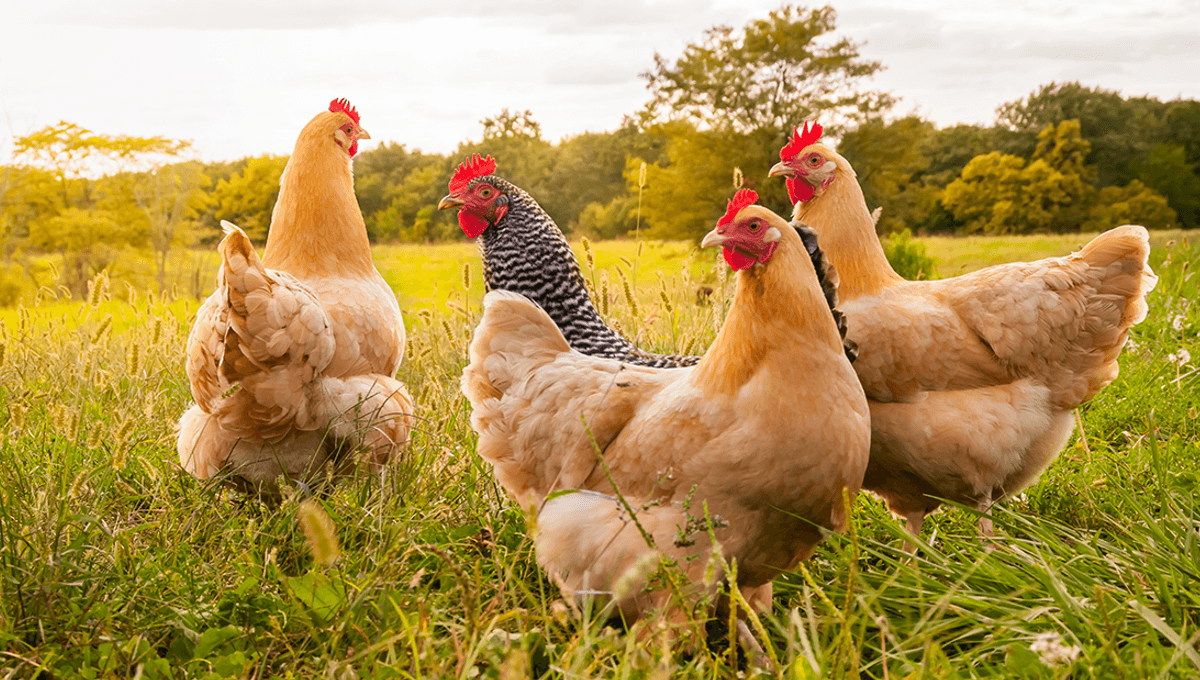
Chicken, whether Kentucky fried or simply buttered, is a large part of the human diet. The average American, for instance, eats around 45 kilograms (100 pounds) of chicken every year, according to the National Chicken Council. If you were so inclined, you could fashion that amount of chicken into a sculpture larger than a German Shepherd dog.
At some point, you may have wondered why we don’t farm and eat other birds on this scale. Are we just picking on the chickens? In a way, yes. But there are several good reasons why eating chicken really took off, and one of them is that chickens don’t take off.
Let’s start with why we eat so many hens and roosters. The history of munching on chicken goes back a long way, and part of that story has been lost to time, like chicken Salmonella in a sink. English naturalist and biologist Charles Darwin first proposed that these animals descended from red junglefowl (Gallus gallus), based on their similarity in appearance, their ability to be tamed, and the variation seen in the species. More recent genetic work has shown that they are likely actually a hybrid animal.
“While domestic chickens inherited the mitochondrial, and most of their nuclear genome from red junglefowl, the yellow skin allele originates from a species of junglefowl other than the red junglefowl, most likely from the grey junglefowl,” a team looking into the origins of chickens explains in their paper.
“The alternative explanation that W and Y haplotypes have been segregating within red junglefowl populations for a sufficient period of time to have accumulated the observed sequence divergence can be ruled out because the yellow skin sequence is too similar to the grey junglefowl sequence.”
It is not entirely clear where chickens were first domesticated and consumed. Scientists have argued, based on depictions of chickens and chicken bones found in the region, that the animal was first domesticated in the Indus Valley region around 2000 BCE. However, more recent studies showing more conclusive evidence of a domestic chicken origin date domestication to between 1650 and 1250 BCE.
The Roman Empire helped to popularize the animals and their eggs as food, but it was still a long time before they became such a large part of people’s diets. World War II, and the unavailability of red meat, certainly helped push chicken to the food status it has today.
One of the reasons why it took off so well was that chickens are slow and fairly stupid, while humans are intelligent and also lazy. The species they came from were ripe for domestication, as they were happy to live near humans.
At first though, many scientists believe that they were initially domesticated for cock fighting, and spread through the world for this purpose, before their second use (sandwiches, stews, fried) superseded their sporting prowess. As demonstrated elsewhere with the dodo, humans cannot resist a bird that can’t fly away forever.
Other birds are edible too. Pigeons have likely been consumed for thousands of years, for example, while geese may have been domesticated 4-5,000 years ago. Squab (farmed pigeons) are regularly consumed, but are not as popular as chicken, and are less easy to farm, with the young birds requiring crop milk in their first 10 days of life.
“You cannot do artificial insemination, like you do for turkey or chicken,” D’Artagnan Foods founder Ariane Daguin explained to Food and Wine. “So you actually need a daddy and a mommy every time you want a baby. It is a long process and it is much, much more intensive than any other poultry.”
Other birds are edible too, including swans. In Western Europe, a type of swan called a “mute swan” was domesticated and consumed for centuries, and was a favorite dish of Henry VIII and Elizabeth I’s court. However, they didn’t catch on as they were more difficult to cook, and had a fishy taste to them.
In short, we eat chickens because they are easier to domesticate and farm, and are much tastier than other birds to humans. But it didn’t hurt their spread around the world that ancient people also liked to watch them fight.

Source Link: Why Do We Eat Chicken, And Not Birds Like Seagull And Swan?
