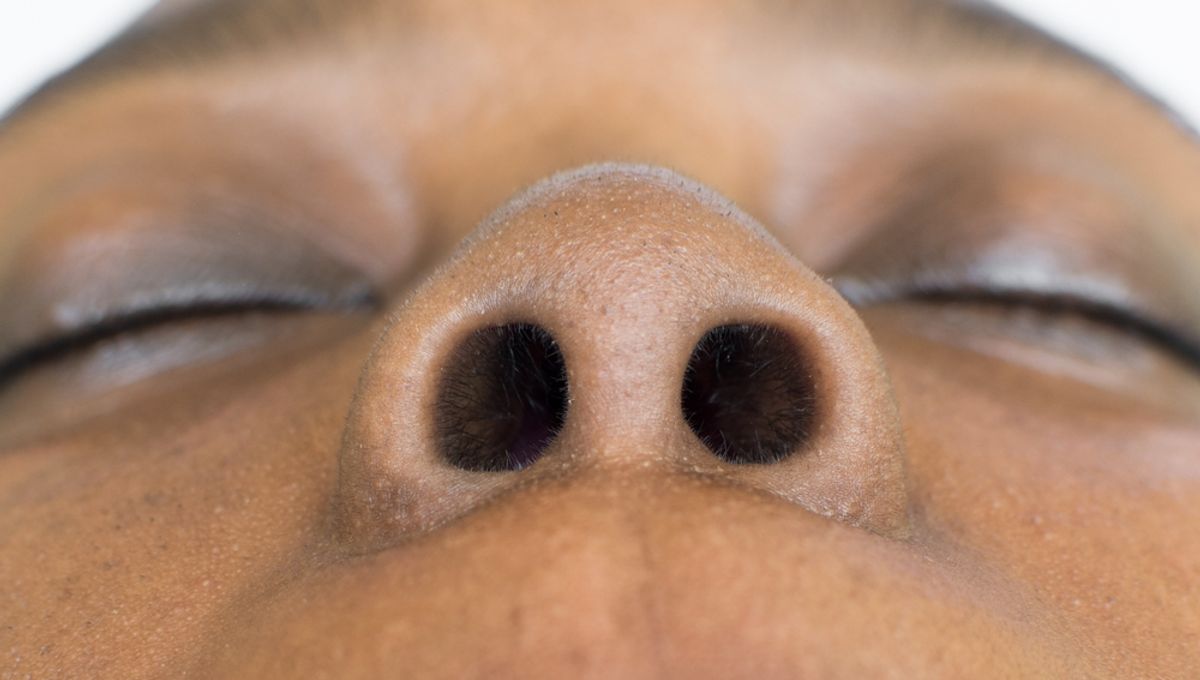
In humans, as in many animals, things tend to come in pairs. We have two eyes, two ears, two hands, and two feet – and, right in the middle of our faces, two nostrils.
For most of those features, of course, having two makes sense. A pair of eyes gives us a wider range of vision, depth perception, insurance against losing an eyeball, and stuff like that. Two ears? Helps us locate sounds, keep our balance, figure out more intricate sounds, and enjoy the impressive audio tech at IMAX theaters.
But two nostrils? What’s with that? They’re too similar to offer much variation in input; too close together to help locate stimuli. All they do is sit there and occasionally get clogged up with snot.
Right?
The nasal cycle
Like a sleeping flamingo switching legs to reduce the fatigue on each, having two nostrils lets them share the load. “While we don’t consciously notice it, we breathe predominantly through one nostril at a time,” Michael Wareing, a consultant ENT surgeon on London’s Harley Street, told The Guardian in 2014. Meanwhile, “the other side becomes a bit congested and rests.”
“This automatically changes over” every few hours, he explained, “so then the other side relaxes.”
It’s called the nasal cycle, and nobody’s totally sure why it exists – although “some people have speculated that it has to do with allowing moisture to build up on one side so that it doesn’t get too dry,” Michael Benninger, a head-and-neck doctor at the Cleveland Clinic, told Live Science in 2021.
Because of this, at any given time one nostril is doing about three times as much breathing as the other – and if you want to know which one is dominant right now, just try exhaling onto a mirror. While both nostrils will make the surface fog up, one of the clouds will be bigger than the other – that’s the one currently doing the lion’s share of airflow (if you try it, take a note of which one it is – studies tend to show that right-handed people favor their left nostril slightly more).
For most of the time – yoga enthusiasts notwithstanding – we’re blissfully unaware of our nasal cycle. The main exceptions come when something goes awry: if we’re sick, for example, one side of our nose might fill with snot, and then the switchover can become really obvious. The same effect can happen if we have a deviated septum, where the wall between the two nostrils is off-center, or if we have nasal polyps or tumors.
Otherwise, it could make itself known during sleep. If you lie on your side – say, the right side – then gravity will cause your right nostril to become more congested through the night, Benninger explained. That’s not a problem while your left nostril is doing most of the breathing – but as soon as the right takes over, it suddenly becomes much harder to get air in through that congested nostril, and you might wake up.
All the better to smell you with
So, if only one of your nostrils is doing most of the breathing at any one time, what’s the other one up to? Well, just because it’s taking a rest, doesn’t mean it’s any less useful – particularly when it comes to smelling.
“Whenever we smell something, our nose and brain work together to make sense of hundreds of […] molecules,” explained Rodrigo Suarez, Senior Lecturer in the School of Biomedical Sciences at the University of Queensland, in a 2018 article for The Conversation. “If we sniff, more of these molecules can reach the roof of our nostrils and it is easier to smell.”
Once inside our noses, the odor molecules dissolve into the mucus lining – and the slower the airflow going into the nostril, the more time there is for that dissolution to occur. The result: different scents get picked up on different sides of your nose.
And back in 1999, acting on something of a hunch, Stanford University neuroscientist Noam Sobel proved it. He recruited 20 test subjects and asked them to sniff a mix of octane and carvone – the former being a slowly absorbed chemical, and the latter a rapidly absorbed one – through one nostril at a time.
Almost all the volunteers reported a stronger octane smell when they used the more blocked nostril, and a more carvone-y smell when using the clearer one. But of course, unbeknownst to them, the mix was the same for every iteration of the experiment.
“These differences are subtle,” Sobel said at the time. “It’s not as if one smells roses and the other smells cherries. But I think it will be fundamental in understanding the sense of smell.”
This richer olfactory picture also allows us to sniff out where a smell is coming from. When we locate a sound, we do it by detecting tiny differences in when it arrives at each ear – and the ability to locate a smell works kind of similarly. “The fact that we have two nostrils allows our brain to detect small differences in the number of molecules that reach each one, so we can follow a smell trail just like tracker dogs,” Suarez confirmed.
“Have you ever tried finding where a smell is coming from?” he asked. “See how hard it gets with one nostril blocked.”
And yes, there may be much less space between our individual nostrils than our ears – but “the brain is good at using even small inputs,” Matthew Grubb, a professor of neuroscience at King’s College London, who focuses on the olfactory system, told Popular Science this month.
It’s not just a theory. Experiments have shown that this difference in individual nostril input is enough to let us hunt down chocolate from 10 meters away in an open field – and that mixing up the aromas equally between our nose-holes screws with our ability to do so.
“There’s pretty good evidence that one of the things nervous systems can do is to use information from the two nostrils to figure out where a smell is coming from,” Grubb said.
Symmetry and survival
Despite all these advantages, it’s worth pointing out that Nature doesn’t have end goals – so the true “reason” behind our dual-nostril situation isn’t really anything we’ve covered so far. Rather, it’s twofold (literally): firstly, because our bodies develop with bilateral symmetry – hence why we have two eyes, two ears, two arms and feet, and so on – and secondly, because it isn’t a big enough problem to justify not having two of them.
Having just one big nostril, on the other hand, would offer quite a few problems. Apart from the lack of smell-o-location, imagine the problems that would turn up when we got a cold: with no backup channel to breathe through, we’d be forced to use our mouths if we got blocked up – which would mean losing out on all the benefits of nasal breathing.
“Humans are naturally designed to breathe through our noses from birth. It’s the way we’ve evolved,” points out the Cleveland Clinic. “Our noses are designed to process the air that comes in very differently than our mouths. These are intentional and functional parts of our body’s design to keep us safe and healthy.”
Using our noses to breathe not only filters the air we take into our lungs of things like germs and pollutants, but it also humidifies it and warms it up. It smells things – including things we don’t even realize are there – and regulates our breathing and blood flow. Having one single nostril to get blocked up would mean more chances to lose all of those advantages at once – not ideal for the survival of a hyper-social animal that only recently discovered the wonders of germ theory.
But the biggest reason to thank our lucky stars that we have two nostrils? Well, as Wareing points out: “imagine how odd we’d look with just the one.”

Source Link: Why Do We Have Two Nostrils, Instead Of One Big Nose Hole?
