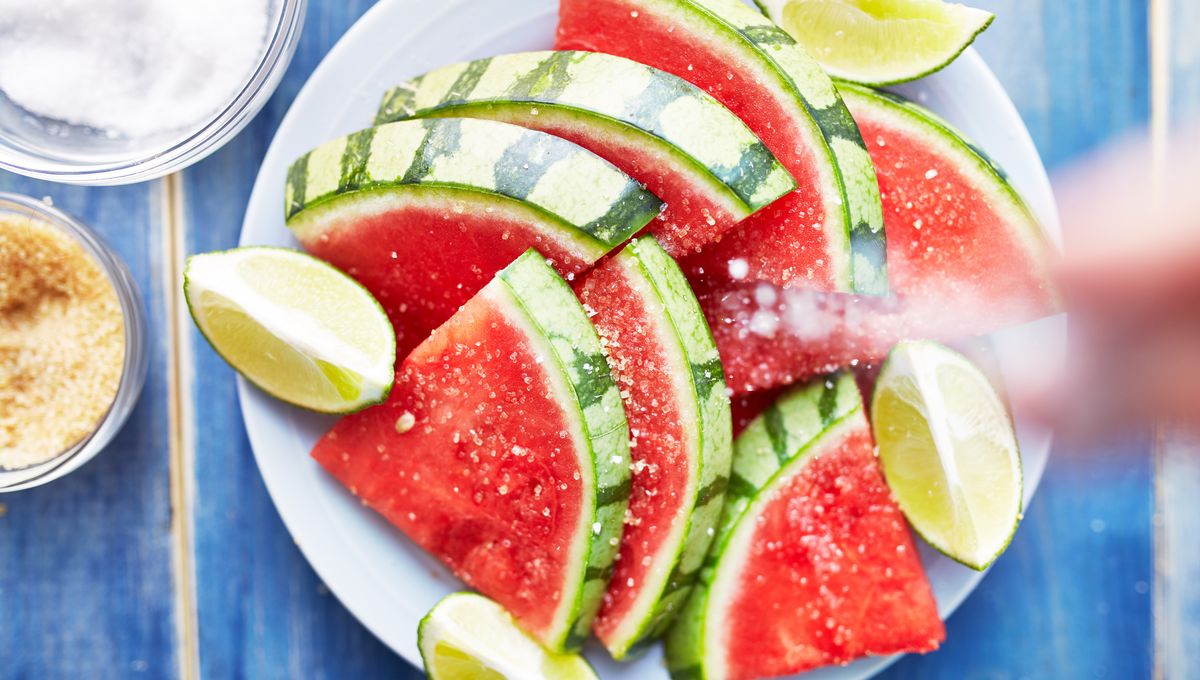
Sprinkling a little salt on some mango or grapefruit doesn’t seem like something that would make it taste nicer and yet people do it all the time – and claim that the fruit is all the sweeter for it. But how exactly does salt lead to more sweetness?
Understanding how this works requires us to zoom in on our tongues. There you’ll find tastebuds, which are clusters of taste receptor cells. Zoom in even further, and you’ll notice these cells are packed full of receptors, which send signals to the brain when molecules in food bind to them, allowing us to identify something as having a sweet, salty, sour, bitter, or umami taste.
Certain tastes have been found to be detected by certain types of receptors, but when it comes to tasting sweet, researchers have discovered the picture to be more complex than might be assumed.
When scientists got rid of the genes encoding the sweet-detecting T1R family of receptors in mice, something unexpected happened – the mice still appeared to enjoy very high concentrations of sugars. Was something else helping the mice to detect sweet?
According to a 2020 study published in Acta Physiologica, the answer appears to be “yes”.
There’s a protein found in sweet taste receptor cells known as the sodium-glucose cotransporter 1 (SGLT1) that, in the kidneys and intestine, uses sodium to help transport glucose into cells.
The study authors found that this also seems to be the case in the tastebuds of mice; when they gave mice lacking a T1R receptor a solution containing glucose and a low concentration of salt, the nerves connected to the mice’s taste receptor cells fired more rapidly than in those that were only given glucose.
While mice can’t be directly compared to humans, we share enough similarities that the study authors think the results might just apply to us to, explaining why a dash of salt makes caramel that much sweeter.
It’s not the only potential mechanism by which salt might makes things sweeter for us, however. Another study involving some of the same researchers found that salt’s sweet-enhancing capabilities might not just be down to the sodium in salt, but the chloride ions too.
Using structural biology techniques, the team found that chloride ions can bind to one of the T1R receptors and when they do so, it changes the shape of the receptor – a sign that it’s been activated and is sending “sweet” signals to the brain.
When they followed this up by giving mice a solution containing small amounts of chloride and looked at the activity of neurons associated with the sweet taste, those neurons fired more. If the mice were given the same solution alongside a compound that blocked the receptor, then that activity didn’t occur.
This, the researchers say, suggests that small amounts of salt may well end up making things sweeter – though, again, they also conclude that research in human taste receptor cells needs to take place before we can say the same mechanisms are involved in us as well.
Who knew all that could be going on inside a tiny tastebud?

Source Link: Why Does Adding Salt To Food Sometimes Make It Sweeter?
