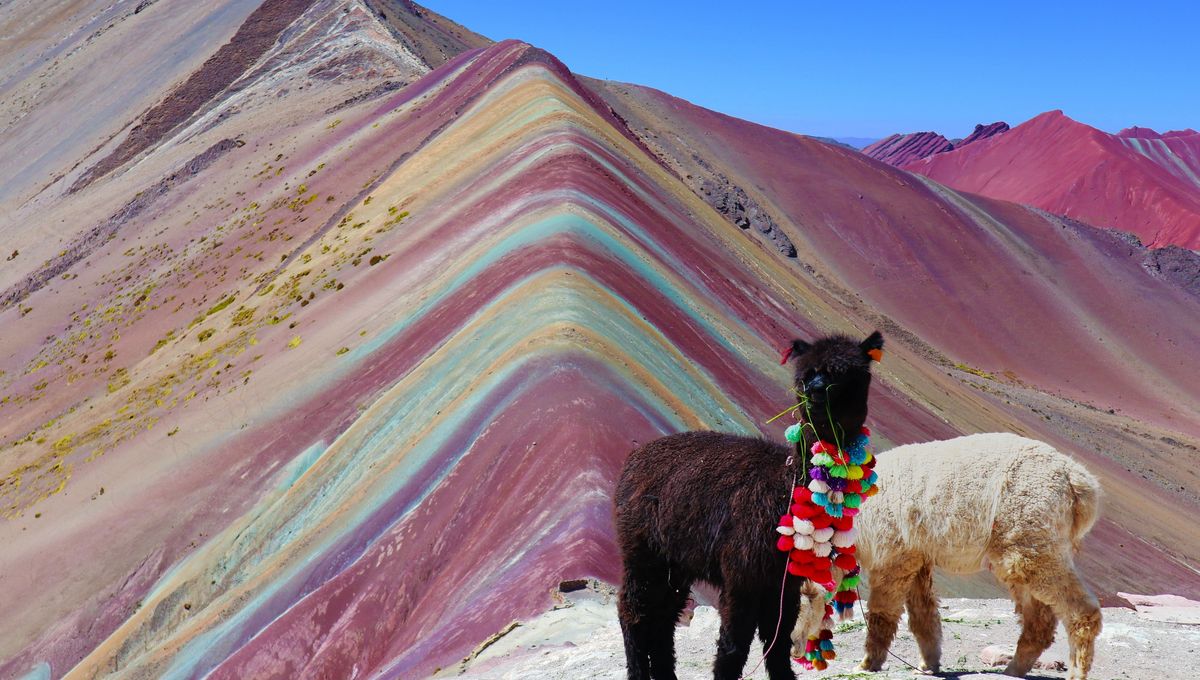
In a world awash with AI slop, you’d be forgiven for thinking Rainbow Mountain was cooked up by an image generator. Rest assured, it isn’t.
Vinicunca, also known as Rainbow Mountain or Montaña de Siete Colores, is part of the Andean mountain range in the Cusco region of Peru. This is the same part of the Andes where you can find Machu Picchu, the so-called “Lost City of the Incas”, although it will take several hours of harsh trekking to travel between the two.
It’s also a tricky hike because these locations are found at extremely high altitudes. Located at 5,036 meters (16,522 feet) above sea level, Vinicunca is known for its steep ridges colored with stripes of sandy browns, unearthly blues, mustard yellows, rich reds, and beetroot purples.
According to the Geological Society of Peru, the mountain features seven distinct colours of stripes that are created by the presence of certain minerals:
- Pink or fuchsia: a mixture of red clay, mudstone, and sand
- White: sandstone and limestone
- Purple or lavender: marl, a blend of clay and calcium carbonate, with silicates
- Red: argillites, iron oxide, and clays
- Green and turquoise: clays rich in ferromagnesian minerals (iron and magnesium) and copper oxide
- Yellow, mustard, or golden: limonites and calcareous sandstones rich in sulfide minerals.
It’s notable that these colours are especially vibrant after a downpour of rain, while the hues take on a softer, pastel tone in the dry season (April to October).
While many geological features are composed of layers of rocks and minerals accumulated over vast spans of time, Vinicunca is especially spectacular because its layers are clearly exposed. Unlike other peaks, where mineral strata are often buried, Vinicunca’s steep slopes have been revealed by millions of years of rain, snowfall, fast winds, and extreme temperatures.
It’s likely that many surrounding mountains conceal similarly rich colours beneath their surfaces. However, Vinicunca is unique because it features a sharp, angular ridge where erosion has stripped those layers bare, revealing the mountain’s interior like a giant gumball slowly licked down to its core.
The name Vinicunca means something like “mountain of colors” in the language of the local Quechua people. Along with herders and roaming tourists, the site is frequented by alpacas and llamas, iconic Andean animals that are an integral part of mountain life in Peru, Bolivia, and Chile.
In the era of social media, the mountain has become a world‐renowned tourist destination. Unfortunately, this influx of people is taking its toll. A 2023 paper about the problem reads: “A high‐mountain setting as such is fragile and does not recover fast, meaning the rapid influx of visitors has caused severe landscape degradation from which it will take several decades to recover.”
This is, unfortunately, the price of being desperately Instagrammable.

Source Link: Why Is Rainbow Mountain So Vibrantly Colorful?
