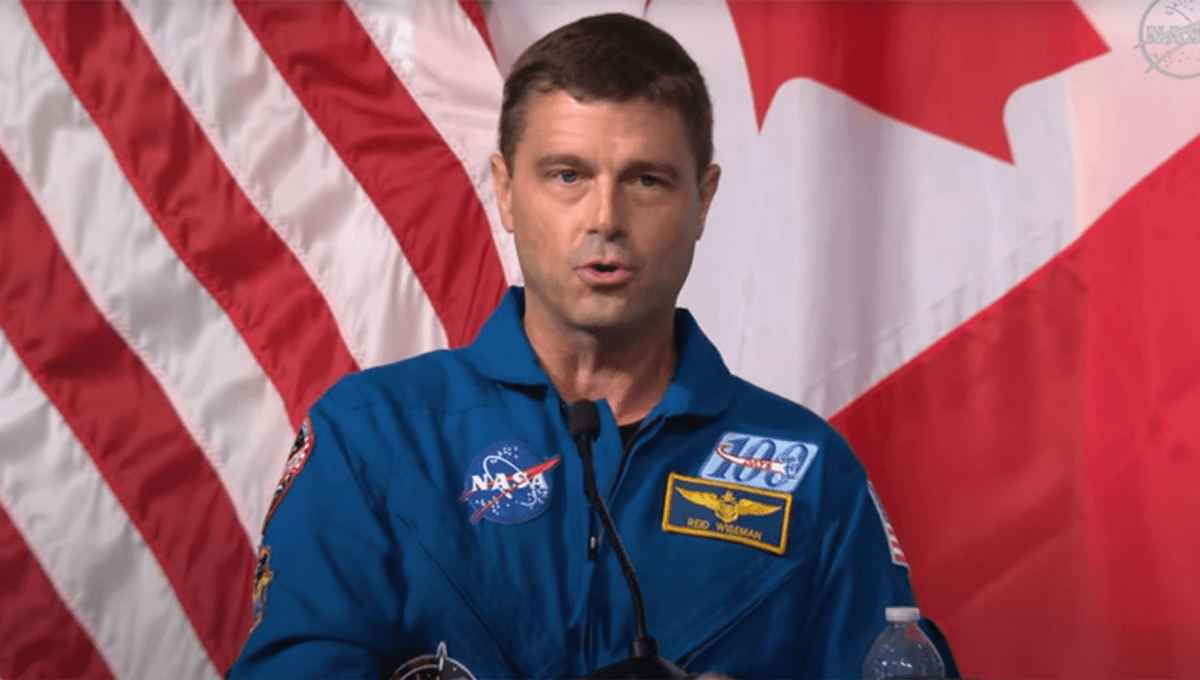
Astronaut Reid Wiseman, who will serve as Commander on NASA’s upcoming Artemis II mission to the Moon and back, has explained why he “hopes” that the crew will be forgotten by history.
On Monday, NASA announced its schedule for the second stage of the Artemis II, the second stage in the space agency’s project to land humans on the lunar surface. In the update, they outlined key details of the mission, which will take place in February 2026, assuming all things go to plan.
Artemis I tested the Orion spacecraft and the Space Launch System (SLS) rocket. Artemis II is a little more exciting and will send four astronauts – including the first woman – around the Moon, the first time we have done this since Apollo 17 in December 1972.
“We together have a front-row seat to history,” Lakiesha Hawkins, Artemis II Mission Manager at NASA’s Kennedy Space Center, said in the conference. “We’re returning to the moon after over 50 years.”
NASA has set potential launch windows for the 10-day mission. The first could see the Orion spacecraft take off on February 5, 2026, with plans for it to launch no later than April 26 of the same year. The launch will see NASA’s Reid Wiseman, Victor Glover, Christina Koch, and Canadian astronaut Jeremy Hansen break records as they travel 9,260 kilometers (5,000 nautical miles) past the Moon.
“This is going to be a free-return trajectory,” Hawkins explained. “We are going to set the course when we do the translunar injection burn on day two to use physics – the Earth and the Moon’s gravity – to make sure that we can return the crew without having to make major course-correction propulsion burns.”
This technique has been used before, notably on the Apollo 8 and Apollo 16 missions.
“We go from launch and then the boosters, of course, which provide about 75 percent of the thrust that we need in order to be able to get the spacecraft a lot higher. Once we do that, then […] the RS-25 engines burn. Then we are going to jettison the boosters as well as the launch abort systems. Once we get through main engine cutoff, then we are going to do the perigee-raising burn, and then we are going to demonstrate a rendezvous proximity operations demonstration.”
The 10-day mission will end with a high-speed return to Earth.
“The crew will endure the high-speed, high-temperature reentry through Earth’s atmosphere before splashing down in the Pacific Ocean off the coast of San Diego, where they will be met by a recovery team of NASA and Department of Defense personnel who will bring them back to shore,” NASA explains.
During the conference, NASA reiterated that safety was the number one priority for the flight. Artemis II was originally scheduled for this year, but NASA pushed it to next year after the Orion capsule’s heat shield was damaged more than expected in reentry in 2022.
“The agency has made a commitment to launch no later than April of ’26. We intend to keep that commitment,” Hawkins added. “We are also, though, working to accelerate, as much as we can, in terms of the preparations and the operations preparation to potentially as early as February. But we want to emphasize that safety is our top priority. As we work through these operational preparations and finish stacking the rocket, we are continuing to assess to make sure that we do things in a safe way.”
All things going well, we will return to the Moon for the first time in 50 years, ahead of a landing as early as 2027. The Artemis II mission would be a stepping stone on that journey, and you might think that the crew would go down in history, just as Frank Borman, Jim Lovell, and Bill Anders did as they went around the Moon on Christmas Eve, 1968.
But during a crew conference on Wednesday, Commander Reid Wiseman explained why he hopes that is not the case. When asked about the legacy they hoped to inspire, he gave his answer.
“This is the first time we are going to send humans to the Moon and [have] humans in low Earth orbit. That is awesome. As humanity, we should take a brief moment to go: that is awesome,” Wiseman said during the conference, adding that their focus over the last few months has not been on legacy, but abort systems and the practicalities of the mission.
“When I look at the future, when we talk about what is our legacy, I don’t want to look five years or 10 years in the future. I want to look 100 or 200 years in the future. Honestly, this is where I thought it may land wrong: I hope we are forgotten,” he told the crowd of journalists.
“If we are forgotten, then Artemis has been successful. We have humans on Mars, we have humans on the moons of Saturn, we are expanding in the Solar System. We have robotic precursor missions going on, we have spacecraft. Maybe we invented something we never dreamed of and inspired some kid somewhere; and that is the footnote. ‘He went and inspired Susie or Johnny to do what they did’. That would be magical.”
As noble a goal as that is, the crew will be making history as they launch to the Moon. As well as being the most distant anyone has ever been from Earth, mission specialist Christina Koch will become the first woman to fly around the Moon, earning her place in the history books for a long time to come.
“I do think about those Apollo astronauts. I have seen them many times in those press conferences. We read their books. They were mission-focused. They went through the training the team put before them. They worked with the teams. They stayed up late. They studied because they cared about giving the most backup they possibly could. And that is what we share with them – that I am so proud and honored to share,” Koch added, responding to the question of legacy.
“Then another thought that comes to mind is about how NASA is revered for that history, and I also want it to be revered for the future; for the future that we are bridging to humanity and doing this mission.”
The crew will fly as early as February, with potential launch windows stretching until April.

Source Link: Why NASA's Artemis II Moon Mission Commander Hopes They "Will Be Forgotten"
