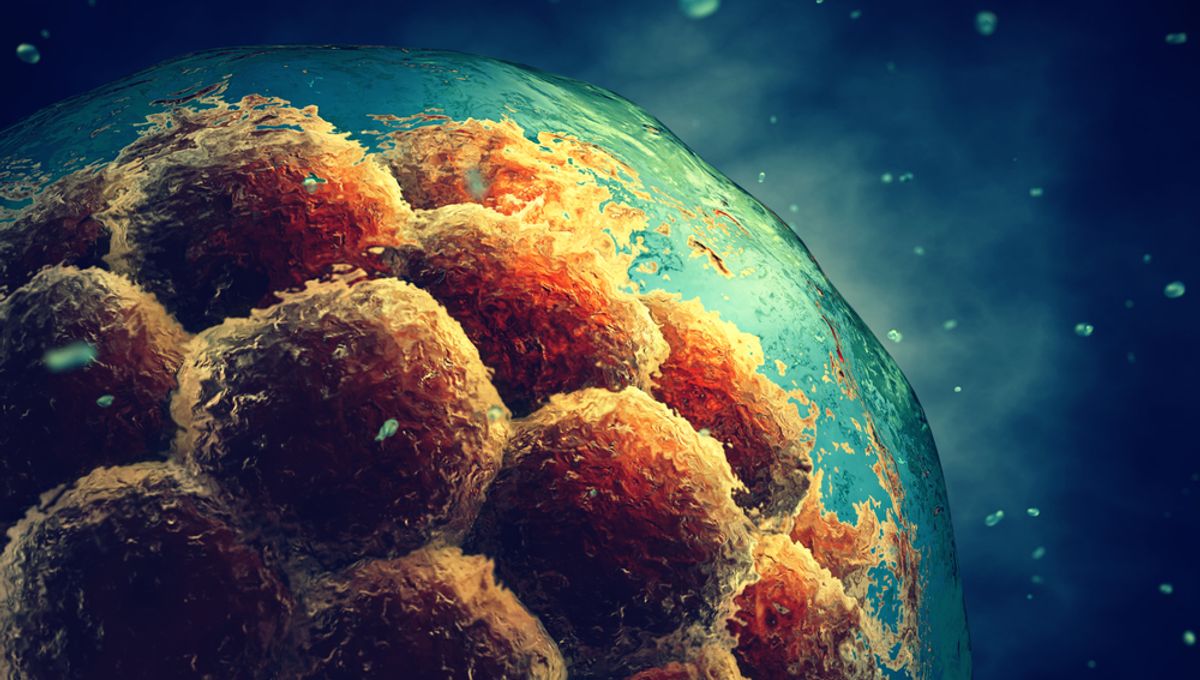
Human stem cells have been coaxed into organizing themselves into synthetic embryo-like models, all without the need for eggs or sperm. These models can be used to help understand a crucial moment in embryo development, which has so far remained a mystery to scientists.
The question mark occurs around two to three weeks after conception when an embryo goes through a stage called gastrulation. In this critical stage of development, it transforms from a blob of embryonic cells into an array of different specialized cells, which later become the precursors of future blood, tissue, muscle, and more types of cells.
Scientists know very little about this fundamental turning point in early development as the microscopic embryo is buried in the womb at this time.
However, it’s hoped these embryo-like models could provide some invaluable insights into the enigmatic process. In doing so, they could help us gain a better understanding of medical problems that happen before birth and why many pregnancies fail in the early stages of development.
A number of groups have recently announced similar success stories in creating synthetic embryo-like models, but this latest is the first publication in a peer-reviewed journal.
In two new studies, two teams of scientists – one from Yale School of Medicine and another from the University of Cambridge – simultaneously explain how human pluripotent stem cells can be triggered to self-organize into three-dimensional structures that closely resemble the human embryo at days 9 to 14 after fertilization.
“Our human embryo-like model, created entirely from human stem cells, gives us access to the developing structure at a stage that is normally hidden from us due to the implantation of the tiny embryo into the mother’s womb,” Professor Magdalena Żernicka-Goetz, who led the team at the University of Cambridge, explained in a statement.
Make no mistake: these embryo-like models are not capable of developing into lab-grown babies. In fact, one of the key tenets of the research is to avoid the ethical minefield of using real embryos for this kind of study.
“Cells are always talking to each other by touch and secreted signals. This is especially true during early human development. The current wave of research into stem cell-derived embryo models […] allows scientists to investigate what is happening during the earliest stages of human development without the need for embryos,” commented Dr Jason Limnios, Group Leader in the Human Pluripotent Stem Cells and Retinal Development Lab, and Research Fellow in the Clem Jones Centre for Regenerative Medicine, at Bond University.
“What [the scientists] created was not an actual embryo, but a collection of several cell types found in the early embryo,” Dr Limnios added.
Reacting to the studies, a number of scientists praised the work as “remarkable” and “exciting,” noting it holds hold promise for the field of fertility research.
“Alongside other recent models of the pre-implantation embryo, these advancements provide an exceptional opportunity to study and understand the initial phases of human development occurring between week 1 and week 3 which has remained elusive for technical, ethical and legal reasons. This research holds significant importance as approximately 50 percent of fertilizations are estimated to cease progression beyond this point,” Professor Jose Polo, a researcher in Epigenetics at the University of Adelaide, and from the Department of Anatomy and Developmental Biology at Monash University, said in a statement.
“This is a very exciting time for developmental biology and human fertility research. These diverse models can be employed in laboratories to gain a deeper understanding of early human development and explore potential solutions for infertility,” Professor Polo added.
The two studies are published in the journal Nature, here and here.

Source Link: Why Scientists Are Making Human Embryo-Like Models From Stem Cells
