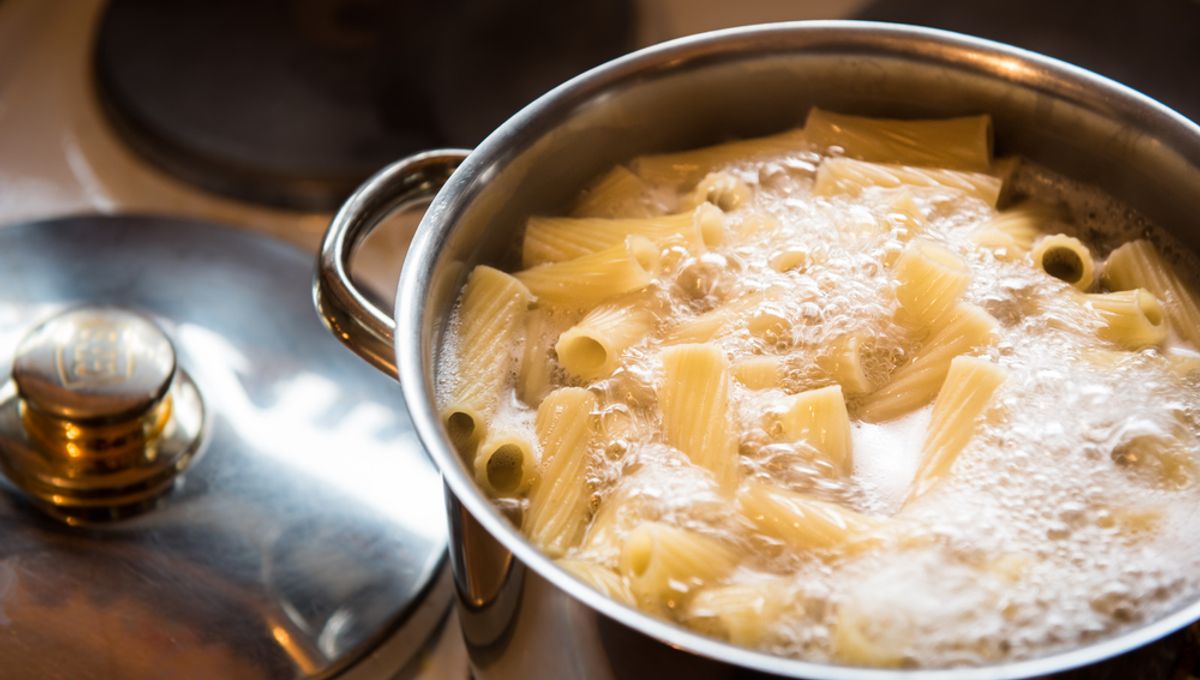
What’s the most valuable thing in your kitchen? That Himalayan pink salt, perhaps? Something gluten free? No: according to generations of chefs and Italians alike, the answer is in your saucepan – and chances are, you’ve been throwing this so-called “liquid gold” down the plughole for years.
“Don’t throw the water out after your pasta is cooked,” advises Martha Stewart magazine. “It’s a simple thing, but it might feel like a revelation.”
“If you haven’t heard this cooking motto before, consider adapting to it now,” they write. “The water left in the pot after you have cooked your spaghetti, fusilli, or shells is loaded with the starch the pasta left behind, which is why it looks cloudy.”
But what makes a little bit of salty, starchy water worthy of the “liquid gold” moniker? Well, it’s surprisingly scientific – and deliciously tasty.
The science of why pasta water improves your dinner
Some things in cooking are a simple matter of taste. Others, though, are pure science.
“Pasta water […] exhibits fascinating physical properties, primarily due to its starch content,” points out an Ig Nobel Prize-winning physics paper from April of this year. “When heated, starch-water solutions undergo a gelatinization transition, altering their viscosity and structural properties.”
It’s one of the reasons why gluten-free pasta is so difficult to wrangle: because, as the noodles are cooked, the starch molecules swell up and leak into the water around them. But “pasta water isn’t just ‘water with starch in it’,” explains Abbey Thiel – aka Abbey the Food Scientist – a food scientist and product development consultant whose doctoral thesis focused on emulsions.
“I would call it a functional ingredient,” Thiel tells IFLScience. “It thickens, stabilizes, and helps fats and water coexist so you end up with a sauce that’s smoother, richer, and clingier.”
[W]hen you finish a pasta dish the classic Italian way (tossing the pasta in the sauce with some pasta water), you’re essentially building an emulsion in real time.
Abbey Thiel
That’s a lot to place on what looks to be just some cloudy water – but starch just happens to have chemical properties that translate particularly well into tastiness. It all comes down to emulsions – mixtures of two liquids that “normally […] want nothing to do with each other,” Thiel explains.
Think wine and butter, she says, or – more pertinently for your everyday pasta sauces – olive oil and the water present in tomatoes. Try to mix these two ingredients together, and you may succeed for a little while – but eventually, “[the] fat separates, water pools, and you get a broken sauce,” Thiel tells IFLScience. “[The] droplets aren’t stable unless you do something to make them stable.”
Luckily, the starchy pasta water is precisely what’s needed here. “Starch is fantastic at helping emulsions form because of how its molecules behave,” says Thiel. It thickens the water, she explains, making it harder for fat droplets to merge and separate; it also coats itself around fat droplets, making for a smoother mix of ingredients. “Think of starch granules as tiny ‘jackets’ around droplets of oil or butter,” Thiel tells IFLScience. “Once coated, those droplets don’t bump back together as easily, so the sauce stays smooth instead of breaking.”
In total, she says, “when you finish a pasta dish the classic Italian way (tossing the pasta in the sauce with some pasta water), you’re essentially building an emulsion in real time. The starch stabilizes the mixture of fat (olive oil, cheese, butter) and water (from the pasta water and the ingredients in the sauce).”
“That’s what gives you that glossy, cohesive, restaurant-style coating instead of two messy layers.”
The best bit? The starchy water doesn’t just make the sauce itself better – it affects the entire dish.
“Starch helps the sauce cling,” Thiel tells IFLScience. “Those hydrated starch molecules also create a sort of sticky network, which is why the sauce grabs onto the pasta instead of sliding off.”
Testing the theory
So much for the science – but how does the pasta-water hack hold up in real life? Well, luckily, somebody’s done the research for us here: Daniel Gritzer, the editorial director of Serious Eats, back in March 2023.
“Most pasta aficionados will tell you that the best way to do it is by finishing cooking the nearly-done pasta on the heat in its sauce with a little of the pasta-cooking water,” he wrote at the time – and while “all of my own pasta-cooking experience supports that theory,” he said, “I’d never done side-by-side tests to prove that it actually works better.”
So, Gritzer carried out a pair of experiments. First, he cooked three sets of pasta in differently-starched ways – one, he boiled, drained, and added sauce; one, he boiled, drained, then tossed with sauce; one, he drained, then briefly cooked it in the sauce mixed with a splash of reserved pasta water – and doled them out to his coworkers to decide which was best.
“The pasta that had been cooked in its sauce with some of that pasta water won by a landslide,” he reported. “That method bound the pasta and its sauce together in a way the other methods didn’t.”
Next, he interrogated this conclusion. “Just because our first test demonstrated that it’s best to cook pasta in its sauce with some of the starchy cooking water doesn’t prove beyond a doubt that the starch itself is important,” he pointed out. “Maybe cooking pasta in its sauce is all that matters, starchy water or not.”
So, back to the kitchen he went – this time, cooking three batches of saucy pasta with respectively “very starchy” water, “moderately starchy” water, and tap water. The “sauce” itself was just a plain olive oil – perfect, if the claims about pasta water’s emulsifying properties are true, for the starchy mix to shine.
And shine it did: “None of the sauces formed a totally perfect emulsion (that’s what I get for trying to make a sauce from nothing more than oil and water),” Gritzer wrote, “but the starchiest water was by far the most emulsified of the three.”
“A little grated cheese tossed in at the end is all I would have needed to fully bind the sauce.”
Liquid gold
The lesson appears to be clear: you should stop throwing your pasta water down the sink, stat. Instead, “think a step ahead,” advises Martha Stewart magazine. “Catch yourself before you drain the pasta in a colander, and ladle a cup or two of water from the pot.”
“Even more efficient is the professional cook’s technique: Skip the colander and scoop the cooked pasta with a mesh spider directly from the pot into a waiting skillet.”
In short, it’s clear why pasta water is called “liquid gold” – it’s evidently the most valuable ingredient in your cacio e pepe sauce. Buon Appetito!

Source Link: Why You Need To Stop Chucking That "Liquid Gold" Down Your Kitchen Sink
