• Email Us: [email protected]
  • Contact Us: +1 718 874 1545
  • Skip to main content
  • Skip to primary sidebar

Medical Market Report

  • Home
  • All Reports
  • About Us
  • Contact Us

Why You Should Never Waste The Stringy Bits On A Banana

June 12, 2023 by Deborah Bloomfield

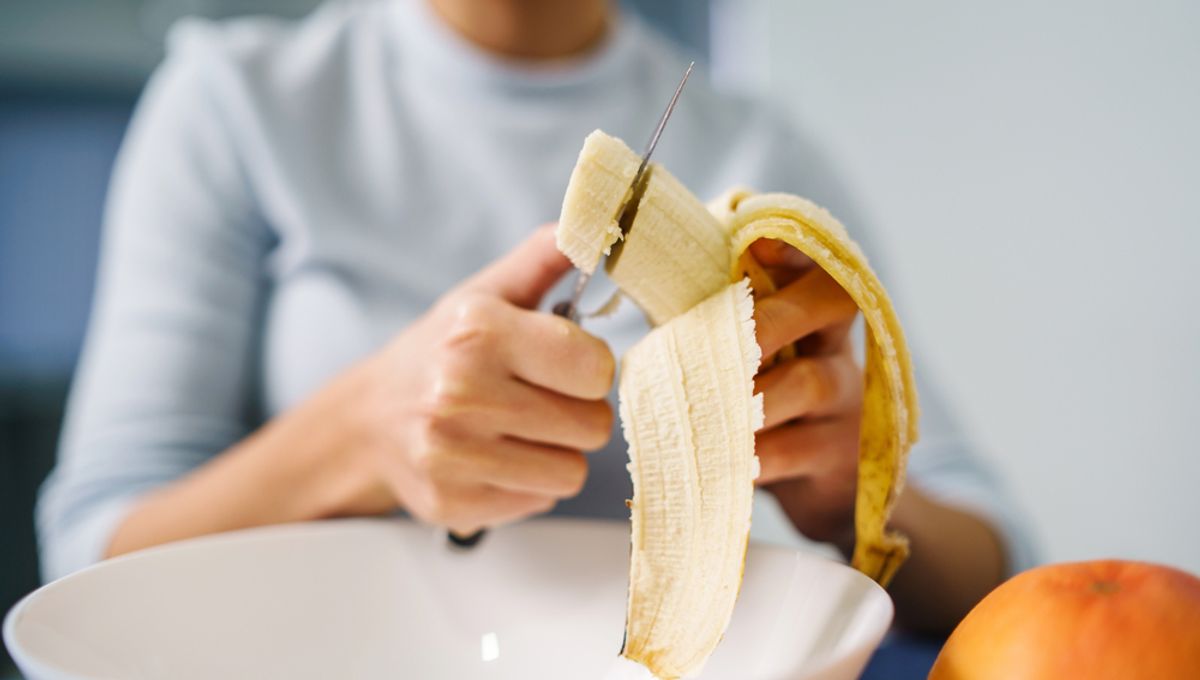
Many banana lovers are quick to banish those strange stringy bits that emerge when peeling the fruit, but there are a few good reasons you should savor these strands. Known as phloem bundles, these stringy bits are perfectly edible and surprisingly nutritious. 

They might be mildly radioactive, but bananas are packed full of goodness. As per the USDA, one medium banana provides just under 100 calories, plus a load of essential nutrients such as fiber, potassium, vitamin B6, vitamin C, magnesium, and manganese, as well as various antioxidants and phytonutrients.

Advertisement

The phloem bundles are no different. The phloem is essentially the internal plumbing of a plant, acting as tubes to pump the sugars and other products of photosynthesis around to wherever they are wanted. These tubes need to be especially sturdy to perform this important task, so they’re formed of more complex types of fiber compared to the rest of the banana.

“Although we have not specifically tested phloem bundles, it is likely that there would be a difference in its nutritional value. Since they are intended to do a specific job, and as such likely have a defined structure which supports that job, they would be expected to have a different compound profile to the regular edible banana flesh,” Nicholas D. Gillitt, Chief Scientific Officer at BerkleyRD and former vice president of nutrition research and director at the Dole Nutrition Institute, told Huffington Post in January 2023.

ⓘ IFLScience is not responsible for content shared from external sites.

“They likely contain more and varied types of fiber and structural components required for their function. Because of this, they probably would have a different nutritional profile for humans,” Gillitt added.

Advertisement

It isn’t just picky humans that have an aversion to banana strings. Viral videos have shown that many monkeys also peel away the strands when peeling a banana. Then again, bananas are a cultivated domesticated plant, so wild monkeys never actually encounter bananas at all ever unless they are around human settlements where bananas have been grown. 

The same is true for banana skins. Although they’re very tough and bitter, they are edible and also rich in several key nutrients. 

If the idea of munching down on peels seems pretty unappetizing to you (we don’t blame you), a good way to avoid wasting banana skins is to place them in water for a couple of days. This will allow some of the nutrients to steep into the water, making it an excellent drink for indoor plants. 

Deborah Bloomfield
Deborah Bloomfield

Related posts:

  1. VW CEO says smart cars, not e-cars, are ‘gamechanger’
  2. El Salvador body to investigate complaints about government’s bitcoin purchases, ATM kiosks
  3. Soccer-Koulibaly says Fiorentina fans racially abused him
  4. The Multiverse: How We’re Tackling The Challenges Facing The Theory

Source Link: Why You Should Never Waste The Stringy Bits On A Banana

Filed Under: News

Primary Sidebar

  • “Cosmic Dipole Anomaly” Suggests That Our Universe May Be “Lopsided”, Seriously Challenging Our Understanding Of The Cosmos
  • Which Animals Mate For Life?
  • Why Is Rainbow Mountain So Vibrantly Colorful?
  • “It’s An Incredible Feeling”: Salty Air Bubbles In 1.4-Billion-Year-Old Crystals Reveal Secrets Of Earth’s Early Atmosphere
  • These Were Some Of The Most Significant Scientific Experiments Of 2025
  • Want To Know What 2026 Has In Store? The Mesopotamians Have A Tip, But You’re Not Going To Like It
  • Can Woolly Bear Caterpillars Predict Winter Weather? No – But They Do Have A Clever Way To Survive The Freeze
  • Is Showering More Hygienic Than Bathing – What Does The Science Say?
  • Why Is Christmas Called Xmas?
  • Stardust Didn’t Reach The Solar System The Way We Thought, So How Did It Get Here?
  • This Might Be The First Time We’ve Ever Seen A Gravitational Wave Event Gravitationally Lensed
  • Carnivorous, Enormous, And Corpse-Scented: What Are The Rarest Plants On Earth?
  • What Are Nieves Penitentes? The Strange Icy Spikes Found In Some Of Earth’s Most Alien Landscapes
  • What Killed One Of The World’s Biggest Crocs? A Necropsy Of Cassisus Suggests A Hidden Killer
  • Avi Loeb Says Interstellar Object 3I/ATLAS Is “Most Likely Natural” As It Heads Away From Earth
  • For The First Time, Moths Have Been Captured On Camera Feeding On Moose Tears
  • USGS Camera Catches A “Dirty Eruption” At Yellowstone’s Black Diamond Pool
  • This Is Why You Shouldn’t Soak Your Dishes In The Sink Overnight
  • With The Powerful Vera Rubin Observatory, We Could Find Up To 50 Interstellar Objects Like Comet 3I/ATLAS
  • First Evidence For Maternal Care In Plants Reveals Placenta-Like Structure That Sustains Their Offspring
  • Business
  • Health
  • News
  • Science
  • Technology
  • +1 718 874 1545
  • +91 78878 22626
  • [email protected]
Office Address
Prudour Pvt. Ltd. 420 Lexington Avenue Suite 300 New York City, NY 10170.

Powered by Prudour Network

Copyrights © 2025 · Medical Market Report. All Rights Reserved.

Go to mobile version