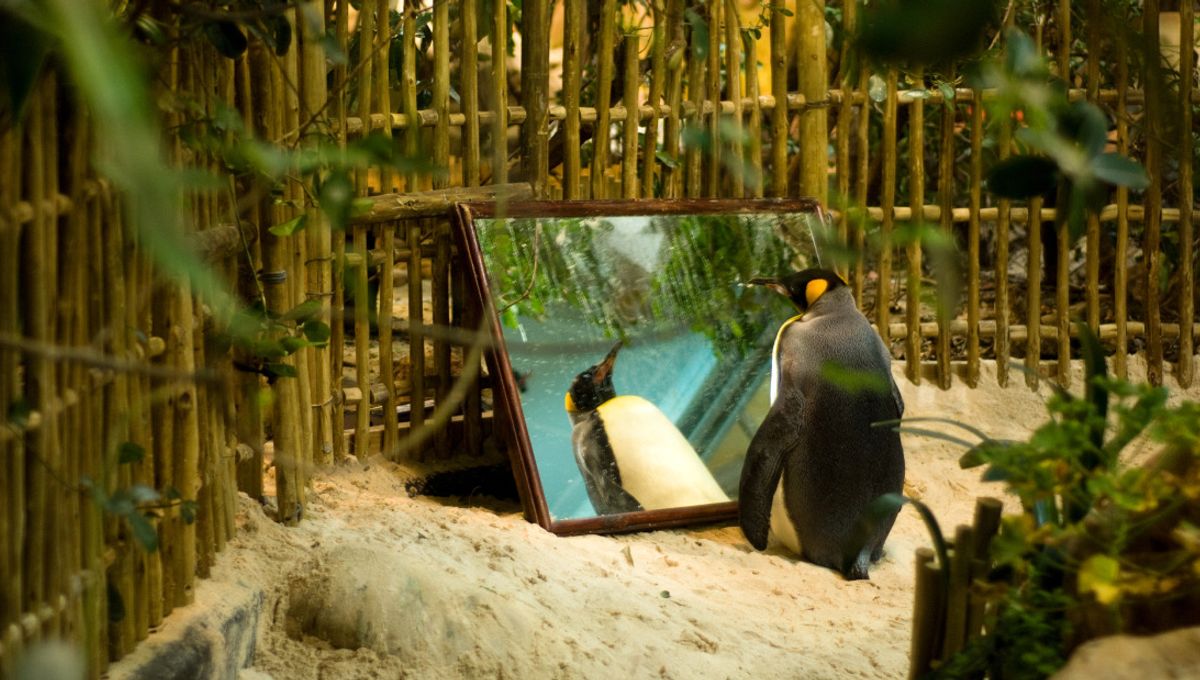
Penguins may have joined the small roster of animals that have passed the mirror test, believed to be the benchmark for a sense of self. Until now, the only animals to have passed have included a few mammals and fish – but now, a preprint paper suggests that wild Adélie penguins may have passed the mirror test, possibly demonstrating they have self-awareness.
The mirror test is a fun experiment in which an animal is placed in front of a mirror after a colored mark, typically a sticker, has been stuck on its body. If the animal then tries to examine and/or remove the mark and doesn’t try to remove invisible marks or preen in the absence of a mirror, the creature is considered to understand the nature of reflections and can identify itself. It’s considered a test for self-awareness, though it can be tricky to interpret if the animal’s behaviors and biology affect the validity of a mirror test.
The preprint paper, which has not yet been published or certified by peer review, was conducted in early 2020 with a group of wild Adélie penguins on the Dog’s Neck Ice Shelf and on Svenner Island in East Antarctica.
Researchers conducted group behavior tests, hidden-head tests, and a modified version of the mirror test to try and establish if the penguins were self-aware. According to the preliminary findings, they could be onto something, but there’s still some way to go before the conclusions can be considered concrete.
None of the wild penguins behaved aggressively towards the mirror reflection of themselves, which is a common occurrence in animals who fail the mirror test. However, when it came to the conditions in which a sticker affixed to the mirror and a bib stuck on the penguin were used, the results were a little murky.
The sticker got right on their nerves, with many of the penguins pecking away and trying to remove it. The bibs, on the other hand, didn’t get much of a response at all. This could indicate anything from the penguins not recognizing themselves to just thinking they look rather dapper in a bib.
Still some ways to go, then – but an exciting start using an improvised approach to explore self-awareness in wild animals.
“We believe that this set of experiments constitutes possibly the first investigations into the potential presence of self-awareness in any penguin species and is pioneering in conducting a set of cognitive experiments on free-ranging individuals of a nonhuman species in its natural environment, without any prior familiarisation, conditioning or acclimatisation to the experimental paradigms employed,” the study authors wrote.
However, they qualify that “future studies, integrating the socioecology and cognitive ethology of penguins” are needed to establish if penguins passing the modified mirror test constitutes self-awareness.
Penguins are a promising species for social awareness because their huddling behavior requires cooperation, so identifying pals is a good way to get ahead. Whether that awareness applies to their own reflection? Well, we’ll have to wait and see.
[H/T: Haika Magazine]

Source Link: Wild Penguins May Be Able To Identify Themselves In The Mirror
