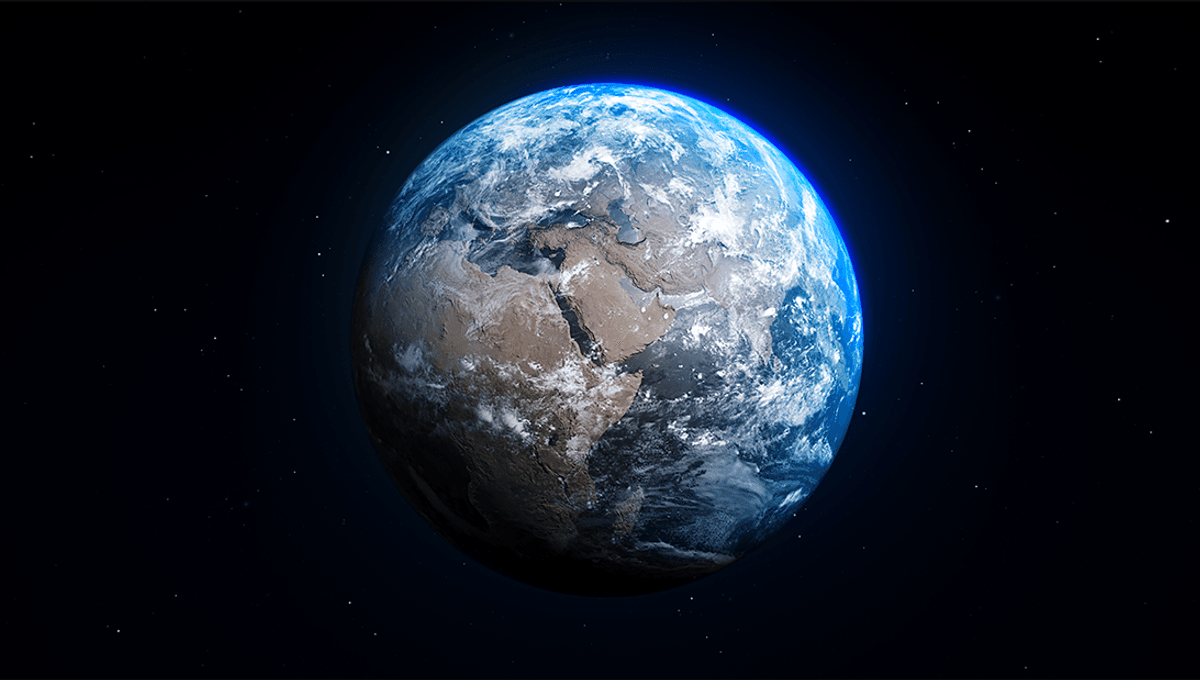
The Earth, unless you subscribe to the flat-Earther “model”, rotates on its axis once every 24 hours. But this hasn’t been the case forever, and one (long) day in the distant future, it could potentially even stop, becoming tidally locked to the Moon. But astronomical events (and, you know, death) may prevent us from ever seeing our planet have one side always facing the Moon, and the other turning away in disgust.
Let’s start with the fun stuff: What would happen if the Earth were to suddenly stop spinning? Though this is a somewhat unlikely scenario, it would, as you might guess, be pretty catastrophic to anything clinging to the planet’s surface.
Picture you are on a roundabout and spinning around, and suddenly the roundabout stops, while you continue to move. While you would probably injure yourself as your momentum forces you into or over the bars, you can thank your lucky stars that the roundabout wasn’t spinning at 1,600 kilometers per hour (1,000 miles per hour).
If the Earth were to suddenly stop, water, rocks, Danny DeVito, and other debris would be sent flying eastwards at that speed, tearing up the surface and sending more shards of Earth and rock into the atmosphere and space. James Zimbelman, senior geologist emeritus at the Smithsonian’s National Air and Space Museum in Washington, D.C, explained to Live Science that thocean ese fragments would then be pulled back by the Earth’s gravity, bombarding the planet over time and liquefying the Earth’s crust into a molten “ocean of rock”.
The Earth, barring a catastrophic crash with another space rock, is not going to suddenly stop rotating. But in the ancient past, our planet rotated faster than it does today. Though it is complicated by factors such as earthquakes, which can speed up and slow down the Earth’s rotation, and the movement of ice and groundwater, estimates suggest the Earth’s rotation is slowing down overall by around 1-2 milliseconds a century.
“For the period from 2000 to 2018, the rate of length-of-day increase due to movement of ice and groundwater was 1.33 milliseconds per century – faster than at any period in the prior 100 years, when it varied from 0.3 to 1.0 milliseconds per century,” NASA explains of a NASA-funded climate study, adding that the Earth could slow at an even faster rate if emissions continue.
“If emissions continue to rise, lengthening of day from climate change could reach as high as 2.62 milliseconds per century, overtaking the effect of the Moon’s pull on tides, which has been increasing Earth’s length of day by 2.4 milliseconds per century, on average. Called lunar tidal friction, the effect has been the primary cause of Earth’s day-length increase for billions for years.”
These aren’t changes you’d notice that much. You aren’t going to get flung into space by a very slight change in rotation speed, over the course of a century. But on longer timescales, the difference is pretty noticeable. Around 600 million years ago, and assuming an average length of day increase of around 1.8 milliseconds per century, the Earth spun on its axis once every 21 hours.
The main factor slowing down the Earth’s rotation, as noted by NASA, is tidal friction between the Earth and the Moon.
“The Moon continues to move away from Earth at a rate of about an inch-and-a-half (4 cm) per year, its drift slowing as it goes. The energy propelling it away comes primarily from Earth’s oceans, which both bulge out in response to the Moon’s gravity and exert a gravitational pull of their own on the Moon,” NASA explains.
“Earth’s bulging oceans don’t exactly match up with the position of the Moon, they’re always a little out of sync because it takes time for all that water to shift and pile up. This interaction does two things: it creates friction that slows Earth’s own rotation, and creates forces that change the Moon’s orbital speed, causing it to fall farther away into space.”
This is a slow process, but eventually, if the Earth and Sun were to continue to dance indefinitely, the Earth would become tidally locked to the Moon, with only one side of our planet seeing our companion chunk of rock, permanently in the same position in the sky. At this point, the Earth would still have days and nights, though they would last as long as it takes for the Moon to rotate around the Earth. You will not be around to see it.
“About 50 billion years from now – if the Moon and Earth could somehow avoid the eventual death of the Sun – the Moon would be so far away, and its orbit so large, that Earth would also tidally lock to the Moon,” NASA explains. “Only the population of one lucky half of our world would ever see the Moon.”
But in all likelihood, the Earth will not see this time, having been engulfed by the Sun in its red giant phase, around 7.6 billion years from now. In short, the Earth will not stop spinning, at least, not before it becomes a tiny part of our dying star.

Source Link: Will The Earth Ever Stop Spinning?
