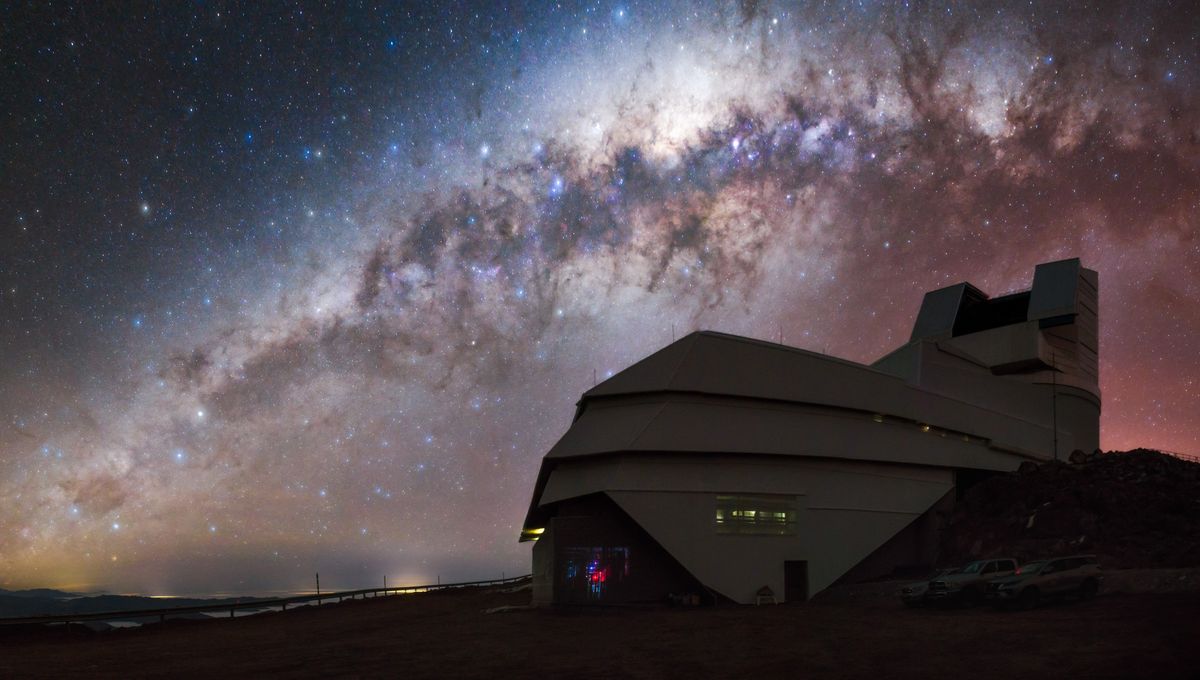
Interstellar comet 3I/ATLAS has been such a fixture of the last six months that we might almost forget that discovering interstellar objects (ISOs) is actually incredibly rare. It’s thought that roughly seven ISOs pass through the inner Solar System every year, and yet we’ve only ever detected three. This year’s extraordinary finding, however, is hopefully a prelude to many more to come, thanks to the game-changing, next-generation Vera C. Rubin Observatory.
Before comet 3I/ATLAS, humanity had discovered just two interstellar objects: 1I/’Oumuamua, discovered in 2017, and Comet 2I/Borisov in 2019. Yet, there should be around 10,000 interstellar objects within the orbit of Neptune at any given time. This seems like a huge number, but space is big. That means that if each object was equally distributed, they would still be 210 million kilometers (130 million miles) away from any other.
Most of the objects are small and dark, orbit far away from the Sun and the Earth, and have little to no change as they pass through the Solar System, which means we simply don’t see them. Why is the Rubin Observatory ideally suited to discover ISOs? Well, it possesses the world’s largest digital camera, and when the 10-year Legacy Survey of Space & Time (LSST) starts next year, it will photograph the cosmos in an ultrawide, ultra-high definition time-lapse like we have never seen before. It’s likely we will find a lot more of these interstellar visitors.
Searching for ISOs is like looking for yellow-colored needles in a haystack – there are very few of them, they’re small, hard to see, and from afar look just like stars or galaxies, and the haystack (the sky, in our case) is big.
Vera Rubin Observatory spokesperson
“The best estimates suggest Rubin should detect between 5 and 50 ISOs over its 10 year survey, stemming from the still-limited empirical constraints on the ISO population,” a spokesperson for the NSF-DOE Vera C. Rubin Observatory told IFLScience.
“If ISOs are more common than the first three discoveries imply, that rate could be higher; if they are rarer, the rate scales accordingly. Either way, Rubin should be able to build the first statistically significant sample of such objects.”
When the observatory revealed its first light images this summer, it was also revealed that it had discovered over 2,000 new asteroids in just a few hours. It even spotted comet 3I/ATLAS, but it was not recognized until people went looking in the data for it. Hunting for ISOs is not easy.
The combination of depth, width, and repeated observing makes Rubin a uniquely capable ‘ISO hunter.’
Vera Rubin Observatory spokesperson
“Searching for ISOs is like looking for yellow-colored needles in a haystack – there are very few of them, they’re small, hard to see, and from afar look just like stars or galaxies, and the haystack (the sky, in our case) is big,” the Rubin spokesperson told IFLScience.
“The reason Rubin will be great at finding them is because it can image the entire visible sky to great depth, and do so repeatedly – allowing it to identify the one thing that makes objects passing through our Solar System stand out from the background: their motion. The combination of depth, width, and repeated observing makes Rubin a uniquely capable ‘ISO hunter.’”
Adding just five more ISOs to the collection would be invaluable. Each object discovered so far has been pretty special; comet 3I/ATLAS even more so compared to the first two. Having a population of ISOs, or finding out that there are multiple populations of interstellar objects crossing the Solar System, would open a whole new world of understanding about the cosmos. Getting 50 more would be even more incredible.
If you are a fan of space rocks, interstellar or homegrown, then the next few years with Rubin will make you very happy. Beyond the potentially up to 50 ISOs, the observatory is expected to more than triple the known number of asteroids, adding 3-4 million new asteroids to the 1.5 million currently known, as well as discovering hundreds to thousands of new comets.
Since its discovery on July 1, Comet 3I/ATLAS has broken record after record. Rubin might find interstellar interlopers like it or not in the future, but it will always be the most interesting comet of 2025!

Source Link: With The Powerful Vera Rubin Observatory, We Could Find Up To 50 Interstellar Objects Like Comet 3I/ATLAS
